Dawn Breeze opening at Deffebach, Hudson (NY), Saturday 8/7/10
« July 25, 2010 - July 31, 2010 | Main | August 8, 2010 - August 14, 2010 »
10 posts from August 1, 2010 - August 7, 2010
August 7, 2010
August 6, 2010
Hardware stores are weird

Fastenal, Kingston (NY)
Hudson station in the ’80s
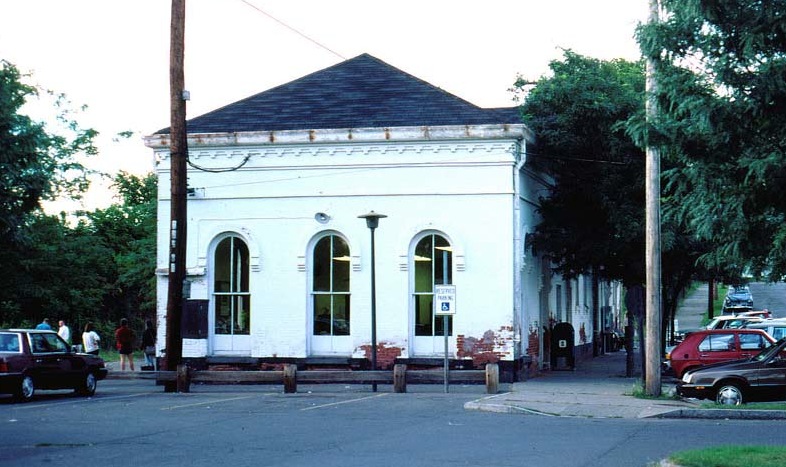
This photo was found at The Blue Comet, a railroad enthusiast’s webpage. It shows the Hudson railway station as it appeared prior to its renovation c. 1990-92, when the porch roofs and other details were reinstated to reflect the station’s original look.
Guessing from some of the cars in the picture, it would appear to date from sometime in the mid-1980s. The restoration of the station (built by the New York Central Railroad in 1874) is one of the few public projects in the City that was really top-notch.
UPDATE: Dennis Kosovac pointed out the website of the architects responsible for the restoration, John G. Waite Associates, which has a brief run-down of their approach:
Because the building’s condition had deteriorated significantly, Amtrak, the Urban Mass Transit Authority, the New York State Department of Transportation and the City of Hudson combined efforts to fund a major restoration of the station.
John Waite served as architect for the project, which included a complete restoration of the station building, rebuilding of the passenger platforms, and the construction of a new 150-space parking lot.
The exterior of the building was restored to its historic appearance with the addition of a metal canopy, polychrome slate roof, ornamental iron roof crestings, and corbelled brick chimney.
The restoration also repaired severely deteriorated brickwork and installed a new sheet-lead damp course to prevent future damage from moisture migration (rising damp). Interior work included expanding the passenger waiting area, construction of a new ticketing facility and baggage room, restoring plaster surfaces and woodwork and installing accessible toilet facilities.
August 5, 2010
Q: What's Catskill have that Hudson doesn't?

A:
- Waterfront dining.
And:
- Places to dock your boat.
- Places to rent boats.
- Marine supply.
- A waterfront bar.
- A Waterfront event space and museum.
Hudson could have these things, and a lot more. If it edges Holcim out.
OSHA fines O&G $8.3 million
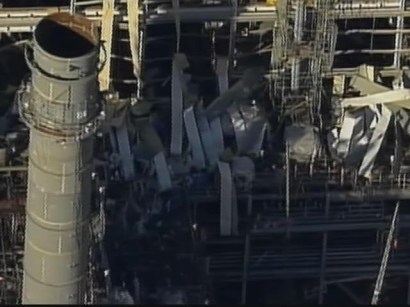 The Associated Press is reporting that O&G, the Connecticut trucking company which has been fronting for Holcim’s waterfront operations, has just been fined $8.3 million for its role in the explosion last winter of a power plant they were constructing in Middletown (CT).
The fine is part of an overall $16 million action against contractors found responsible for the deaths of six workers and serious injury to some two dozen more. The fine does not cover separate negligence lawsuits against O&G for “intentional disregard or indifference to” safety standards which are also being advanced by the victims and their families.
From the OSHA news release:
“The millions of dollars in fines levied pale in comparison to the value of the six lives lost and numerous other lives disrupted,” said U.S. Secretary of Labor Hilda L. Solis. “However, the fines and penalties reflect the gravity and severity of the deadly conditions created by the companies managing the work at the site. No operation and no deadline is worth cutting common sense safety procedures. Workers should not sacrifice their lives for their livelihoods.”
On Feb. 7, a gas blow operation was being performed in which flammable natural gas was pumped under high pressure through new fuel gas lines to remove debris. During this operation, an extremely large amount of natural gas was vented into areas where it could not easily disperse. Welding and other work was being performed nearby, creating an extremely dangerous situation. The explosion occurred when the gas contacted an ignition source.
“These employers blatantly disregarded well-known and accepted industry procedures and their own safety guidelines in conducting the gas blow operation in a manner that exposed workers to fire and explosion hazards," said Assistant Secretary of Labor for OSHA Dr. David Michaels. "We see this time and time again across industries when companies deliberately ignore safety precautions in the interest of completing jobs quickly, and workers end up being killed or seriously hurt.”
Michaels noted that “We know there were significant financial incentives if certain deadlines were met.”
Coming on the heels of 300-plus violations by Holcim at Catskill, this news makes the question loom larger than ever: Are these the types of companies we trust to ensure safety and prevent contamination at our Waterfront? Would you take a kayak out next to one of their barges, especially without a real Harbor Management Plan? Would you feel safe on Routes 9 and 9G with hundreds of their trucks crossing the road every week without traffic lights, knowing this track record?
What would it take for local officials to recognize that track records matter, and should inform their decisions?
NOTE: The two OSHA citations can be downloaded in full as PDFs by clicking here and here.
Holcim & taxes: Let’s do the numbers
Does the Holcim corporation make much in the way of a contribution to the finances of the City of Hudson? Not much, especially in comparison with other parts of the City, according to numbers obtained from local assessment rolls.
Some hard data appears below to answer the question of what, precisely, Holcim contributes to Hudson’s tax base—and how this compares with other taxpayers.
According to the 2010 Final roll prepared by Assessor Garth Slocum, Holcim’s assessment represents just 1% of the City’s total taxable value:
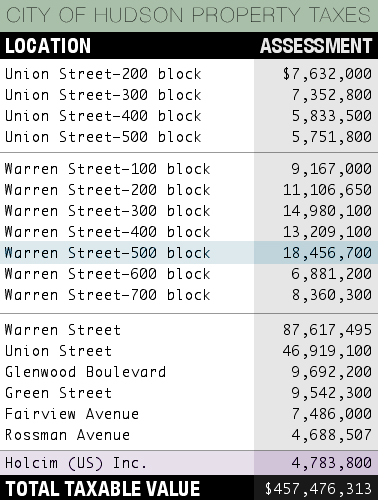
Yet in exchange for that unimpressive 1%, the company seems to be getting 99% deference in planning the future of the City’s waterfront.
Meanwhile, many business owners have expressed grave concern that this deeply flawed plan will forclose the possibility of adding a second major economic engine to complement that of the main street business district. So, how much does Warren Street contribute to Hudson’s tax coffers?
Properties on Warren represent 19% of the City’s total taxable value. In other words, 1 in 5 dollars that the City would in property taxes this coming year will come from Warren Street; only 1 in 100 comes from Holcim. (The taxable properties in the 500 block alone, highlighted in blue above, have an assessment four times higher than Holcim.)
And if Garth Slocum’s 2010 roll is thrown out by Acting Supreme Court Justice Paul Czajka in response to the HPOC lawsuit, and the 2009 roll were reinstated, the disparity would be even starker. Holcim’s share of the Hudson property tax pie would fall to less than 1% (.0084), whereas Warren Street’s share would rise to 21.5% (.2145).
In fact, the table above shows that individual blocks around the City contribute more to the City’s property tax base than Holcim. The 200, 300, 400 and 500 blocks of Union Street each represent between 1.2 and 1.6 times the assessed value of the seemingly all-important Holcim parcels in South Bay. Green Street and Glenwood Boulevard each contribute double what Holcim does. The 500 block of Warren contributes nearly four times Holcim’s property taxes.
And so on.
This hard data raises the question again: Why does a single company that contributes far less than locally-owned businesses and home owners get treated as if they are the only game in town by City officials? Holcim, to this site’s knowledge, also does not contribute sales tax revenues to the City coffers (being a bulk/wholesale operation, with subsidiaries based either out of state or out of the country entirely). Moreover, there is not a shred of evidence available to indicate that the draft Waterfront plan’s support for such destructive uses would create new jobs for local residents. As with this company’s failed “Greenport project,” the economic assumptions and claims made by Holcim and its boosters have no factual basis. They appear to be driven more by a nostalgia for a long-gone day when technology was less advanced, meaning that such industries actually employed thousands of people—which they no longer do.
During a recent meeting with Common Council representatives, planner Frank Fish of BFJ made a raft of unsubstantiated claims to support his firm’s decision to ignore public input— choosing instead to cheerlead for the supposed value of having a heavy industrial presence at the Hudson Waterfront.
Among Fish’s offhand comments was a claim that doing so would be “good for the tax base.” The planner offered no data to support his unsourced notion, and the draft LWRP which he and City attorney Cheryl Roberts presents no analysis of the benefits and trade-offs which would result from their choices.
And indeed, the 2005 ruling by Secretary of State found that zoning out discordant and incompatible heavy industrial activities would ultimately be better for the economic growth and stability of Hudson—because it would bring more people to the River, and allow other more mutually-supportive businesses to thrive.
August 3, 2010
Book design

A recently-completed project for the Burrill B. Crohn Research Foundation—the redesign of a new edition of my great-grandfather’s final book—can be read online at Issuu.com. “Baba,” as I knew him, is the namesake of Crohn’s Disease. (His memories of practicing medicine in the first half of the previous century are surprisingly lively and vivid, this wholly biased reader found—having not revisited the text in about 15 years before this redesign.)
August 2, 2010
August 1, 2010

More...
Categories
- Academia (1)
- Accidents & Emergencies (63)
- Activism (60)
- Agriculture (16)
- Alphabets (2)
- AphoriSams (6)
- Arbitrary Anniversaries (1)
- Architecture (7)
- Art (61)
- Auctions & Sales (1)
- Awards & Honors (1)
- Bars & Nightlife (5)
- Blogs (7)
- Books (5)
- Buildings & Architecture (7)
- Cement (8)
- Charts & Graphs (6)
- Charts/Data/Graphs (2)
- Cities | Albany (4)
- Cities | Hudson (410)
- Cities | Kingston (2)
- Cities | Newburgh (2)
- Cities | NYC (8)
- Cities | Pittsfield (1)
- Cities | Poughkeepsie (2)
- Cities | Troy (1)
- Cityscapes (1)
- Columbia County Airport (7)
- Counties | Albany (3)
- Counties | Berkshire (13)
- Counties | Columbia (139)
- Counties | Delaware (1)
- Counties | Dutchess (13)
- Counties | Greene (27)
- Counties | Litchfield (2)
- Counties | Orange (1)
- Counties | Otsego (2)
- Counties | Rensselaer (10)
- Counties | Saratoga (2)
- Counties | Schoharie (3)
- Counties | Sullivan (4)
- Counties | Ulster (9)
- Counties | Washington (2)
- County | Orange (2)
- Court Rulings (5)
- Creatures (1)
- Crime (32)
- Demographics (7)
- Design (4)
- Economic Development (70)
- Education (5)
- Elections & Voting Rights (76)
- Environment (49)
- Events (20)
- Film (11)
- Fonts & Type (1)
- Food and Drink (49)
- Free (8)
- Friends (1)
- Friends & Relations (1)
- Graffiti & Vandalism (4)
- Graphic Design (15)
- Hamlets | Annandale (1)
- Hamlets | Linlithgo (1)
- Health (13)
- Historic Preservation (15)
- Housing (6)
- Hudson River (33)
- Hudson Valley (32)
- Hudson Valley Blogs (6)
- Humor (11)
- Interviews (1)
- Landscapes (10)
- Language (8)
- Law (14)
- Law Enforcement (20)
- Letters to Editors (10)
- Literature (16)
- Local Celebrities (9)
- Local History (7)
- Lodging (7)
- Maps & Geography (1)
- Marketing (2)
- Media & Publishing (103)
- Medicine (2)
- Modwood (3)
- Music (4)
- Music | Concerts (5)
- Music | mp3s (1)
- Music | Videos (8)
- Nature (28)
- News Roundups (10)
- Nightlife (2)
- Nonfiction (1)
- Nonprofits & Charities (4)
- Obituaries (22)
- Open Government (9)
- Parody (4)
- Photographs (118)
- Planning & Land Use (100)
- Politics | Columbia County (119)
- Politics | Dutchess County (11)
- Politics | Hudson Valley (31)
- Politics | International (9)
- Politics | Massachusetts (4)
- Politics | New York State (35)
- Politics | Rensselaer County (3)
- Politics | U.S. (46)
- Quotable (53)
- Radio (5)
- Random Access Memories (2)
- Real Estate (11)
- Real Estates (1)
- Redesigns (1)
- Regions | Adirondacks (1)
- Regions | Catskills (9)
- Regions | Central New York (1)
- Regions | Conn. River Valley (1)
- Regions | Mid-Hudson (11)
- Regions | Mohawk Valley (1)
- Regions | Upstate (3)
- Religion (3)
- Satire (10)
- Shopping Locally (20)
- Signage (22)
- Snapshots (14)
- Social Media (1)
- Sports | Baseball (4)
- Sports | Basketball (1)
- Sports | Football (5)
- Strictly Personal (2)
- Sustainability (3)
- Taxes (28)
- Technology (11)
- Textures (5)
- The Departed (6)
- The Letter S (4)
- The Woodchuck (1)
- Think Pieces (5)
- Towns | Amenia (1)
- Towns | Ancram (4)
- Towns | Annandale (1)
- Towns | Ashland (1)
- Towns | Athens (9)
- Towns | Austerlitz (2)
- Towns | Canaan (1)
- Towns | Castleton (1)
- Towns | Catskill (20)
- Towns | Cementon (2)
- Towns | Chatham (12)
- Towns | Claverack (36)
- Towns | Clermont (4)
- Towns | Coeymans (3)
- Towns | Colonie (1)
- Towns | Copake (7)
- Towns | Coxsackie (2)
- Towns | Fishkill (2)
- Towns | Freehold (2)
- Towns | Germantown (10)
- Towns | Ghent (118)
- Towns | Gilboa (1)
- Towns | Great Barrington (MA) (2)
- Towns | Greenport (45)
- Towns | Hillsdale (9)
- Towns | Hyde Park (1)
- Towns | Jewett (1)
- Towns | Kinderhook (8)
- Towns | Lee (MA) (1)
- Towns | Leeds (1)
- Towns | Lenox (MA) (1)
- Towns | Lexington (1)
- Towns | Livingston (21)
- Towns | Nassau (1)
- Towns | New Baltimore (1)
- Towns | New Lebanon (12)
- Towns | Oak Hill (2)
- Towns | Palinville (1)
- Towns | Pine Plains (4)
- Towns | Ravena (1)
- Towns | Red Hook (1)
- Towns | Rhinebeck (6)
- Towns | Salisbury (1)
- Towns | Salisbury (CT) (1)
- Towns | Saugerties (3)
- Towns | Schodack Landing (1)
- Towns | Shokan (2)
- Towns | Stockport (13)
- Towns | Stuyvesant (5)
- Towns | Taghkanic (53)
- Towns | Wappingers Falls (1)
- Towns | Windham (1)
- Tu(n)esday (15)
- Typo Phile (14)
- Unsolicited Redesigns (3)
- Vaccines & COVID (2)
- Videos (19)
- Village | Elizaville (1)
- Villages | Athens (4)
- Villages | Barrytown (1)
- Villages | Cementon (2)
- Villages | Elizaville (1)
- Villages | Old Chatham (1)
- Villages | Philmont (9)
- Villages | Tivoli (2)
- Villages | Valatie (3)
- Vintage Valley (22)
- Virtual Graffiti (6)
- Wear & Tear (1)
- Weather (3)
- Wildlife & Pets (25)
Archives
- March 12, 2023 - March 18, 2023
- February 12, 2023 - February 18, 2023
- September 18, 2022 - September 24, 2022
- April 24, 2022 - April 30, 2022
- November 21, 2021 - November 27, 2021
- October 31, 2021 - November 6, 2021
- October 24, 2021 - October 30, 2021
- September 26, 2021 - October 2, 2021
- September 12, 2021 - September 18, 2021
- August 9, 2020 - August 15, 2020