An article this morning by Tom Casey in The Register-Star reports that the City of Hudson is seeking funding “to create a marketing and development plan for several vacant buildings, including the L&B Furniture and McGuire properties, and to create a detailed plan to connect the separated portions of the waterfront from the North Bay to the South Bay.”
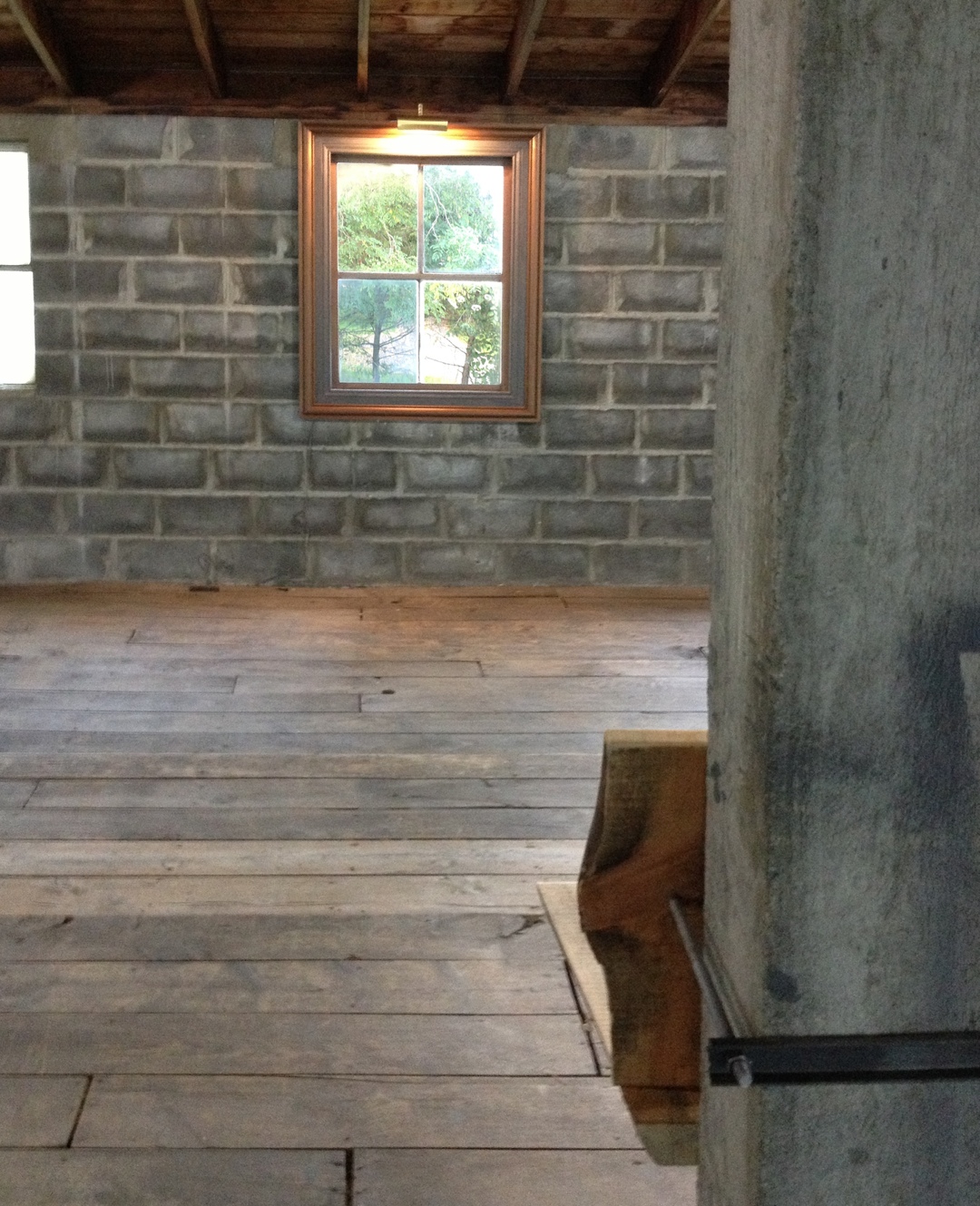
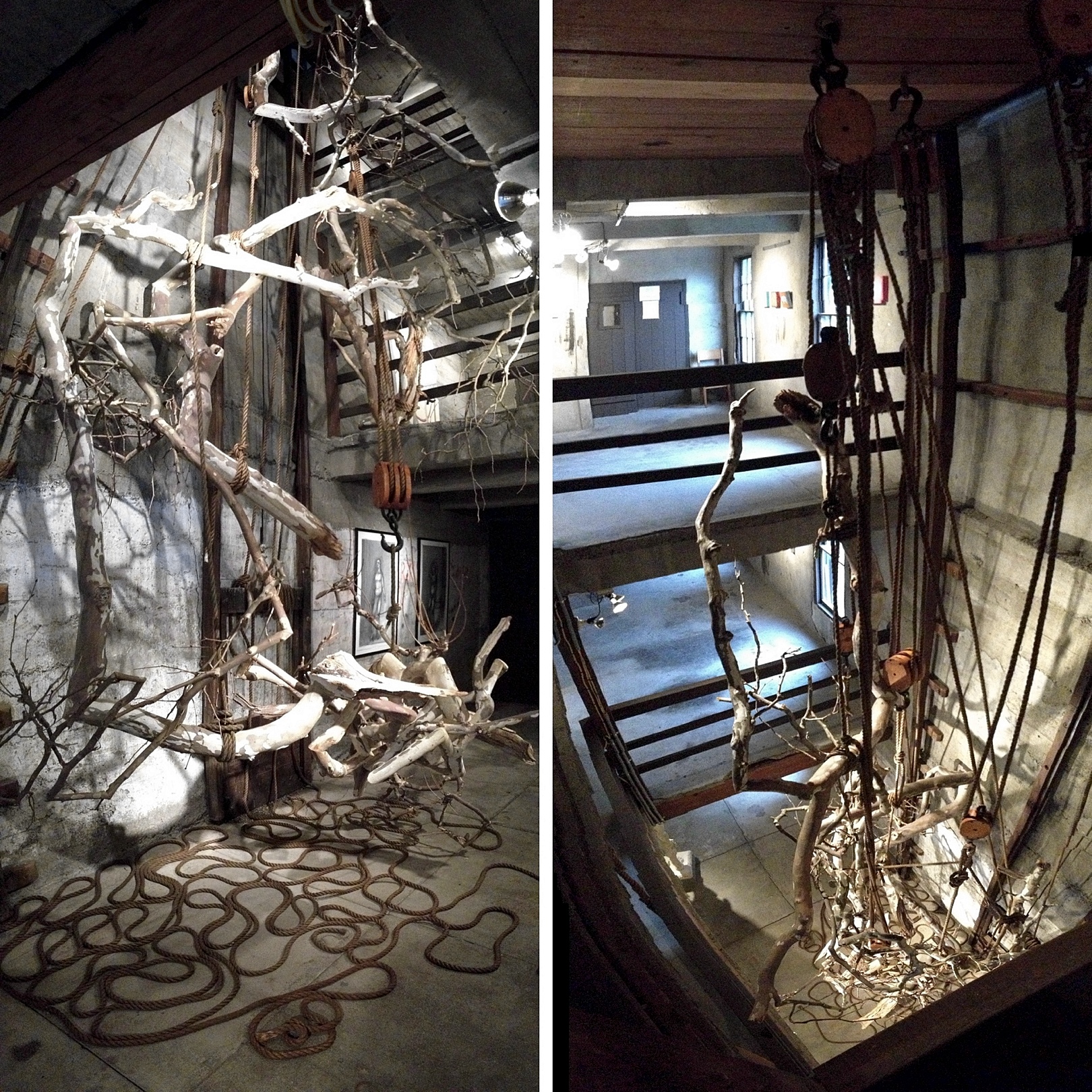
In point of fact, the L&B Furniture site (actually renamed LB Furniture before it closed) is hardly a “vacant building.”
The vast space houses plenty of renters, including the highly successful CNC fabrication business Digifab, a metal shop, a recycler, music practice spaces, and more. Indeed, The Register-Star itself published an article by Lindsay Suchow in November 2010 about the revival of the building, entitled “New life at old furniture warehouse.”
(Note: The above correction was submitted as an online comment to the paper’s website early this morning, but it has suppressed it. Apparently the Hudson “community paper” feels free to make obvious mistakes, but does not like them being pointed out.)
The focus of the article is to bemoan the seeming lack of interest in a Hudson grant application, reporting that “on Tuesday, there were no members of the public at the public hearing, which the group stressed needs to change to help take the ideas and proposals to improving and developing Hudson’s waterfront to the next step.” Casey quotes a development official as claiming that
“All the ideas you (the public) provided during the LWRP are now bearing some fruit... So much of that comes out of that public comment, you gave us the foundation, and now it’s step two.”
The official may be making that statement naïvely, or in hopes of changing the dynamic, but its whitewashing sentiment comes across as an affront to those who actually were around for the degraded Waterfront process.
The LWRP was a travesty of public input. One would be hard-pressed to make up a more textbook example of how to undermine public faith in public policy.
The sustained participation and comments of thousands of residents over many years—in public workshops, surveys, hearings, postcards, petitions, emails, letters and more—was cast aside for the South Bay in favor of the demands of a Swiss-owned multinational polluter and a Connecticut-based construction company. The former has racked up millions internationally in fines for environmental and anti-trust violations, and the latter is known for its role in the huge Rowland corruption scandal, and for an explosion at one of its projects that killed six workers.
The architects of the highly unpopular and unresponsive Waterfront plan were former Mayor Rick Scalera, Linda Mussmann of TSL and her real estate attorney, Cheryl Roberts, now a candidate for State Assembly, with the spine-free connivance of Council President Don Moore. Roberts erased records of two well-attended workshops and a 300-person survey from the LWRP narrative, because that input ran counter to her agenda—while incorporting virtually all of the demands of lawyers from Holcim and O&G. (This is what the leaders of the Columbia County Democratic Committee, such as Cyndy Hall and Victor Mendolia, shamelessly trumpet as Roberts’ “environmental sensitivity.”)
And Moore, having tried but failed to block public access to a key draft of the plan, refused to allow any of the 80 people who attended the final meeting about the plan to speak before the Council voted on it.
Meanwhile on the North Bay side, a huge outpouring of support for the Furgary Boat Club was again spurned by Roberts, Moore and the current mayor, Bill Hallenbeck. The Furgarians were evicted at gunpoint by a SWAT team, no less. A widespread local belief is that the eviction of Furgary after 100 years of peaceful stewardship of the North Bay was driven by a plan advanced by the Chatham-based Columbia Land Conservancy—which would be the beneficiary of some of this new Hudson grant funding, , according the The Register’s article.
No wonder then that no one showed up for these hearings. The public has gotten the firm message that their input does not matter, and would be a waste of a citizen’s breath. The current backers of these grant proposals no doubt are operating in better faith than their predecessors. But mix these recent and strong impressions of official disdain with a dearth of publicity about the weekday meeting (announced via obscure public notice), and you have a perfect recipe for the public to stay away, even though the topic is one of keen importance to the future of Hudson.
The public is interested—it just isn’t convinced that the City will listen. It’s up to its leaders to convince people otherwise, by making a serious outreach to groups and residents who have been burned multiple times before.
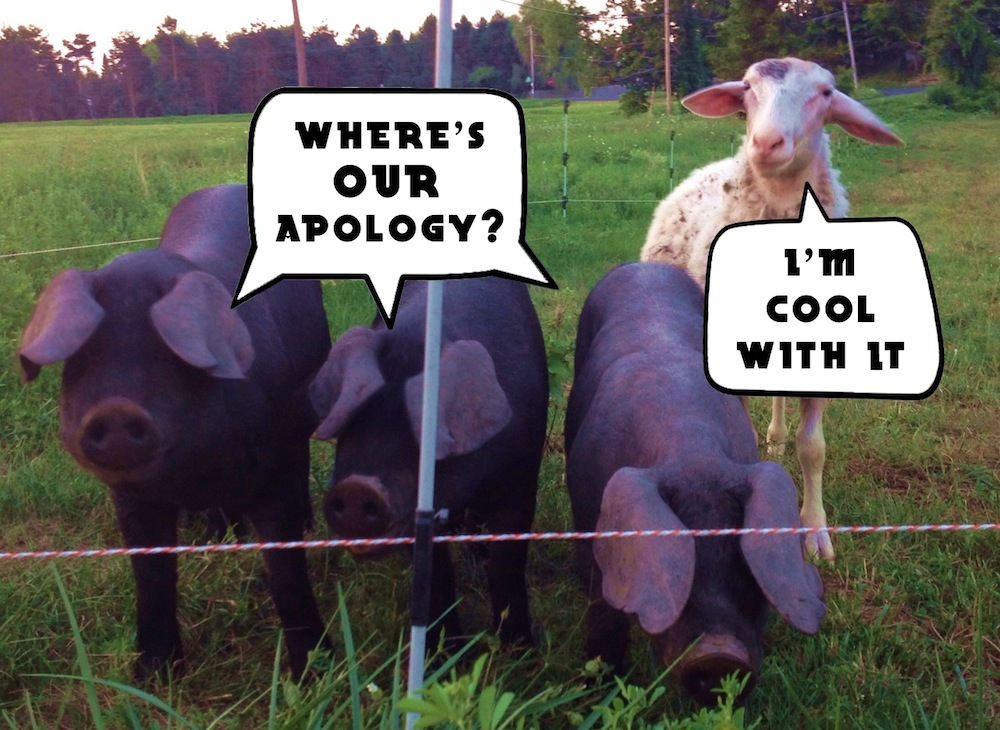
The promoters of Bacon Fest are offering an apology following widespread complaints about last weekend’s first-time event in Hudson. “We apologize if we inadvertently left people feeling disappointed. That sucks and we are sorry,” says the unattributed statement on the event’s website.
Many attendees who did not arrive at the event’s 9 am opening bell did not get much if any charred pig fat, apparently due to organizers and exhibitors underestimating popular demand.
“Lots of people came to Bacon Fest and didn’t get any bacon,” confessed one of the judges on his blog.
After boasting that 3,000 people attended—1,000 for free after the bacon ran out within a matter of hours—and that $3,000 was raised for charity, and that “the streets of Hudson were overflowing with people, most of them wearing bacon t-shirts,” Bacon Fest gets around to expressing its regrets:
“It was never our intention to shortchange anyone on food or fun. Where we exceeded in motivation, enthusiasm and dedication, we fell short on experience. We know better now, and from these mistakes we will build a better executed festival for next year.”
(Note: Hudson-Catskill Newspapers reported attendance in the “hundreds.”)
Looking on the bright side, event organizers further posit that “it was an unintended compliment to the day that festival goers, unhappy with the state of the event, took to the streets to search out other food options and poured into the businesses of Hudson, many for the first time ever.”
But “all that being said,” the statement continues, “the day was not a total success.” Indeed, the one-day festival has been getting raked over the coals on its Facebook page...
“What a disappointment... no bacon smell and some of the vendors didn't even have bacon.”
“I was very disappointed in this festival. I will not attend again. Troy’s Pig Out is much more worth the trip than Hudson. There is NO cover charge and goes for two days without running out of food or Bacon.”
“Very disappointed that when I was in line at 1:00 with advanced tickets , was only offered a 50% refund if we entered.”
We showed up at 10am and were disapointed by the size of the event for the $10 entrance fee. We left and went to the Chatham Fair which was HUGE and fun. I run an event for 1,000 people and use the same tent company and your tent was a 1/4 of the size of our tent. It's such a beautiful location and I expected so much more.”
“Still so angry over this.”
... and in the comments on the Albany Times-Union’s various food blogposts:
Personally, I think that would be a great release for a public relations professor to take and give to a class to rip apart.
This was a complete waste of time; not enough vendors, not enough samples, not enough to make me go back again.
We went to the garlic fest on Saturday, in Bennington. That was AWESOME! Note to baconfest organizers: just copy them.
Vowing to return, Bacon Fest says that “we know better now, and from these mistakes we will build a better executed festival for next year” to continue their stated goal of “work[ing] together to build a better world, especially one fueled by the power of bacon... never underestimate the power of bacon.” *Grunt.*
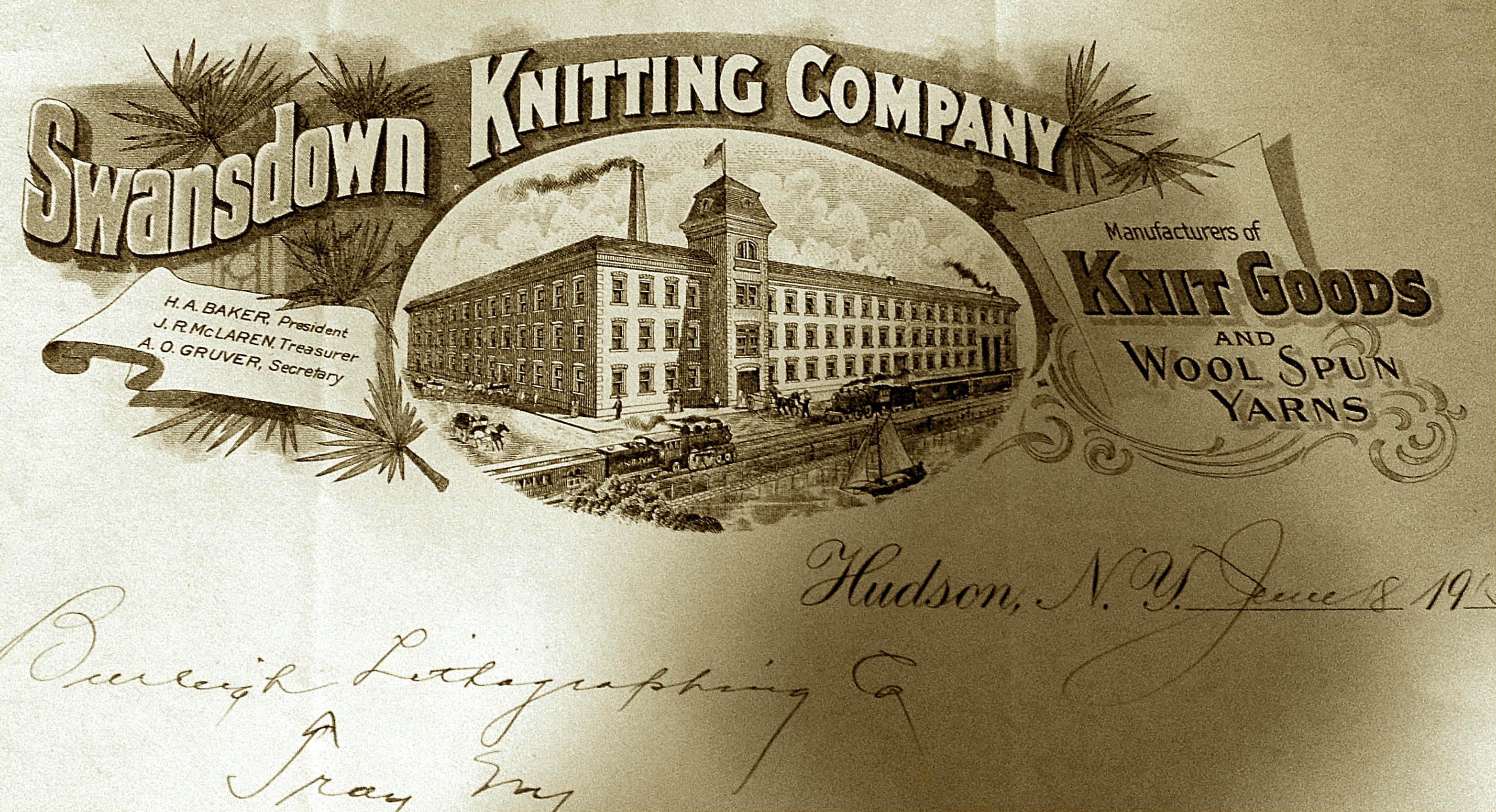
This building stood by the Hudson River on North Front Street, along the railroad tracks, just south of the Furgary Boat Club but was demolished in just the past few years. Dated 1913, the letterhead is from a private collection in Hudson (NY).
Over at The Gossips of Rivertown, Carole Osterink reported a widespread rumor that “Carmine Pierro, longtime aide to Rick Scalera in and out of the mayor's office and now an alderman from the Fifth Ward” may move out of Hudson, having recently purchased a house in Taghkanic.
Public records in the Columbia County Real Property Department office demonstrate the truth of at least the second half of that rumor.
As previously discussed here, the County keeps public files of RP-5217 forms, which are one-page documents filed whenever a piece of property changes hands. Such documents record basic info on real estate transactions including the buyer, seller, the prices paid, the attorney of record, and the like—and are available to anyone to inspect.
And sure enough, an RP-5217 turned up in the file which shows that Cappy Pierro and his wife purchased a house in Taghkanic on the 6th of July for $450,000. Pierro’s attorney for the sale was Jack Connor, who also is one of the City of Hudson’s lawyers.
For now, the couple appears to still own two houses in Hudson’s 5th Ward—one in their own names which is assessed at 1/3 that price ($151,000), the other via a charitable trust in their names ($167,000). Both properties had their assessments reduced slightly in 2012 (by $2,000 and $6,000, respectively).
Pierro continues to serve as a Hudson Alderman, chairing a Common Council meeting this week in Don Moore’s absence. Other sources claim that the couple is in the process of selling their Parkwood properties, and may have already found buyers for both... However, the County’s records show no sales having closed yet on either, and neither appears in the Columbia County MLS listings. (Note: There are a few realtors in the County who don’t belong to the MLS.)
Or maybe the Pierros just want to scent some country air—though at more than twice the price of both of their existing houses combined, that’d be some pricey air.
Pierro could in theory continue to represent the 5th Ward even if he did not have his primary residence there—he has several relatives in the Ward, who presumably might agree to maintain a room for him, even if he sold his local properties. In the past, various Aldermen, such as former 4th Ward Council member Alan Keith, managed to retain their position well after moving out of town; and there have been periodic claims that current 4th Ward Supervisor Bill Hughes does not bunk down in Hudson all that often.
Any flagrant falsification of residence might in theory result in legal action, or even invalidation of votes taken by the Council if an Alderman’s weighted vote was improperly cast. But ultimately such matters are usually taken care of by voters, who tend to want their representatives to be bona fide residents.
NOTE: This summary of the Americlean controversy was written about ten years ago as background for a (successful) nonprofit grant application. Citizens who were involved in the fight to stop Hudson’s old glue factory—what is now the Basilica—included Philip Alvaré, Jennifer and Kim Arenskjold, Carole Clark, Jack Harrell, Peter Jung, Peter Meyer, Sara Sterling, myself and many others, including some no longer in Hudson (such as Byrne Fone and Edward Gomez).
During a four-month controversy in 1999, local residents discovered the importance of face-to-face grassroots organizing, diligent research, media exposure, sustained public pressure, and savvy use of the internet for making change at the regional level.
As a result, a unique relic of the Valley’s industrial architecture was spared from becoming a sketchy toxic waste center, and instead preserved to become Basilica Hudson—arguably the most dynamic art and performance center in this stretch of the Hudson River.
Below is a detailed review of those four hectic months, explaining how citizens prevailed against long odds to protect their quality of life and preserve a prime opportunity for more positive development.
In the waning days of 1998, some residents of the City of Hudson, New York, spotted an obscure legal notice in our local paper.
The bland notice indicated that Hudson and Columbia County intended to apply jointly for $600,000 in grant funding from the Department of Housing and Urban Development (HUD) Canal Corridor program to attract “a business”—the name was unspecified—to the City’s waterfront. I said there would be an informational meeting about the application in early January.
As is all too typical of such meetings, this one was scheduled inconveniently on a weekday, during work hours, a time calculated to draw as few audience members as possible. But much to officials’ surprise and dismay, several residents did attend.
After a lot of hemming and hawing, the County development agency was finally convinced that residents deserved to know the name of this mysterious “business” which would benefit from a $600,000 in Federal largesse.
“I think it’s called ‘Americlean,’” he said. About the nature of Americlean’s business, he was similarly vague: “Something to do with supplies for the dry cleaning industry—wire hangers, polybags, that kind of thing.” After further grilling, citizens determined that the proposed site would be an imposing brick building, a former glue factory, adjoining the wetlands of South Bay and a stone’s throw from the Hudson River.
Alarmed by the obvious evasiveness, citizens went home to look up Americlean on the web—a relatively novel task for many in the late ’90s.
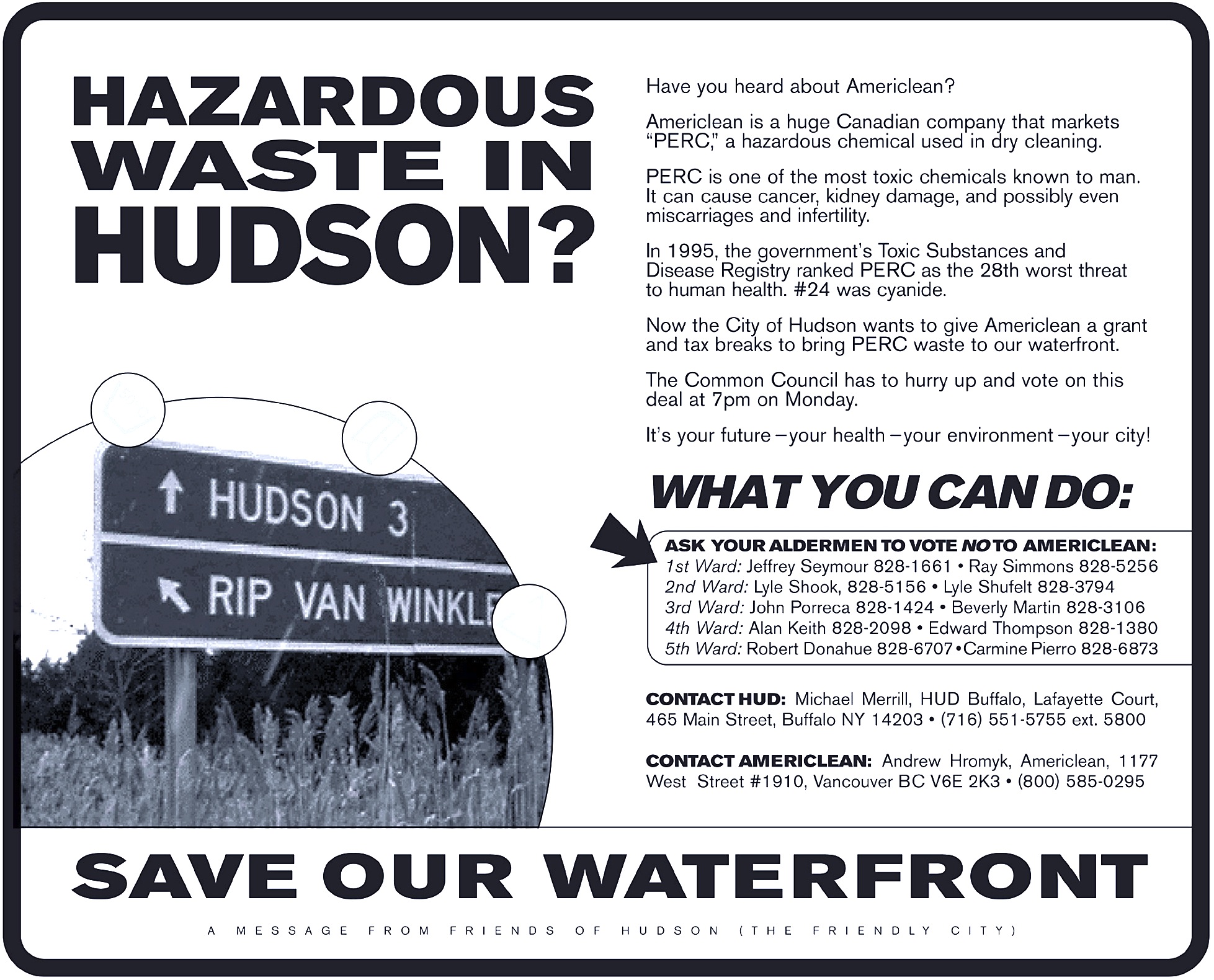
It was soon learned that the main business of Americlean (a Canadian company, despite its name) actually involved shipping and “processing” huge quantities of a hazardous waste generated by the dry cleaning industry: a chemical called perchloroethylene.
Thanks to a relatively new search tool called Google, residents then figured out that “perc” is one of the more carcinogenic substances known to man. Once considered a miracle substance, many places such as New York City had begun to ban perc’s use altogether as a health risk to dry cleaning workers and their neighbors.
Americlean’s website claimed to have a miraculous, patent-pending process which would allow the company to recycle perc safely, then resell it to the drying cleaning industry with relatively little leftover waste product. The company claimed to have a pilot plant in Canada that had successfully tested this process.
When we brought this new information to the attention of our local Common Council, its members professed to be both unaware and unconcerned by Americlean’s real intentions. So what if they were hauling and processing hazardous waste, instead of making coat hangers—they were eager to believe the company’s claims of creating 100 well-paid jobs for local workers. Besides, the deadline for applying for the grant was rapidly approaching, and if Hudson didn’t submit something, the funding would be lost. So the Council hurriedly voted in favor of applying to HUD.
In other words: City and County leaders actually wanted the Feds to pay a little-known and even less-tested Canadian company $600,000 to to truck hazardous waste through local neighborhoods, down to the Hudson River, when an unspecified process would be used to neutralize it.
“You people have no idea how much toxic waste already goes through Hudson,” lectured then-Mayor Rick Scalera, as if this would reassure his listeners.
Those who questioned the wisdom of the Americlean plan were subjected to all manner of personal attacks from public officials, from public meetings to the pages of the local newspaper. One woman took the initiative to call Americlean’s president directly, hoping to learn more about his plans—then found herself falsely accused of “impersonating a Common Council member” as elected officials rushed to discredit her unflattering account of the conversation.
In an apparent reference to the sexual preferences of a few of those speaking out against the project, 5th Ward Alderman Bob “Doc” Donahue read a prepared speech in which he insinuated that “these people speaking out don’t have children, they only have pets.”
Weeks of verbal sparring in newspaper articles, public meetings and letters to the editor ensued. It became obvious that the politicians wanted to make this an us vs. them issue, and the local paper was all too happy to help pit neighbor against neighbor.
A major turning point came when challengers of the hazardous waste plant shamed the Mayor into holding a public hearing in which the company would present its plans, and residents would have a chance to question Americlean in person. Up to that point, none of the company’s executives had ever appeared publicly in town.
In preparation for the big hearing, challengers raised $800 to take out a half-page ad in our local newspaper to increase awareness of the event. Even this caused a new controversy, as The Register-Star’s publisher decided to preview the citizens’ planned back-page ad for Americlean in advance of its publication. The paper also ran a front page story the same day featuring the company’s one-sided rebuttal, in an apparent attempt to blunt the ad’s impact.
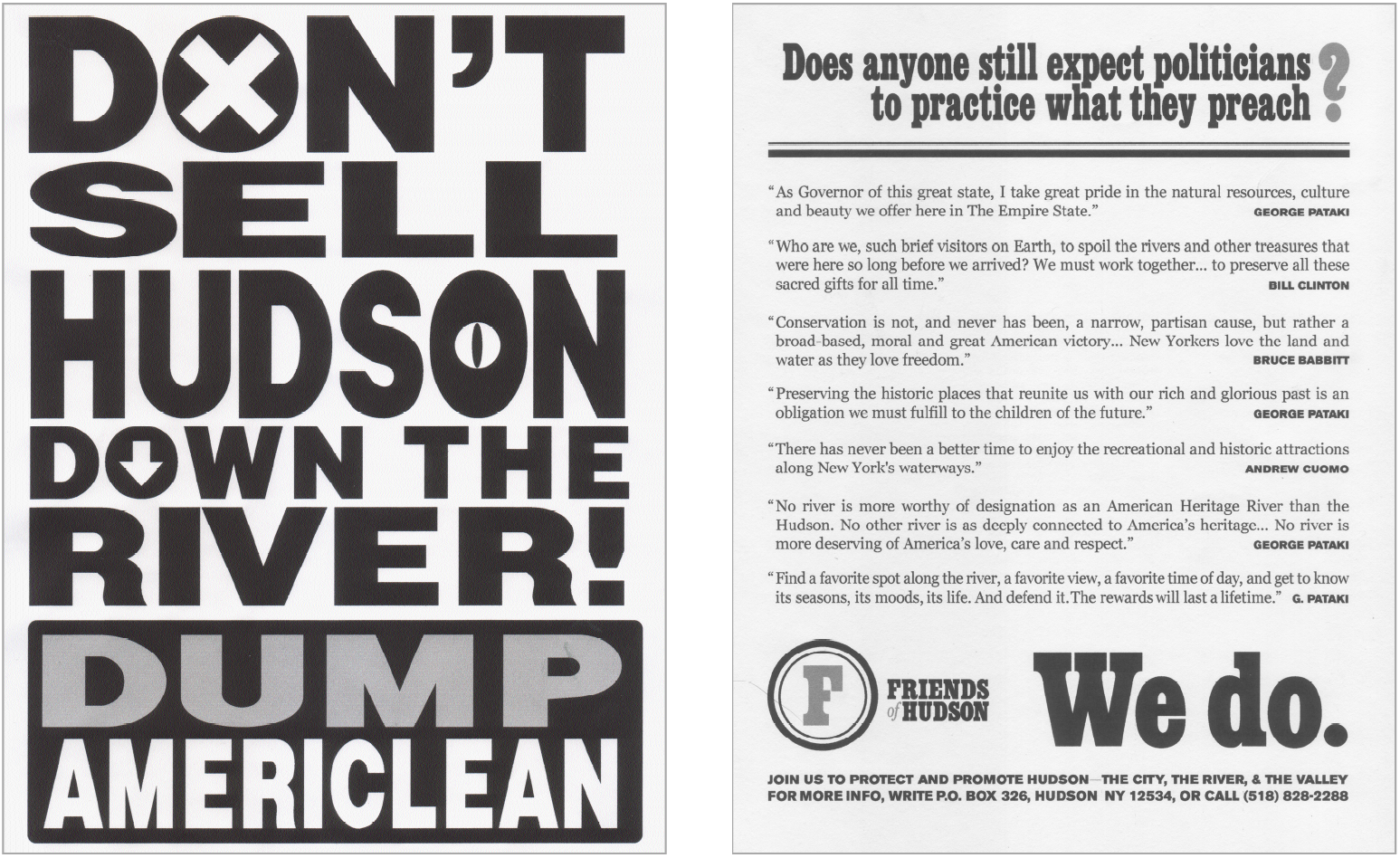
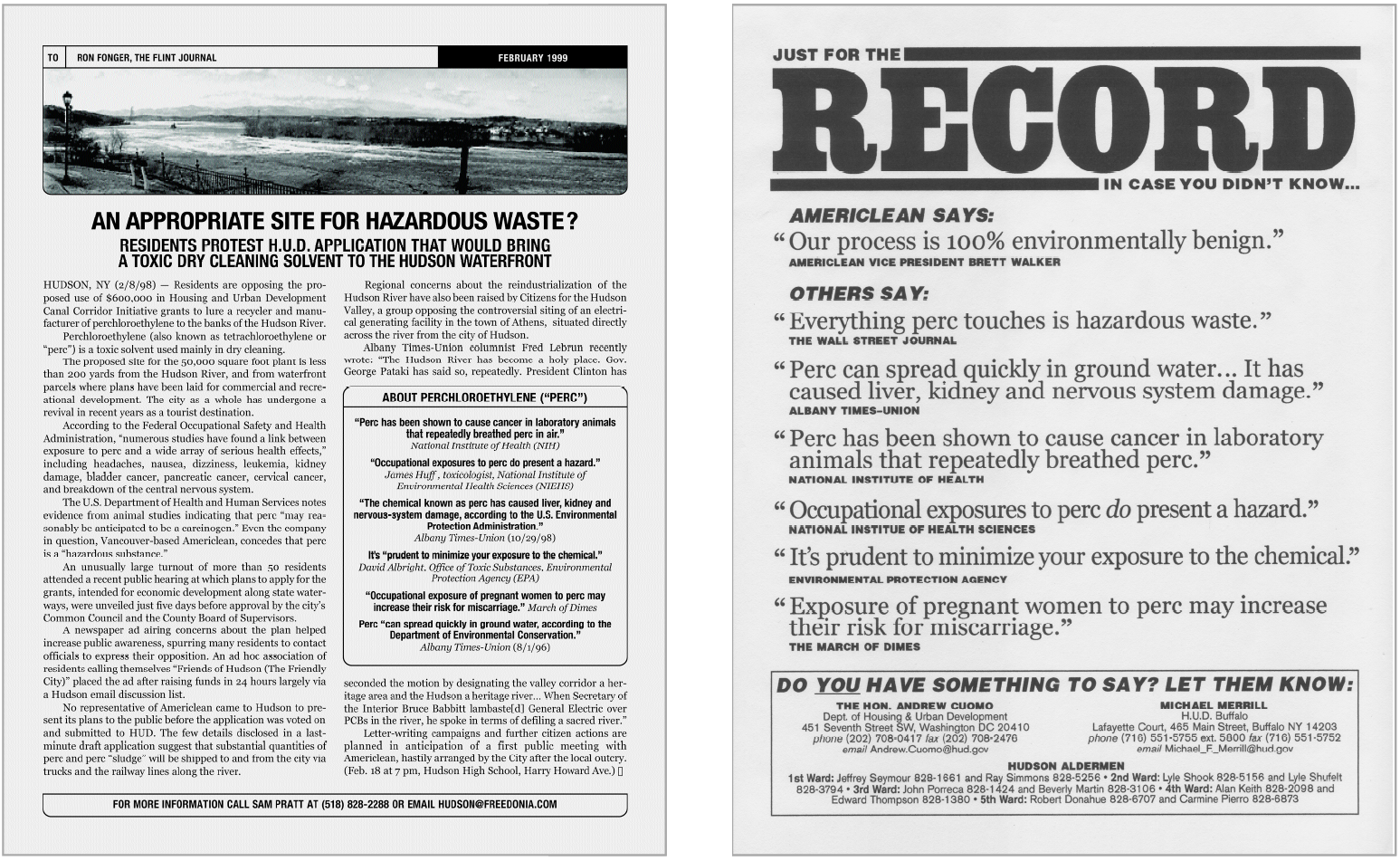
Undeterred, residents followed up with a one-page insert in the paper (see For the Record, below). This contrasted Americlean’s own claims with contradictory evidence to the contrary found in mainstream publications and scientific research reports.
More crucially, citizens made three key decisions:
(1) Going door-to-door in their neighborhoods with flyers about the hazardous waste proposal;
(2) Garnering coverage by the area’s local television stations, bringing a broad range of residents together to be interviewed; and
(3) Meeting privately to review research and stategy, drawing up a list of questions to be raised, and parcelled out among those who would attend.
Previous to these three actions, there was a surprisingly low awareness of the controversy, despite its being the subject of numerous newspaper articles. Going door to door, citizen activists discovered that even most residents living within 300 yards of the proposed toxic waste plant had never heard about it. Exposure on area television also greatly increased awareness among those who hadn’t been attending meetings or following the bitter debate in the papers.
Detailed research about the company, its plans, its technological claims, and track record were boiled down to a list of important questions and revelations to be delivered at the hearing. The process of sharing information about the company, its technology, and the associated health concern was greatly expedited by the (then-novel) internet. Corporate, scientific and regulatory information once hidden in obscure libraries and agency files was readily available to anyone with a computer. A net-savvy new resident set up Hudson’s first “list-serv,” an automated email discussion list. This allowed conversations and debates which might have taken weeks to arrange were condensed into a matter of hours.
Operating as a combination early warning system, round-the-clock roundtable and independent research institute, this email list helped residents to discuss new developments, share research, refine strategy, and mobilize members on a moment’s notice for a public meeting or media opportunity.
Hoping to create an impression of public apathy about the proposal, the powers that be chose a huge auditorium for the hearing, located as far as possible from the proposed toxic waste site without quite leaving town... Officials expected that many would not bother to make the trip, and even if they did the room would look empty.
But much to the Mayor’s obvious annoyance, citizen grassroots organizing resulted in a full hall, packed by a diverse array of local residents from many different walks of life. The company’s representative, Brett Walker, came across as smug, overdressed, overcoiffed and stunningly unprepared for question after painstakingly-researched question. In many ways the audience seemed to know more about perc processing than Walker.
One resident brought along a chemist and safety consultant for labor unions to testify—to devastating effect, as Americlean’s glib spokesman could not answer her direct, technical questions. Walker professed not even to be able to remember where his company’s much-touted “pilot plant” was located, furthering the growing impression that the project was a sham. Many started to believe that Americlean’s real agenda was to take the $600,000 grant, and get paid to accept waste that would wind up in Hudson’s wetlands, or river, or get incinerated in the St. Lawrence Cement proposal, which had just been announced just up the hill in Greenport.
Especially effective were the parents, health care professionals, and lifelong residents who had been reached through our door-to-door outreach. Many spoke out forcefully against the project—debunking the official spin that only “outsiders” were opposed to it. A statement by City of Hudson consultant Bill Loewenstein that the Hudson waterfront was always an industrial wasteland was met with hoots and groans.
By the end of the hearing, even those who had gone in supporting the project left with about the hazardous waste plant. “I was trying to help you out here,” said one exasperated company supporter, who Walker did not recognize as an ally and treated shabbily. The lone exception may have been Mayor Scalera, who complained at the meeting’s conclusion that he had “never been so embarrassed by the behavior” of Hudson residents—who had just saved him from making a catastrophic blunder in welcoming what had just been exposed as a sloppy, fly-by-night development partner.
Over the coming weeks, citizens kept up a drumbeat of letters to the editor, television appearances, and pressure at Council meetings. Finally in mid-April, the headline broke in our local paper: The City had delivered the bad news to the company that the Hudson did not want them to truck any hazardous waste into the City, and would only welcome them if they limited their activity to the original hangers-and-polybags line. Americlean withdrew its proposal in short order, and was never heard from again in Hudson.
Soon enough, the former glue factory found a healthier, more forward-looking purpose, when a developer and restoration expert from Florida purchased it to found an arts center. While that developer ran into obstacles from embittered City leaders (who denied him access to water and sewer services), a second set of developers bought the building and managed to overcome those political obstacles.
Today, the factory complex has been impressively renovated, operating as Basilica Hudson. It features a year-round schedule of exhibitions, performances and festivals, as well as hosting weddings and charity galas. Rather than a dumping ground for toxic waste, “The Basilica” serves as a venue for both local projects and businesses, and internationally-acclaimed artists and groups.


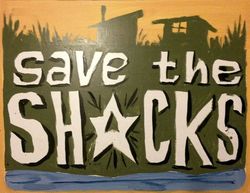 Meanwhile on the North Bay side, a huge outpouring of support for the Furgary Boat Club was again spurned by Roberts, Moore and the current mayor, Bill Hallenbeck. The Furgarians were evicted at gunpoint by a SWAT team, no less. A widespread local belief is that the eviction of Furgary after 100 years of peaceful stewardship of the North Bay was driven by a plan advanced by the Chatham-based Columbia Land Conservancy—which would be the beneficiary of some of this new Hudson grant funding, , according the The Register’s article.