Where was the Ghent Town Board on the night of August 16th? For 50 minutes, they were at another Ghent meeting. For the remaining two hours, they were... apparently somewhere else.
On that night, an estimated 300 residents attended the public meeting at the West Ghent firehouseorganized by State Assembly member Didi Barrett to discuss the massive fire which leveled TCI of NY two weeks earlier. Also present were officials of a wide variety of County, State and Federal agencies.
Not present were any representatives of TCI, nor any of the Columbia County Board of Supervisors except Claverack’s Robin Andrews. Also missing in action were the members of the Town Board of Ghent.
A recent letter to The Register-Star by the Town Board’s attorney (who did attend) sought to rebut a previous letter by Democrat Lee Jamison, explaining that their absence was because Barrett’s meeting “conflicted with an already-scheduled Town Board meeting held the same night.”
However, the draft minutes of the August 16th Town Board meeting have now been posted to Ghent’s website... and they show that the meeting ended at 7:20 pm. Four Board members were present, with the Town Supervisor absent (reportedly due to a planned vacation). Only a handful of routine items of business were transacted: approval of the use of the West Ghent Community Center for an unnamed event, a brief budget update, monthly reports, and the paying of the bills before a motion to adjourn.
The Barrett meeting began just 50 minutes earlier, a little after 6:30 pm, and lasted until at least 9:30 pm, with attendees milling outside well after that. The Google map directions above show that the Ghent Town Hall is barely a 10 minute drive from the firehouse, and that’s if you drive it slowly.
In short, it would appear that the Town Board members could have attended about two-thirds of the supposedly “conflicting” TCI meeting. (As for the 22 missing County Supervisors, they have not bothered to issue an excuse—not even a flimsy one—though Hudson’s Ellen Thurston no doubt would have attended if not for illness that night.)
This site also is told that a retraction of parts of the above letter from the Board’s attorney will soon to be published at the request of Barrett’s staffers, who had clear evidence contradicting a claim “that town officials were not contacted about this meeting, nor asked to participate.” Meanwhile, a peculiar opinion piece from Planning Board chair Jonathan Walters (an registered independent voter, who was present for a portion of the firehouse meeting) sarcastically noted that “Ms. Barrett probably pick[ed] up a dozen or so votes for her re-election.”
One gets the unfortunate impression that partisan political jockeying—specifically, GOP irritation that Democrat Barrett was getting credit for taking a lead on the TCI in the midst of a heated election campaign—has taken precedence over discussing arguably the biggest emergency in Ghent in the past quarter century or more.
The Ghent Town Board’s next meeting is on September 2oth at 7:30 pm at Town Hall on Route 66.
Before TCI moved to Ghent, it was known variously as Trans-Cycle Industries and TCI Incorporated. Documents from the early 1980s show the company was dogged by residents reporting fires at and emissions from its Newburgh location. The company initially tried to move to Athens (NY), but ran into a buzzsaw of community opposition.
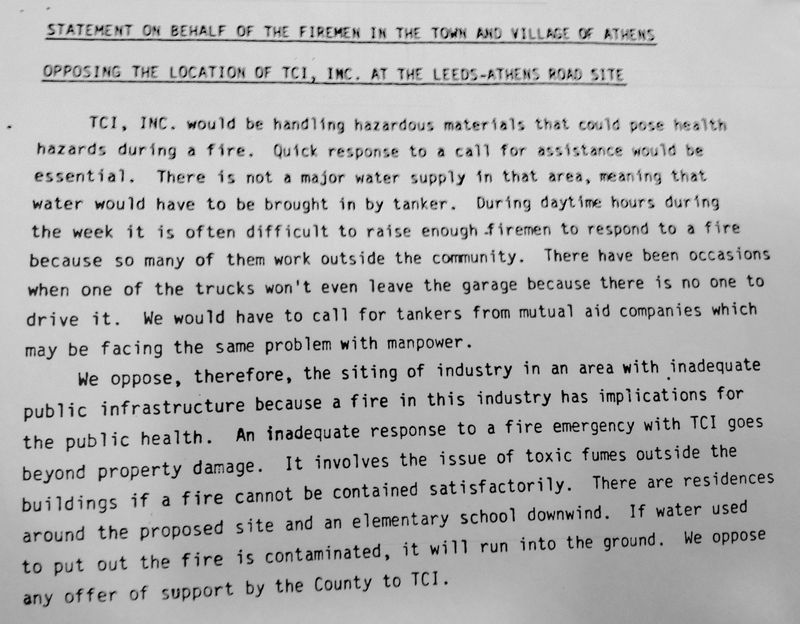
The opposition of Athens’ first responders was particularly instrumental to TCI’s defeat there. The 1980s document above (found in a large archive of legal papers held by a Ghent resident’s attorneys) reveals what the firefighters of the Town and Village of Athens thought about the project. The Athens firefighters opposed it based on their assessment that that:
the “hazardous materials” handled by TCI “could pose health hazards during a fire”;
fighting such a fire would require extensive “public infrastructure”;
“a fire in this industry has implications for the public health”;
“an inadequate response” to such a fire could have implications “beyond property damage”;
these implications could include “the issue of toxic fumes... if a fire cannot be contained satisfactorily”;
“water used to put out the fire” could be “contaminated” and “run into the ground.”
Abandoning the idea of moving from Newburgh to Athens, TCI set its sights on Ghent, securing permission in 1986-87 from the Town to build a structure on land owned by David Rivenburgh.
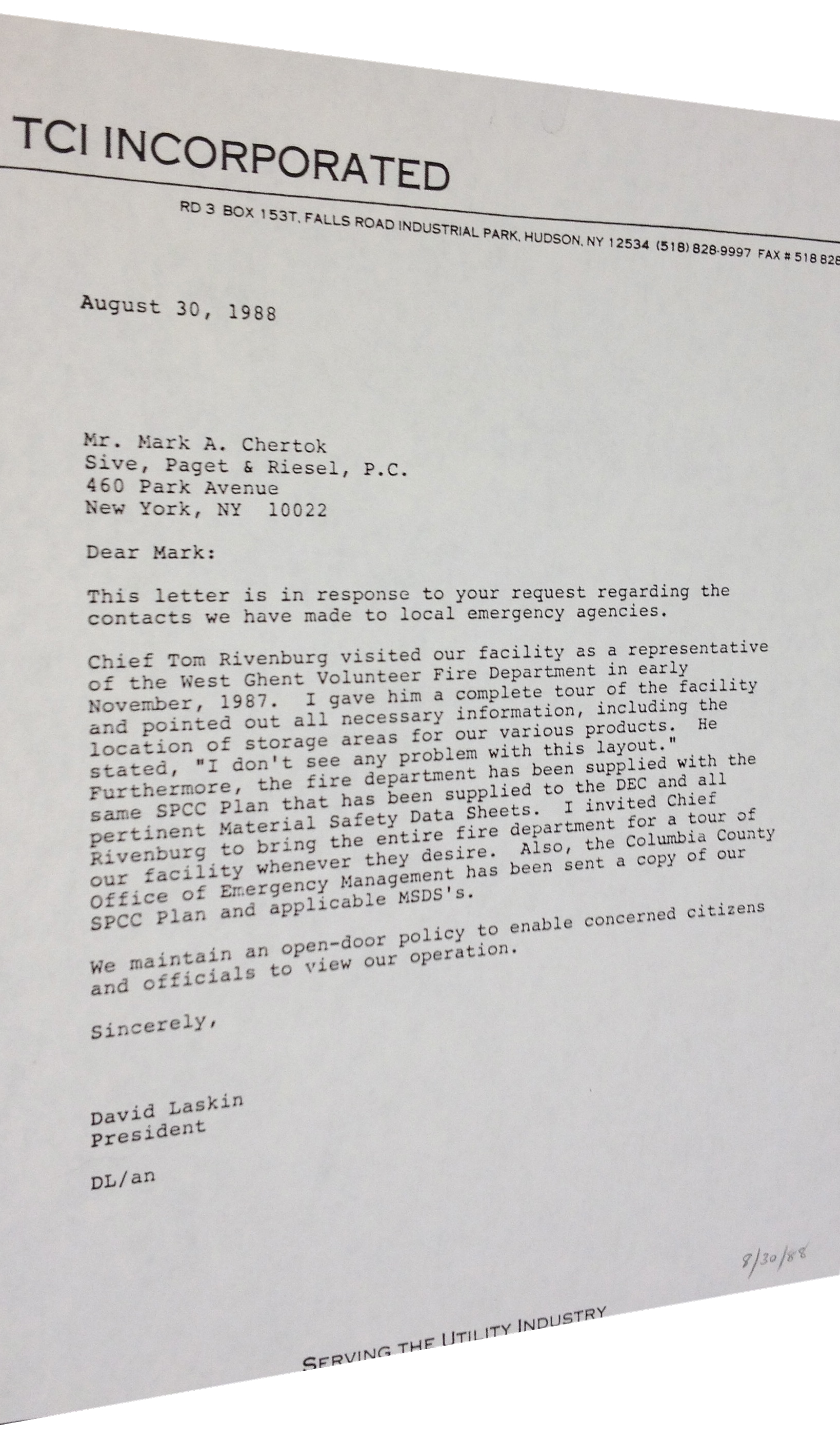
No similar objections appear to have been raised, except for the Town Planning Board chair briefly quizzing the company in a short letter about the potential presence of PCBs onsite. The same archive referenced above contains a 1988 letter from TCI of NY President David Laskin to a lawfirm in New York City, which purports to memorialize a visit to TCI by West Ghent fire chief Tom Rivenburg—a different spelling of the name, and no known relation to David:
Here, Laskin claims that Rivenburg said that “I don’t see any problem” with the facility’s arrangements. The letter also claims that “the fire department has been supplied with the same SPCC [Spill Prevention, Control, and Countermeasure] Plan that has been supplied to the DEC and all pertinent Material Safety Data Sheets,” and that this had also been forwarded to the Columbia County Emergency Management office.
The letter further invited “the entire fire department” to tour TCI’s newly-built plant, which Laskins says has “an open-door policy to enable concerned citizens to view our operations.”
Today, multiple reports indicate that the remains of the TCI facility is under 24-hour armed guard while it is being demolished and, the public has been told, remediated of any pollutants. A stormwater plan for the site was recently agreed to by TCI and the NYS Department of Environmental Conservation, but not before almost a foot of rain has fallen on the site since the time of the catastrophic fire.
Late ’80s paperwork obtained by this website raises questions about when and how TCI of NY became a processor of PCBs. Company letters, official Town of Ghent correspondence, and media reports dating from 1986-1989 indicate that either TCI’s plans changed, or Town officials were mistaken about the company’s real intentions.
On September 3rd, 1986, David Rivenburgh of Falls Road Industrial Park, Inc. applied for two building permits related to land his corporation was acquiring from William Wiegelt. Rivenburgh indicated that one of the buildings planned for the site would be bought by TCI Incorporated of Hudson. Accompanied by a $50 check, his application didn’t mention the use of PCBs, but alluded to handling “electronic transmission and distribution equipment.”
Plainly, this language set off alarm bells with Ghent Planning Board chairman John Winkler. He wrote back on September 15th asking Rivenburgh to produce a letter from TCI Inc. The letter, Winkler said, should explain among other things “what waste products are produced,” “how is waste matter disposed,” and whether the company deals with “any toxic materials, particularly PCB’s.”
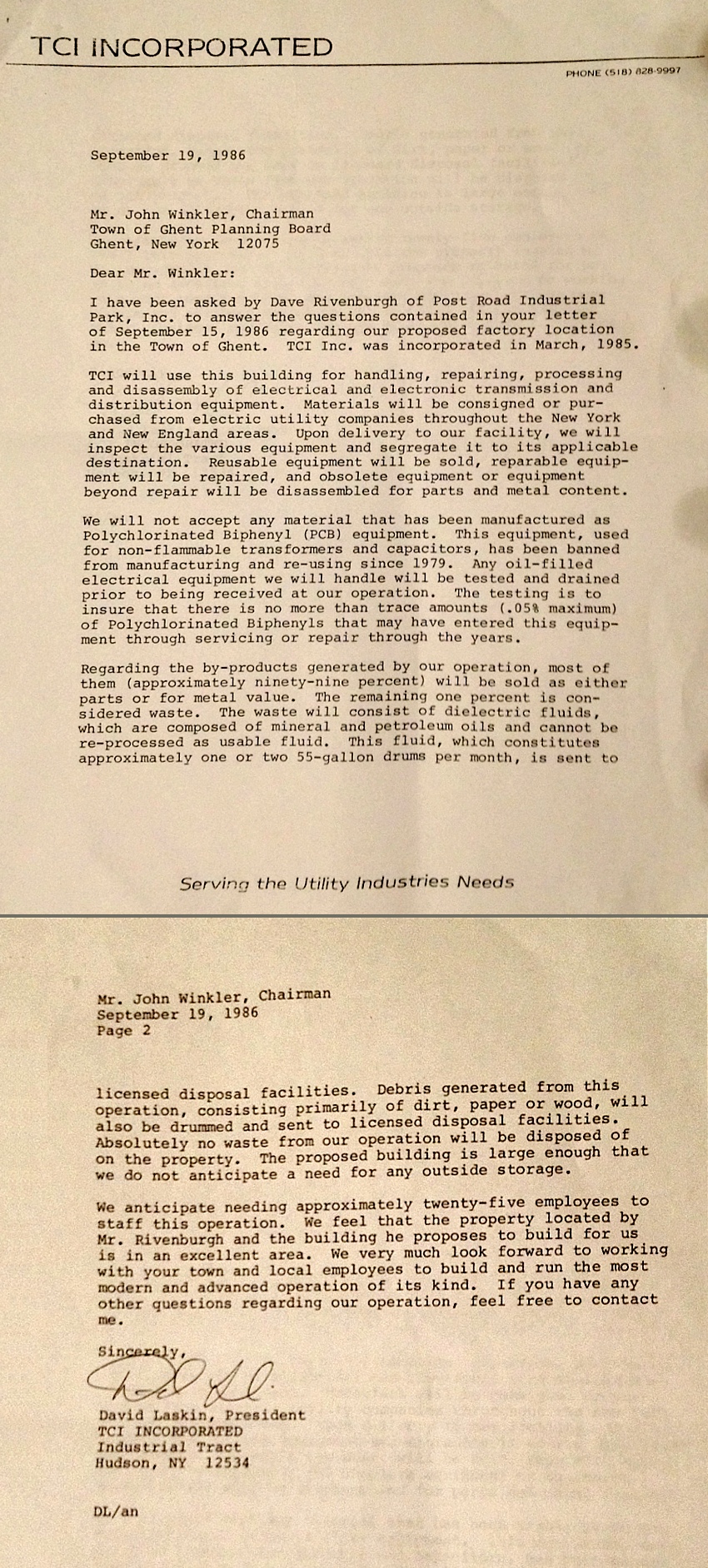
Within four days, David Laskin of TCI Incorporated wrote to Winkler, affirming that:
“We will not accept any material that has been manufactured as Polychlorinated Biphenyl (PCB) equipment.
Laskin then goes onto reassure the Town:
“Any oil-filled electrical equipment we will handle will be tested and drained prior to being received at our operation. The testing is to insure that there is no more than trace amounts (.05% maximum) of Plycholorianted Biphenyls that may have entered this equipment through servicing or repair through the years.” [emphases added]
Later correspondence and official comments suggests that either Laskin was not adequately clear in that last sentence, or the Town failed to grasp a nod-and-a-wink message buried within the letter’s technical language.
Laskin also wrote to the Planning Board chair that its “proposed building is large enough that we do not anticipate a need for any outside storage.” Photographs of the site, as well as published accounts, show that materials were stored outside the building. Indeed, some have suggested that the impact of the fire might have been worse had more transformers and other materials been stored inside instead of out.
Indications that the Town of Ghent was starting to feel a bit bamboozled emerge from documents and news reports from 1988-89, when TCI applied to the State to add an incinerator to its Ghent facility. That incinerator plan was opposed by neighbors such as Marlene and Jerry Brody of Gallagher’s Stud, as well as by the Town. Legal wrangling dragged into the early ’90s, but the incinerator never came to pass.
The Brodys
The Town of Ghent’s legal correspondence firmly reiterates that TCI’s original application for a local use permit did not include the handling of “PCB equipment,” and that any other equipment would be drained “to insure there were no PCBs. On September 22nd, 1989, Town attorney Ted Guterman, (who is still serving in that capacity today) forwarded the Town’s Position Statement on the project to Planning Board chair Winkler:
“When TCI initially applied for a use permit in 1986... It was specifically indicated that the process would not include nor would TCI accept any material that has been manufactured as PCB equipment. It was further indicated that any oil filled electrical equipment would be tested and drained prior to being received at the premises in order to insure that there were no PCBs.”
Guterman’s understanding was echoed in a December 13th, 1989 article in the T-U, which quoted Brody attorney Jason Shaw as saying that “TCI was not forthcoming about the presence of PCBs when it applied three years ago to open its operation.” He added that “I don't think TCI was up-front about the fact that there would be toxic
substances at the facility... They did not clarify the
definition they used in an attempt to muddy the issue.”
In the same article, Guterman recalled “Laskin telling the Planning Board there would be no PCBs on the property.” Laskin countered that the Board “ knew we'd be handling the material and the amount would be miniscule... I can't remember how many hours we spent going over this.”
The Position Statement forwarded by Guterman also flagged the Town’s concern that TCI’s activities
“not result in any toxic waste generated or disposed of on the
property or through the air, including PCBs. It should be noted that the
Town of Ghent Zoning Ordinance contains a provision specifically
prohibiting storage collection, retention or utilization of toxic waste
or by-products or other similar toxic chemicals in any district.”
23 years later, the Town experienced what many residents now view as an uncontrolled incineration of materials which may never be authoritatively inventoried.
Whoever one chooses to believe as to TCI’s original intent, clearly PCBs at some point began passing through the facility in both lower and higher concentrations than 50 parts per million.
For example, as reported previously at this site,
a March 2012 TCI manifest shows roughly 2,000 pounds (901 kilos) of
liquid PCBs with a concentration of 50-499 ppm (parts per million),
along with 350 pounds of solid PCB debris, was shipped from TCI in Ghent
to their sister company in Alabama. The Albany Times-Union for its part has obtained records “that showed some 50,000 pounds of PCB-containing materials and oils moving from the Ghent complex this year.”
It remains to be seen if, when and how TCI modified its original
application materials to secure permission for such use—or if the Town
let this unintended use slide. With TCI saying it plans to rebuild, and
many residents calling for a full site plan review if it really does, it
becomes all the more essential to determine what precisely the company
has been permitted to do locally.
In the 15-minute video above, renowned cancer expert Dr. Mitchell L. Gaynor discusses the science and health risks associated with the burning of PCBs.
Speaking at his Columbia County home, Dr. Gaynor first reviews the fundamentals of environmental carcinogenesis: how environmental exposures contribute to cancer. He then discusses how the uncontrolled incineration of PCBs leads to the formation of even more toxic dioxins and furans.
The former Medical Director at the Weill-Cornell Medical Center for Complementary and Integrative Medicine, Gaynor proceeds to explain why he has found the official reassurances and limited testing done to assess the risks of TCI of NY’s recent inferno in Ghent to be inadequate thus far.
The founder and president of Gaynor Integrative Oncology, Dr. Gaynor’s extensive resumé includes four books, and countless appearances in national media, from Good Morning America to Martha Stewart to Newsweek. He has also published numerous “studies on oncology and the effects of environmental toxins on health in peer review journals such as The American Journal of Clinical Oncology andThe Proceedings of the American Society for Clinical Oncology.
He has been honored for his environmental advocacy by the New York State Assembly—whose Committee on Environmental Conservation oversees the work of some of the officials responsible for the testing which is called into question in this video.
Ralph Gardner, Jr., who has house near Ghent, has an excellent column today in that notorious left-wing publication, The Wall Street Journal, about the August 1st TCI inferno.
In his usual fluid and droll prose, Ralph likens the official reassurances about the TCI fire to those issued by EPA and NYC after 9/11—and also to the plot of a Don Delillo novel (such as White Noise, whose Airborne Toxic Event many immediately thought of when the PCB handler’s plant exploded).
Meanwhile, The Albany Times Union’s James Odato reports that EPA in Massachusetts performed some of the testing across the Berkshire County line that New York State officials have been refusing to do here in Columbia County.
NYS DEC spokesperson Charsleissa King even goes so far as to suggest that samples taken in the Berkshires are adequate justification for not doing the same in the neighborhood of the fire.
Perhaps Ms. King needs to be reminded that this inferno took place in Ghent, New York, not Pittsfield, Massachusetts... Or that National Weather data shows thawinds were less than 1 mph from the start of the fire around 10 pm until dawn, meaning that the most intense impacts would likely occur locally, not across the border.
This makes it all the more eyebrow-raising that Berkshire and Rensselaer counties got timely notifications to close their windows, turn off air conditioners, and stay inside, while Columbians did not. (Maybe that name has DEC thinking we’re a Third World country?)
More likely, the State just doesn't want to know, and doesn't want to spend the money to test properly—even when they can charge it back to TCI... or especially when they can do so. DEC Region 4 has consistently been protective of corporate interests in our region for the past few decades, regularly taking the side of mining interests, coal-burners, tire-burners, and now waste handlers.
In the wake of August 1st’s inferno at TCI of NY, longtime Churchtown firefighter Nathan Chess has circulated the following email message, which is reproduced below by permission.
Chess writes that “it is with great trepidation that I push the send key with this message, but the mushrooming of this situation appears to be getting worse. And I care too much for my brother and sister responders to hold back any more.” He expresses his ongoing concerns about the health and safety of his fellow First Responders, noting that “We were only minutes away from bagpipes and flag-draped coffins.”
PCB testing is only part of the picture. What about tests for dioxins and furans—which on a toxicity level make PCBs look like lemonade?
From a cursory review of PCB incineration, the temperatures required are in the range 1000ºC with a extremely technical process to insure the complete breakdown of the PCBs without the subsequent creation of dioxins (a/k/a Agent Orange) and other highly toxic substances, I admit that my research is based on a quick skim of of highly technical information. But I am sure there are others within our community that are better educated on these procedures.
Additionally, as of this date it appears that no baseline testing have been done on the responders, command personal, EMS and other who where in close proximity to both the fire and plume for close to three hours. Thankfully, the majority of responders (including myself) were kept at what appears to be a safe distance from the incident. But as we have learned the hard way in such situations, distance does not ensure safety.
From my understanding this testing and comparison work would fall under the purview of the New York State Occupational Health Clinic Network, but I have seen no mention of any actions taken. No doubt it would also be their responsibility to have an ongoing procedure to monitor the workers currently involved in any remediation work.
And where is the Town of Ghent? [There’s] lots of praise for the bravery of the first responders, but sorry to be crude but action talks and we know what walks. It's good to see that one of the supervisors had the time to update his Facebook page with a posting that truly dealt with the ongoing situation—not!
And while I am on this point, it is only based on sheer luck that a serious loss of life was avoided. It was only based on basic “off the cuff” comment by the company’s “keyholder” that the responding units were advised that there was a substantial amount of solid sodium stored in the plant. This chemical is used as part of alternative treatment of low level PCB (< than 50ppm). But when exposed it creates an exothermic reaction and produces hydrogen gas (i.e.: Kaboom!)
We were only minutes away from bagpipes and flag-draped coffins.
I would also like to make perfectly clear that these comments and opinions are strictly my own and in no way represent my fire company or that any commanders, coordinators, supervisors and the many brave and dedicated responders, members, dispatchers, law enforcement, EMS and others who whose participation and selflessness make the Columbia County emergency services organization one of the best...
I have always taken great pride and satisfaction from my work with all of these individuals and organisations in the state and on par with any in the country.
But I feel it is my responsibility to express my beliefs, perceptions and and reactions to this event. Whatever the consequences, if it saves one life or prevents any injuries, it will be well worth it.
NATHAN CHESS 1st Lieutenant Churchtown Fire Company
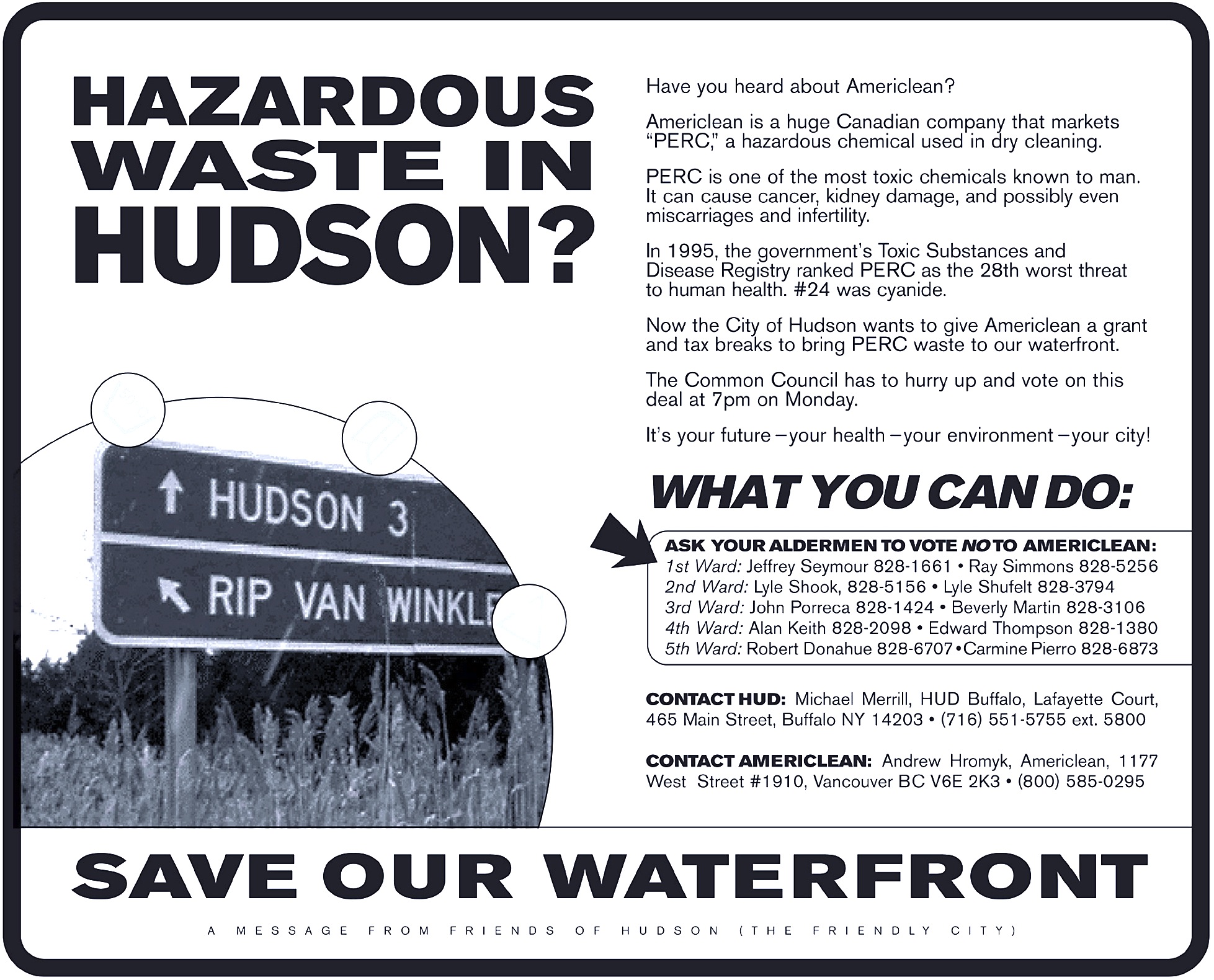
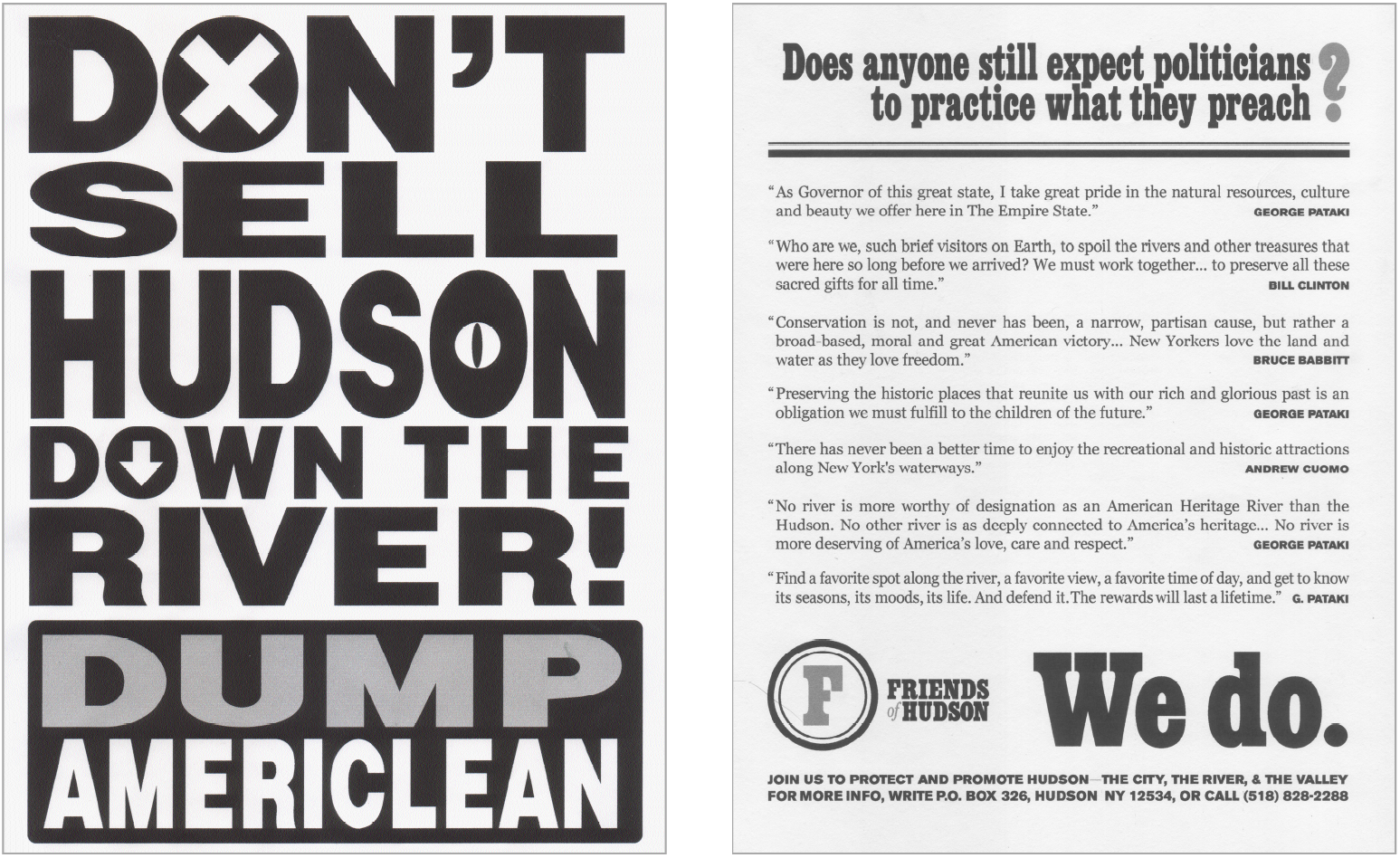
NOTE: This summary of the Americlean controversy was written about ten years ago as background for a (successful) nonprofit grant application. Citizens who were involved in the fight to stop Hudson’s old glue factory—what is now the Basilica—included Philip Alvaré, Jennifer and Kim Arenskjold, Carole Clark, Jack Harrell, Peter Jung, Peter Meyer, Sara Sterling, myself and many others, including some no longer in Hudson (such as Byrne Fone and Edward Gomez).
During a four-month controversy in 1999, local residents discovered the importance of face-to-face grassroots organizing, diligent research, media exposure, sustained public pressure, and savvy use of the internet for making change at the regional level.
As a result, a unique relic of the Valley’s industrial architecture was spared from becoming a sketchy toxic waste center, and instead preserved to become Basilica Hudson—arguably the most dynamic art and performance center in this stretch of the Hudson River.
Below is a detailed review of those four hectic months, explaining how citizens prevailed against long odds to protect their quality of life and preserve a prime opportunity for more positive development.
In the waning days of 1998, some residents of the City of Hudson, New York, spotted an obscure legal notice in our local paper.
The bland notice indicated that Hudson and Columbia County intended to apply jointly for $600,000 in grant funding from the Department of Housing and Urban Development (HUD) Canal Corridor program to attract “a business”—the name was unspecified—to the City’s waterfront. I said there would be an informational meeting about the application in early January.
As is all too typical of such meetings, this one was scheduled inconveniently on a weekday, during work hours, a time calculated to draw as few audience members as possible. But much to officials’ surprise and dismay, several residents did attend.
After a lot of hemming and hawing, the County development agency was finally convinced that residents deserved to know the name of this mysterious “business” which would benefit from a $600,000 in Federal largesse.
“I think it’s called ‘Americlean,’” he said. About the nature of Americlean’s business, he was similarly vague: “Something to do with supplies for the dry cleaning industry—wire hangers, polybags, that kind of thing.” After further grilling, citizens determined that the proposed site would be an imposing brick building, a former glue factory, adjoining the wetlands of South Bay and a stone’s throw from the Hudson River.
Alarmed by the obvious evasiveness, citizens went home to look up Americlean on the web—a relatively novel task for many in the late ’90s.
It was soon learned that the main business of Americlean (a Canadian company, despite its name) actually involved shipping and “processing” huge quantities of a hazardous waste generated by the dry cleaning industry: a chemical called perchloroethylene.
Thanks to a relatively new search tool called Google, residents then figured out that “perc” is one of the more carcinogenic substances known to man. Once considered a miracle substance, many places such as New York City had begun to ban perc’s use altogether as a health risk to dry cleaning workers and their neighbors.
Americlean’s website claimed to have a miraculous, patent-pending process which would allow the company to recycle perc safely, then resell it to the drying cleaning industry with relatively little leftover waste product. The company claimed to have a pilot plant in Canada that had successfully tested this process.
When we brought this new information to the attention of our local Common Council, its members professed to be both unaware and unconcerned by Americlean’s real intentions. So what if they were hauling and processing hazardous waste, instead of making coat hangers—they were eager to believe the company’s claims of creating 100 well-paid jobs for local workers. Besides, the deadline for applying for the grant was rapidly approaching, and if Hudson didn’t submit something, the funding would be lost. So the Council hurriedly voted in favor of applying to HUD.
In other words: City and County leaders actually wanted the Feds to pay a little-known and even less-tested Canadian company $600,000 to to truck hazardous waste through local neighborhoods, down to the Hudson River, when an unspecified process would be used to neutralize it.
“You people have no idea how much toxic waste already goes through Hudson,” lectured then-Mayor Rick Scalera, as if this would reassure his listeners.
Those who questioned the wisdom of the Americlean plan were subjected to all manner of personal attacks from public officials, from public meetings to the pages of the local newspaper. One woman took the initiative to call Americlean’s president directly, hoping to learn more about his plans—then found herself falsely accused of “impersonating a Common Council member” as elected officials rushed to discredit her unflattering account of the conversation.
In an apparent reference to the sexual preferences of a few of those speaking out against the project, 5th Ward Alderman Bob “Doc” Donahue read a prepared speech in which he insinuated that “these people speaking out don’t have children, they only have pets.”
Weeks of verbal sparring in newspaper articles, public meetings and letters to the editor ensued. It became obvious that the politicians wanted to make this an us vs. them issue, and the local paper was all too happy to help pit neighbor against neighbor.
A major turning point came when challengers of the hazardous waste plant shamed the Mayor into holding a public hearing in which the company would present its plans, and residents would have a chance to question Americlean in person. Up to that point, none of the company’s executives had ever appeared publicly in town.
In preparation for the big hearing, challengers raised $800 to take out a half-page ad in our local newspaper to increase awareness of the event. Even this caused a new controversy, as The Register-Star’s publisher decided to preview the citizens’ planned back-page ad for Americlean in advance of its publication. The paper also ran a front page story the same day featuring the company’s one-sided rebuttal, in an apparent attempt to blunt the ad’s impact.
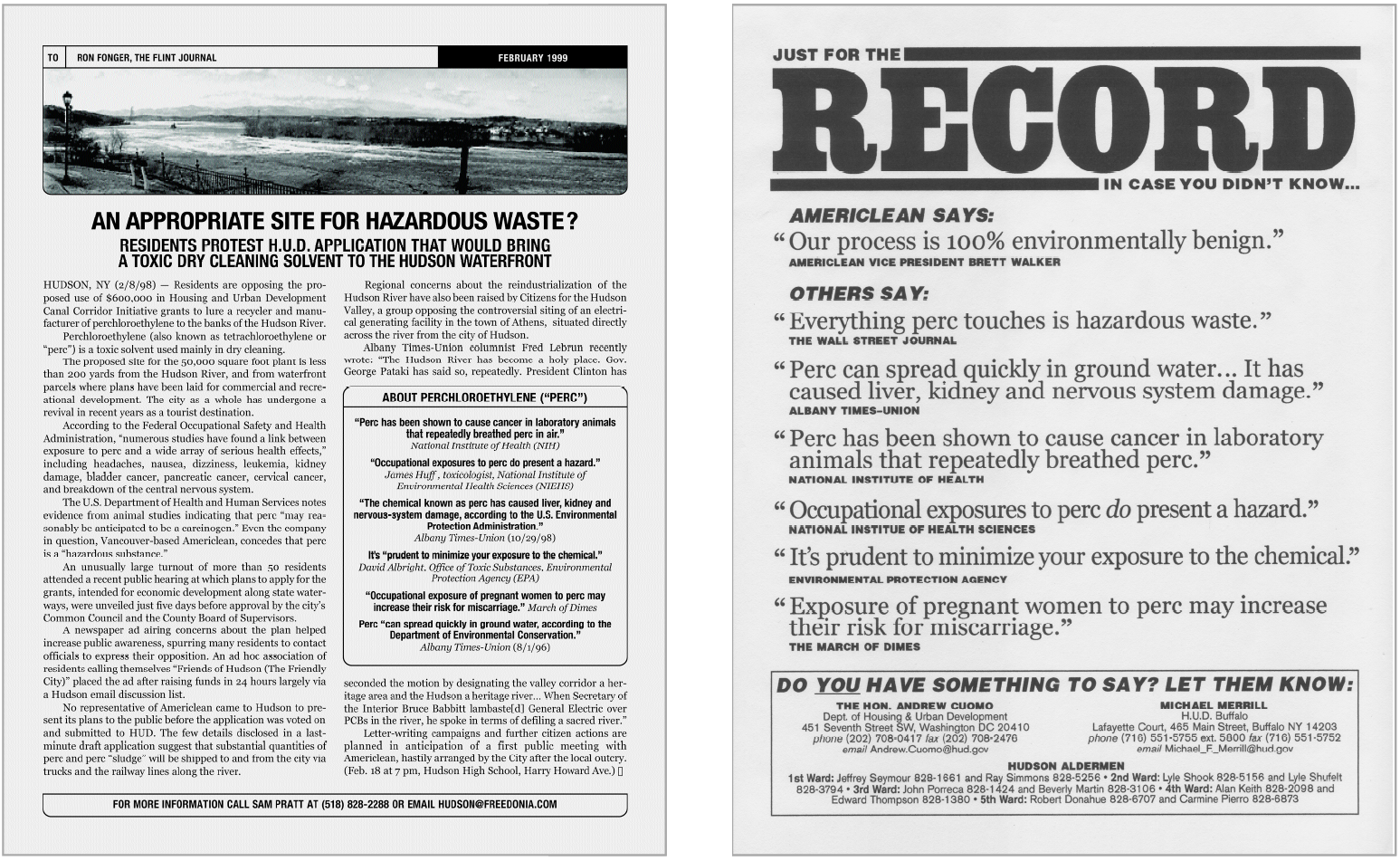
Undeterred, residents followed up with a one-page insert in the paper (see For the Record, below). This contrasted Americlean’s own claims with contradictory evidence to the contrary found in mainstream publications and scientific research reports.
More crucially, citizens made three key decisions:
(1) Going door-to-door in their neighborhoods with flyers about the hazardous waste proposal;
(2) Garnering coverage by the area’s local television stations, bringing a broad range of residents together to be interviewed; and
(3) Meeting privately to review research and stategy, drawing up a list of questions to be raised, and parcelled out among those who would attend.
Previous to these three actions, there was a surprisingly low awareness of the controversy, despite its being the subject of numerous newspaper articles. Going door to door, citizen activists discovered that even most residents living within 300 yards of the proposed toxic waste plant had never heard about it. Exposure on area television also greatly increased awareness among those who hadn’t been attending meetings or following the bitter debate in the papers.
Detailed research about the company, its plans, its technological claims, and track record were boiled down to a list of important questions and revelations to be delivered at the hearing. The process of sharing information about the company, its technology, and the associated health concern was greatly expedited by the (then-novel) internet. Corporate, scientific and regulatory information once hidden in obscure libraries and agency files was readily available to anyone with a computer. A net-savvy new resident set up Hudson’s first “list-serv,” an automated email discussion list. This allowed conversations and debates which might have taken weeks to arrange were condensed into a matter of hours.
Operating as a combination early warning system, round-the-clock roundtable and independent research institute, this email list helped residents to discuss new developments, share research, refine strategy, and mobilize members on a moment’s notice for a public meeting or media opportunity.
Hoping to create an impression of public apathy about the proposal, the powers that be chose a huge auditorium for the hearing, located as far as possible from the proposed toxic waste site without quite leaving town... Officials expected that many would not bother to make the trip, and even if they did the room would look empty.
But much to the Mayor’s obvious annoyance, citizen grassroots organizing resulted in a full hall, packed by a diverse array of local residents from many different walks of life. The company’s representative, Brett Walker, came across as smug, overdressed, overcoiffed and stunningly unprepared for question after painstakingly-researched question. In many ways the audience seemed to know more about perc processing than Walker.
One resident brought along a chemist and safety consultant for labor unions to testify—to devastating effect, as Americlean’s glib spokesman could not answer her direct, technical questions. Walker professed not even to be able to remember where his company’s much-touted “pilot plant” was located, furthering the growing impression that the project was a sham. Many started to believe that Americlean’s real agenda was to take the $600,000 grant, and get paid to accept waste that would wind up in Hudson’s wetlands, or river, or get incinerated in the St. Lawrence Cement proposal, which had just been announced just up the hill in Greenport.
Especially effective were the parents, health care professionals, and lifelong residents who had been reached through our door-to-door outreach. Many spoke out forcefully against the project—debunking the official spin that only “outsiders” were opposed to it. A statement by City of Hudson consultant Bill Loewenstein that the Hudson waterfront was always an industrial wasteland was met with hoots and groans.
By the end of the hearing, even those who had gone in supporting the project left with about the hazardous waste plant. “I was trying to help you out here,” said one exasperated company supporter, who Walker did not recognize as an ally and treated shabbily. The lone exception may have been Mayor Scalera, who complained at the meeting’s conclusion that he had “never been so embarrassed by the behavior” of Hudson residents—who had just saved him from making a catastrophic blunder in welcoming what had just been exposed as a sloppy, fly-by-night development partner.
Over the coming weeks, citizens kept up a drumbeat of letters to the editor, television appearances, and pressure at Council meetings. Finally in mid-April, the headline broke in our local paper: The City had delivered the bad news to the company that the Hudson did not want them to truck any hazardous waste into the City, and would only welcome them if they limited their activity to the original hangers-and-polybags line. Americlean withdrew its proposal in short order, and was never heard from again in Hudson.
Soon enough, the former glue factory found a healthier, more forward-looking purpose, when a developer and restoration expert from Florida purchased it to found an arts center. While that developer ran into obstacles from embittered City leaders (who denied him access to water and sewer services), a second set of developers bought the building and managed to overcome those political obstacles.
Today, the factory complex has been impressively renovated, operating as Basilica Hudson. It features a year-round schedule of exhibitions, performances and festivals, as well as hosting weddings and charity galas. Rather than a dumping ground for toxic waste, “The Basilica” serves as a venue for both local projects and businesses, and internationally-acclaimed artists and groups.
Chris Bishop of Old Ghent Realty shares his rough notes of last night’s meeting, which he descibed as “wild, very emotional and properly combative.” He adds that “the audience was much more eloquent than these notes”:
Both DEC and Homeland Security had outside contractors collect test samples.
Bill Black stated that Albany had two foam units—one was required to stay at the airport, the other was out of service. They had to bring foam trucks from Stratton AFB and Rennsalaer. (It was ironic to have the speakers set up in front of a dinky trailer with a hand painted sign reading Columbia County Foam Response Unit.)
The Homeland Security reps stated their contractors were doing test samples in the early morning, VOC and particulate at TCI and downwind, at approximately 4 am.
The Fire Dept. Coordinator said “we pretty much let it burn.”
Thomas Lanphear stated that TCI would comply with [a] regulation every March to list what was at the site the year before.
Brian Hemlock of TCI didn’t show up, even though he was on the program. Basically all restraint ended once that was announced.
Some of the eloquent audience members, in brief, and in rough order of appearance, said:
Zachary Pesce insisted the DEC and the Department of Health spend the money to do the testing they should have been doing since that night.
Howard Brandston spoke about how in general, environmental tests are done to get the results the administration wants.
James Wilcox said that testing needed to restore confidence in the county's agriculture.
Gianni Ortiz said a map of the plume exists, but is not public. DEC admits to having it but doesn't know the source. She referenced Dr. Chris Walchik as to importance of certain aspects of wind direction—winds aloft and the wind profile at sunrise as the accumulation during the night disperses with the first winds of morning.
Victor Mendolia asked why couldn’t there be low-tech warnings to the populace—fire alarms, etc.
Koethi Zan cited the need for dioxin tests, asking for written details of clean-up procedures. This evokes a response from the DEC that they will set up a specific section of their website to the TCI fire.
Paige Smith Orloff questioned the 7-and-a-1/2 mile radius, iterating how this is a county-wide crisis, not just Ghent.
At this point the Columbia County Hazmat director came up to the mic, and states he saw a plume map from the National Weather Service. He detailed the decontamination procedures for the responders: soap and water being typical for most contaminations.
An audience member questioned rebuilding TCI, saying Columbia County is not equipped to deal with a major industrial fire.
Ed Simonson asked why sodium was in that building, and for a list of procedures followed in testing analysis.
Jim Orell (Morell?) suggested TCI could be indicted for reckless endangerment.
Another audience member pointed out that no one from the Ghent Town Board was at the meeting, and the only County Supervisor at the meeting was Robin Andrews—emphasizing hat this is a County issue, and that the local towns can't supervise these companies properly.
Charles Ballard asked where money would come from to clean the site. He commended the Homeland Security office for not being evasive on the phone. He suggested thepublic should receive the same blood tests for toxins as responders. And he about a January fire at TCI, and why that didn't raise red flags.
The Health Department admitted that they were moving offices at the time of the fire and after, and were not equipped to handle many public calls regarding crisis.
Someone asked how many of these type of recycling facilities are located in New York.
Fran Martino of the Greater Stockport Watershed asked for thorough testing of water in nearby Widow's Creek, which flows into the Claverack, into the Stockport and eventually the Hudson River.
Tim Loughner, a firefighter at the scene, felt the department should have had more up to date info on what was at TCI.
In an unusually balanced and well-researched Register-Star article, the director of the University of Albany’s School of Public Health’s Institute for Health and Environment questions the validity of State tests which claim no pollution impacts from the towering TCI inferno on August 1st and 2nd.
Reporter John Mason (who cut his teeth on pollution issues while reporting on the St. Lawrence Cement proposal) cites UAlbany’s Dr. David Carpenter as saying that he “does not trust the results because they relied on Aroclor tests, which he said are not appropriate.” Dr. Carpenter, who also runs an independent PCB testing lab, states that
“I don’t trust (the DEC testing) at all... I would say it’s invalid. These analyses are cheap and relatively fast. The congener tests are expensive, but this is not going to tell you anything. I would recommend a much more detailed analysis of the soot.”
Mason’s article also gives the State plenty of opportunity to defend itself. This is the type of in-depth reporting which can really earn a local paper the trust of readers, and is all too rare in the Register’s pages. This site has heard through separate channels that the Register is in possession of one or more samples of debris collected at a neighboring property, and may be in the process of having it analyzed.
Dr. Carpenter’s assessment is particularly timely in light of tonight’s 6:30 meeting at the West Ghent Fire Company (near the entrance to the Commerce Park off Route 9H, about a half-mile south of Kozel’s, which unfortunately I cannot attend due to a prior obligation). The meeting was organized by State Assembly member Didi Barrett, who expects all or most of the involved officials and agencies to be in attendance.
Working with videographer and filmmaker David McDonald, this site has produced a video interview with two of TCI of NY’s closest neighbors, Dmitri and Barbara Bassakalis. The couple evacuated their house on the night of August 1st, then stayed up all night observing the fire from a safe distance—all the while hoping they would have a house to which to return.
Some key revelations from their interview last Wednesday include:
According to the couple, a representative of the NYS State Department of Environmental Conservation who visited their site (after Mr. Bassakalis appeared on Albany TV) declined to take a sample of the countless black, oily objects which fell on their deck, cars, lawn and into their pool.
Instead, the couple says they were told not to worry about the many black objects, and told to simply wash it away. (Note: Their house relies on well water.)
Mr. Bassakalis, who also works for the State, reports that he was refused entry to the County and State’s joint press conference on Thursday, August 1st, where he had hoped to learn details of what had just happened in his neighborhood;
At the time of this interview, the couple said they had not been visited by anyone from TCI, and their multiple calls to the company’s insurer Zurich had not been returned.
A request sent to TCI by this site last week, asking to sit down with a representative of the company, has not been answered.
Below is a still image of some of the material observed in their aboveground pool late last week, during a visit with Ghent resident Patti Matheney. Other images and video clips appear in the video by permission from Lance Wheeler, Tony Bashford and Mark Johnson.
Once again, a toothy rodent is putting Columbia County on the national media map. Only this time, it’s a rabid beaver.
Image: National Geographic
Boy Scout Troop 32 out of Elizaville was camping along the Delaware Water Gap in Pennsylvania when its leader, a Pine Plains resident, was attacked repeatedly by a beaver. The Troop leader “suffered bites [on] his backside, his leg and arm” before his scouts “killed the animal as it clung to its victim even after he reached shore.”
According to The Pike County Courier and dozens of other media outlets around the country, the beaver was tested and found to be rabid. The man is being treated for rabies, and of course is wished a speedy recover.
(Growing up along a small river, in my experience these animals avoid humans whenever possible, and aren’t to be feared—but rabies will turn any critter into a crazed killer.)






 Posted with Blogsy