This year’s 25th Annual Crystal Apple Award ceremony with be the last, Columbia County Chamber of Commerce director David Colby told me this week.
While there have been a few worthy winners in the past (such as FACE Stockholm and Camphill Ghent), the award has a spotty past of picking longterm success stories. As reported previously here, “nearly 40% of the 1992-2013 award winners either defunct, disappeared, or discredited.”
At times, the winner seemed to be whichever business had received the most government backing. A particularly weak pick of this type was the Chamber’s 2010 award to as-yet-unproven Local Ocean, which within a few years defaulted on its County PILOT plan, then then went out of business.
Some of the biggest ups and downs of the year include:
Biggest Sale of a Small Object: Auctioneer Colin Stair of Stair Galleries in Hudson sold a Tsarist figurine by Fabergé for $5.2 million in October to an undisclosed phone bidder. The figurine was discovered in a Rhinebeck attic.
Wackiest Would-Be Terrorist: County resident (and Kinderhook Elk) Eric Feight was arrested as part of a harebrained plot to build a ray gun intended to beam radiation into mosques, with the apparent crackpot goal of giving Muslims cancer.
Most Avant-Garde New Building in an Historic District: Grigori Fatayev built this handsome black box off Willard Place behind the Allen Street home of painter Tony Thompson. The building now serves as Thompson’s studio.
Most Welcome Threat to Leave the County: Following two catastrophic fires in 2012, and after suing the Town of Ghent for upholding its zoning code in 2013, TCI of NY threatened to move their PCB (mis-) handling business across the river to Coeymans. While many breathed a sigh of relief, reminding TCI to not let the door hit them in the back on the way out, it remains to be seen whether Coeymans will really take on the troubled company. The first weeks of the New Year may provide an answer, as the end date for the postponement of TCI’s lawsuit comes due. The company agreed to drop the suit if they found a new home.
Liveliest Glimpse of Old Hudson: A video of people hanging out and partying in the 7th Street park in the early 1990s was posted by YouTuber Satansdarkmetal.
Most Misleading Local Headline: The Register-Star titled an article about the Board of Supervisors voting to keep on pursuing eminent domain against Meadowgreens owner Carmen Nero: “Board Rejects Eminent Domain Resolution.”
Most Pandering Local Headline: For its article about a local engineer who allegedly “zoned out” while speeding a Metro-North train into a fatal accident around a curve at Spuyten Duyvil, Columbia Paper editor Parry Teasdale used this headline: “Germantown Engineer Assists Crash Probe.”
Most Heartening Turnout at a Public Meeting: Hundreds streamed into the Livingston Town Garage for the first public meeting of Livingston Farmers & Families, which is organizing to alter or stop a massive power line project from Upstate to NYC. The meeting featured the political speech of the year, a ripsnorter by farmer and Town Board member Will Yandik, who seems destined for higher office.
Clumsiest Campaign Rollout: The first major media introduction of newly-minted Hudson Valley resident Sean Eldridge, who is seeking to unseat Congressman Chris Gibson, came in the early Summer pages of the New York Times. But the article mainly provided fodder for his opponent. The Times’ revelations about the cost of Eldridge’s Shokan house, with the implication that he and Facebook zillionnaire Chris Hughes had shopped around for a district to run in, were swiftly followed by an Albany Times-Union exposé of how Eldridge’s campaign was paying area residents $100 a pop to focus group attack messages on Gibson.
Most Revealing Comment by an Official Once Thought to Be More Enlightened: Mistakenly thinking that the press and public had left the room, Hudson Development Corporation director Sheena Salvino denigrated citizens who had come out to support the Community Garden as a “mob.”
Most Revealing Comment by an Official Never Thought to Be More Enlightened: County Economic Development tsar Ken Flood shared his unvarnished opinion with Ghent resident Kevin Delahanty that “restaurants in Hudson and Chatham ... don’t provide good jobs except for the owners.”
Worthiest Ideas Gathering Dust on Some Politician’s Shelf: In July, the Columbia County Emergency Management Council proposed a series of sensible, forward-thinking guidelines to prevent major disasters. Little or nothing has been heard about their recommendations in the six months since.
Ugliest Use of Social Media by an Elected Official: Ghent Town Board member Richard Sardo opined in a Facebook post that MSNBC host (and Berkshire County resident) Rachel Maddow “looks very much like an ugly man.” Sardo, who coupled this assessment of Maddow’s looks with his barely-disguised hots for FOX anchor Megyn Kelly, badly lost his Tea Party bid for Town Supervisor against Republican Mike Benvenuto.
Most Gratifying Told ’Ya So: The Valley Alliance was vindicated as the City of Hudson glumly acknowledged the group’s contention that the people, not Holcim, already owned 4.4 acres along the Waterfront. Research by the Alliance demonstrated that the riverfront lands had been improperly sold in the early 1980s without State approval.
Least Merited Award: Hudson Phoenix president John Tonelli was given the Chamber of Commerce’s “Businessperson of the Year” award in June, just months after announcing the arrival of his plastics extrusion business. But Phoenix seemingly never made any hires, and according to a Chamber source the company had “ceased operations” by November.
Least Festive Street Fest: A car show put on by American Glory’s Joe Fierro, with little or no notification to neighbors, shut down the 300 block of Warren Street on a Spring Saturday, but attracted little interest.
Most Hilarious Banter Between Star Chefs: A New York Magazine article about the opening of Fish & Game featured this exchange between the restaurants’ principals, Zak Pelaccio and Jori Jayne Emde:
Foraging for ingredients turns out to have its limitations. Before long, Pelaccio suggests we give up the mushroom hunt. Emde reluctantly agrees. “I mean, I can smell mushrooms though,” she says, then tells me about recently sniffing her way to ramps. “Zak calls me a hound dog.” She gives an animalistic howl. “It’s weird, that’s the sound I make when we’re having sex.”
“It boosts my self-esteem,” says Pelaccio.
“Like you need it,” she returns.
“We always need it,” Pelaccio says.
Least Effective Tool for Promoting Business: In March, the Columbia County Industrial Develpment Agency (IDA) had to revoke its Payment in Lieu of Taxes (PILOT) plan for fish-breeder Local Ocean, as the company had gone into default. Yet another past Chamber award-winner, the company announced its closing in August.
Lamest Campaign by a Candidate Claiming to be a Skilled Organizer: Hudson’s Victor Mendolia garnered the lowest number of votes of any mayoral candidate in a two-person race in recent memory, possibly in City history. The former City Democratic chair lost his campaign manager in the process of losing to incumbent Bill Hallenbeck, despite Democrats having a massive registration advantage over Republicans, and despite Hallenbeck himself earning fewer votes than his first run. Turnout was almost half of Hudson elections of a decade ago, despite the number of registered voters staying the same. As of August, Mendolia had spent more on restaurant dinners than his campaign had banked up for the Fall campaign.
Most Important Unread Mail: Government records uncovered by Ghent resident Patti Matheney revealed that the Department of Homeland Security had warned local emergency officials of the presence of highly-explosive sodium in the TCI building. But the warning apparently went unheeded, contributing (along with egregious negligence by the company itself) to some 12-15 explosions when water was dumped on the company’s smoldering building. Shamelessly, TCI attorney Bill Better shamelessly tried to use this revelation to deflect responsibility from his client.
Most Confusing Campaign Signage: Road signs for the Taghkanic Republican slate seemed to deliberately conflate 20something candidate Ryan Skoda with his much better-known father, farmer (and sitting Town Board member) Richard Skoda.
Most Concerted Effort to Deny the Obvious: Hudson City Attorney Cheryl Roberts, Alderman Cappy Pierro, Council President Don Moore, and attorney Giff Whitbeck repeatedly attempted to deny that Standard Oil had occupied a key piece of the Hudson Waterfront, even after clear evidence was brought forth to prove it. Roberts, who had incorrectly identified the Standard Oil location, and lectured citizens about being “completely wrong,” even wondered aloud whether oil tanks existed in the 1880s. Moore similarly wagged his finger at the public about “being careful.” Eventually, the Gang of Four could not help acknowleding their mistake, brushing it off with barely a shrug. (Their motivation appeared to be a desire to avoid any investigation into contamination.)
Most Selfish Bogarting of Scarce Public Services: The new Barlow Hotel somehow convinced the City of Hudson to not only build an awning over the sidewalk, but also to grant the business exclusive use of two parking spaces in the 500 block of Warren, ostensibly for loading and unloading of baggage. The request was granted despite the block being the the busiest in Hudson, and there being a vast public parking lot immediately behind the hotel. (This frequent perambulator of that part of the street has yet to see a single guest using the two much-needed spaces for their intended purpose.) The City has not clarified what the criteria are for securing one’s own private parking spaces, but no doubt others would love to get the same special treatment.
Least Dignified Post-Election Email: Claverack resident Chris Lastovicka broke with American election tradition in trashing the Town’s voters in the wake of her partner’s loss of her Supervisor seat. Incumbent Robin Andrews lost by 20 votes to Republican Kippy Weigelt. Lastovicka blamed weekenders whom she claimed did not turn in enough absentee ballots—despite Andrews picking up 60 votes from absentees. No blame was assigned to the candidate herself for failing to take a stand on issues such as TCI or the County Airport, or for opposing both an increase in the State minimum wage and common sense gun regulations.
Most Blatant Media Conflict of Interest: Community radio station WGXC had scheduled an interview with recently-departed Mendolia campaign manager Clay Laugier. But the interview on the @Issue show was abruptly canceled without explanation—the most obvious being that Laugier was likely to be critical of Mendolia—a co-host of the show, on leave at the time.
Most Missed Bar, Bar Owner, and Bar Patron: 2013 brought the sad demise of the Iron Horse bar, its owner Frank Martino, and one of its most loyal patrons—former Hudson Police Commissioner Jeff “Sweeps” Bagnall. Join me in pouring one out tonight, New Year’s Eve, for all three.
UPDATE: A prominent figure involved in County development writes that Phoenix Hudson has “ceased operations.”
The arrival of Phoenix Hudson last Fall occasioned the usual breathless local media hype, and backslapping among the Columbia County development establishment.
Phoenix, the latest company to take a shot at occupying the 70,000 square foot former Emsig button factory on 2nd Street, was expected to begin manufacturing plastic fencing by October 2012, “running at capacity by November” of last year.
“By the end of the year we hope to be up at around 20 to 25 people working there,” President John Tonelli told the Register-Star.
Tonelli received the customary invitation to address the Hudson Rotary. Then in June 2013, the Chamber of Commerce bestowed upon him its Business Person of the Year award, passing over more established businesses such as Basilica Hudson.
Lately, though, this site has received persistent tips to check into the status of Phoenix. Some even claim that the company has either already abandoned Hudson, or is on the verge of doing so. A daytime phone call to their office reached only a bland voicemail message, with no company directory. (Note: The Hudson Development Corporation provided the wrong number for Phoenix, sending me instead to Coldwell Banker.)
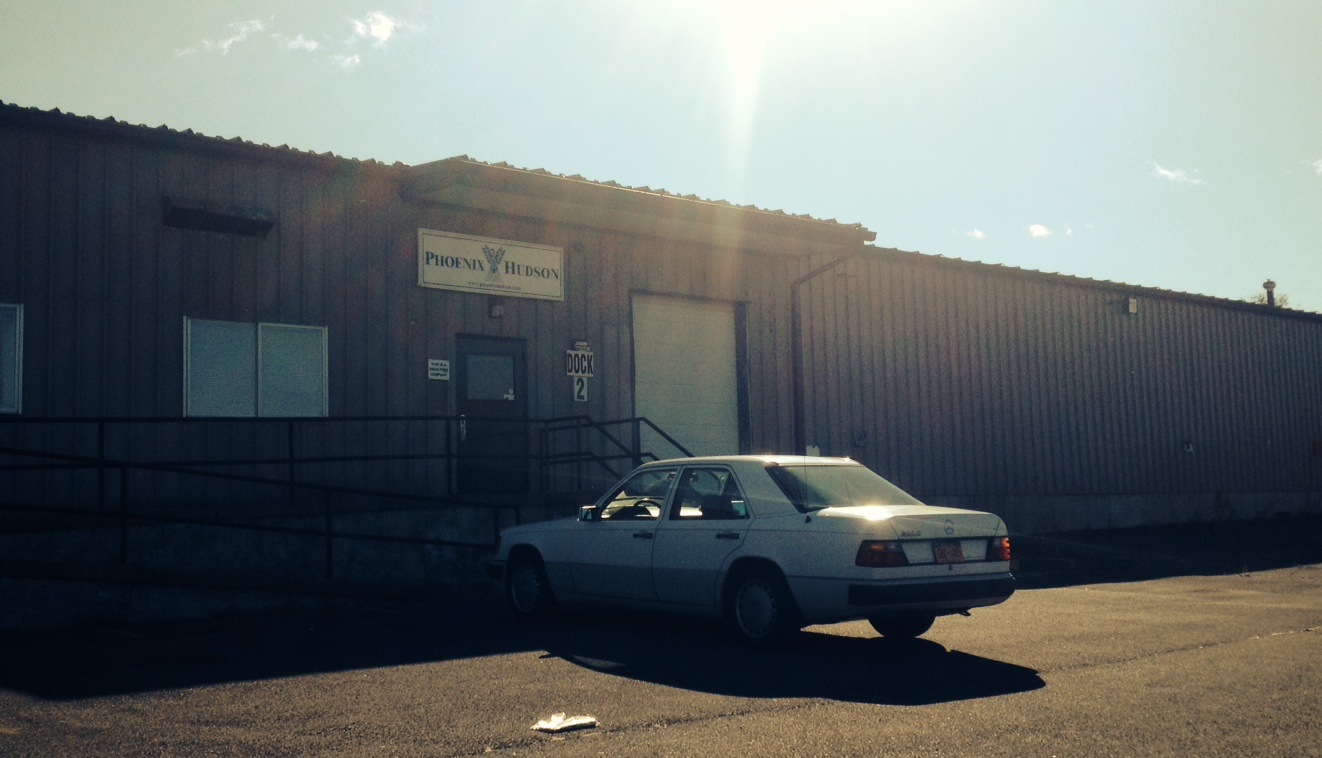
An in-person weekday visit to the company’s headquarters at the old button factory did not yield any signs of an active business employing 20-25 people. A single white Mercedes was parked out front, with plenty of weeds coming up through the concrete around the shuttered loading bays.
A lone employee emerged, identifying himself as “Dmitri.” Asked whether Phoenix was hiring, or manufacturing anything in the building, Dmitri indicated that for now the company is just selling off “existing inventory.” Would the company actually start making products locally at at some point? “Probably some time next year,” he said, though not too confidently.
With no apparent public disclosure or debate, a $2.5 million grant proposal to help convert the Columbia County Airport into “the Upper Hudson Valley Regional Airport” was made to New York State in July 2012, this site has learned.
The application for Empire State Development funding, signed under penalty of perjury by County Commissioner of Planning & Economic Development Kenneth J. Flood, suggests that the taxpayer-supported airport in Ghent could expand to soak up “more intense” traffic from other “congested” airports in the area.
County officials have been denying any intent to expand, in the face of speculation prompted by recent moves to use eminent domain to acquire more land adjoining the airport, supposedly only to satisfy safety concerns.
But their own 2012 application discloses very different long-term airport goals. Flood writes to the State:
[T]he required infrastructure needs to be extended and capacity increased for more intense airport operations and development of nearly 70 county owned acres of land for aviation and non-aviation companies.
Flood then parenthetically drops a bombshell: The reënvisioning of the County Airport as the “Upper Hudson Valley Regional Airport,” which would attract “substantial” added air traffic now handled by other area facilities:
The future development at the Columbia County Airport (proposed AKA Upper Hudson Valley Regional Airport) that will occur as a result of the improved infrastructure will allow this facilty to absorb a substantial amount of corporate and smaller freight aircraft operations that are causing congestion at other airports in the region.
The funding, Flood continues, would “substantially increase the total land area within the airport perimeter that would be shovel ready for aviation related businesses,” and
would allow for the development of approximately 70 acres of county owned land within the airport perimeter with a prioritization for the attraction of corporate aviation businesses... in order to service Richmor’s Corporate HQ, expand airport operations (construction of new hangars, new terminal, pilot lounge), develop 70 acres of county owned land for high tech aviation businesses and develop the area as a cornerstone of the southern Capital Region...
At the time the grant proposal was submitted, it was described publicly as an attempt to upgrade failing water and sewer services shared by the Commerce Park and Airport. The minutes of the County Economic Development Committee similarly described the application as just a “Water and Sewer Extension to County Airport.”
Likewise, the very end of a July 2012 article in the Register-Star said blandly that “Flood has applied for $2.5 million in funding to upgrade the sewage treatment plan[t] and connect it to the county airport as part of a $3.5 million project.”
In a strained attempt to tie this new “Regional Airport” into existing billion-dollar State investments in nanotech in Malta and the general Albany area, Flood argues:
The County as a whole, but more specifically this Commerce Center location is in a unique position to attract and capture key suppliers that would support the growing nanoscience center located less than 30 miles away in the Capital District.
That such business travelers would land an extra 30 miles south to Columbia County, rather than using the much closer, more convenient and advanced Albany, Schenectady or Saratoga Springs airports, seems specious. Those airports don’t appear to be maxed out as far as their capacity to serve demand.) The notion seems as farfetched as the County’s hopes of someday attracting a major package distribution hub for a company like DHL—an idea reported by Meadowgreens owner Carmen Nero during his speech at the Supervisors’ recent non-information session.
Flood soldiers on, promising the State “the construction of at least one 8-Bay T-Hangar and one corporate hangar in the immediate five year period,” plus “the identification of non-aviation development areas that can be used by the County to generate revenues for the Airport.”
Touting “the success” of the Commerce Park—the source of intense controversy over the seizing of farmland at its inception, and which few local residents seem to view as successful—Flood again attempts to make the case that this
the 70+ acres of land within the perimeter of the adjacent County Airport offered a unique opportunity to attract aviation related businesses that were not able to access the larger airports within the region.
Flood briefly alludes to an unnamed neighboring property owner who could benefit from the funding:
[T]he service area will be expanded to include additional adjacent county and privately owned lands that are presently zoned commercial/industrial. In fact one nearby property owner needs to connect to the existing facilities in order to progress a planned commercial/light industrial development project.
(Who that neighbor might be is unspecified. Again in the Reg-Star in 2012, Flood alluded to the possible siting of a slaughterhouse at the Commerce Park, though this hasn’t come to pass. Another theory floated by a Ghent resident is that Ginsberg’s Foods has been contemplating the construction of a vast new facility on the north side of Route 66 near Whittier, adjoining the Commerce Park and airport. Another source described the project as “the size of Shea Stadium.” Yet another source indicates that David Ginsberg headed up the search committee which originally hired Flood as economic development czar.)
In response to an application question about whether “the proposed project [will] involve participation in community based planning and collaboration?,” Flood responded:
The project involves participation from public and private entities, some of whom work directly with traditionally underserved populations.
No comment.
[NOTE: A copy of the NYS Consolidated Funding Application #17918, orginally obtained by Ghent resident Patti Matheney, can be downloaded here as a PDF.]
Around noon today, Ancram Supervisor Art Bassin sent the following letter and attached list of questions to the County’s economic development czar Kenneth Flood. Flood has been flogging a plan to use eminent domain to seize acreage abutting the County-run airport from owner Carmen Nero.
Ken,
You have stated on numerous occasions over the past few years that if we do not expand the airport safety zone, the FAA will require us to shorten the runway, which could cause Richmor to cut back staff at the airport, and hamper future growth at the airport for the larger jets that require the longer runway.
The recent FAA letter responding to your question about what will happen if we do not expand the safety zone stated we might not qualify for future grant money, but did not say they would require us to shorten the runway.
Even after getting this letter, you maintain that if we do not expand the safety zone, the FAA will require us to shorten the runway, and that they may even require us to repay all or some of the grant money we have already been awarded. You cite "the regulations" to support your contentions.
There here have been a lot of questions raised over the years about the need to expand the airport safety zone. There have been a variety of FOIL requests, and a series of questions from both Supervisors and county residents related to past, current and future levels of activity at the airport by type of aircraft. To date, the County's responses to these questions have not been clear or complete.
The general impression many people have of the airport is that it is, has been and will continue to be a small, low level of activity facility that supports small, mostly propeller driven aircraft. The few larger jets that are based at the airport appear to be anomalies.
Before the County spends any more time or money on the eminent domain process, we need unambiguous answers to the questions that have been asked multiple times, but never adequately answered.
If we find that, in fact, the FAA will require us to shorten the runway, we can evaluate the impact of that action and make a decision about whether to proceed with the safety zone eminent domain action or not, based on the possible impact to Richmor and the County of a shorter runway. It is not clear that even if the FAA does require that we shorten the runway that we can justify moving ahead with the eminent domain process or any material investments of public funds from County, State or Federal sources.
If, however, the FAA tells us we will not be required to shorten the runway if we do not expand the safety zone, there seems to be little reason to continue with the eminent domain process.
Here are the questions I think we need answers to before we decided if we need to expand the safety zone and move ahead on eminent domain. Until we get coherent answers to these questions, we should table the eminent domain discussion and stop spending any tome and money on it.
For the FAA:
If the County decides not to expand the safety zone, will they require us to shorten the runway?
If yes, by how much, and by when?
If yes, under what regulatory authority, exactly?
If this is a safety issue, why have we not been required to shorten the runway already?
For Richmor:
If the runway is shortened by FAA mandate because the safety zone is not expanded, how much revenue and how many jobs, if any, will you lose by year over the next 10 years?
If the safety zone is expanded, how much revenue and how many jobs will you be able to add by year over the next 10 years?
How much in additional facility and equipment investments will you have to make to the facilities at the airport to achieve the revenue and job growth related to expanding the safety zone?
How much annual revenue has Richmor generated, by type revenue outlined on page 5 of the lease agreement, since Richmor started leasing the airport from the county?
How many people have been employed by Richmor, by year, at the County Airport since Richmor started leasing the airport from the County?
How many total take offs and landings have there been at the airport, by year and by type of aircraft, since Richmor has been the base operator?
How many take offs and landing per year, over the next 10 years, does Richmor project if the safety zone is expanded, or if it is not expanded?
For the Economic Development Commissioner and County Financial Managers:
What has Richmor paid the County in rent, by year, since they started leasing the airport from the county?
Have we been auditing Richmor revenues annually to verify that the rent we have been paid, which is based on a percentage certain Richmor revenues outlined on page 5 of the lease agreement, is correct?
If we have been auditing Richmor revenues, how soon can you circulate these audits to members the BOS? If not, when will an audit of the Richmor lease payments since the beginning of the lease period be done and shared with the BOS?
A recent Register Star article mentioned that over $6 million of public money has been invested in the airport and in airport consulting efforts over the years...is this correct?
What was the actual total amount of specific investments made with public money from County, State and Federal sources since the inception of the airport, by project and date?
How much in additional investments using public money from County, State and Federal sources are planned for the airport if the safety zone is expanded, for what, and when?
How much in additional investments using public money from County, State and Federal sources are planned for the airport if the safety zone is not expanded?
For the County Attorney
If we proceed with the eminent domain process and secure the expanded safety zone, can we increase the annual Richmor rent to include the amortization of the additional public money (County, State and Federal) spent to achieve this safety zone expansion, or must we rely only on increased revenues from Richmor's business to raise the County's rental income?
Similarly, can the Richmor lease be modified to include the amortization of all past and/or future public monies spent on behalf improvements to the airport which benefit Richmor, or again, do we have to rely on increases in Richmor's future revenues to see higher rental payments?
For C & S Consultants about the 2011 Business Plan
How did C&S determine that the airport generated an annual economic impact of 95 jobs, $7.6 million in income and $20.4 million in total economic impact, as stated on the cover of the 2011 Airport Business Plan?
The 2011 Business Plan outlines $13 million of recommended capital improvements for the 2011 to 2015 period on page 18, while on pages 32 and 57 it recommends $8 million in capital improvements. Why the $5 million difference in capital projects?
If the Plan had been implemented as recommended, projected activity at the airport was forecast to improve between 2011 and 2015 from 27 aircraft to 38 aircraft, and operations (takeoffs and landings) to increase from 19,200 to 21,900 (page 40). Based on 2013 data and conditions, are these projections still valid looking ahead five years, or should they be modified?
Why and how is a 10% increase from 19,200 to 21,900 operations significant enough to justify an investment of between $8 million and $13 million in public funds?
Operating income was projected to increase from a loss of $30,000 in 2011 to a profit of $85,000 in 2015 (page 57). Is $85,000 in operating income the best we can expect to do for an investment of between $8 million and $13 million in public funds?
Kevin Delahanty, an executive who has made a home in Columbia County for some 35 years, recently had a wide-ranging conversation with economic development and planning czar Kenneth J. Flood. Their talk was prompted by the growing controversy over the potential use of eminent domain to acquire more land for the County airport, but ranged over a much broader terrain of topics.
Delahanty recapped their talk in a longish letter to Flood on Tuesday, reproduced in full below. (As of press time, he had not received any acknowledgment or reply.) Delahanty’s account reveals a number of statements which raise eyebrows—either due to what Flood said, or what he claimed not to know. According to the letter, the County’s top development official believes that:
“Restaurants in Hudson and Chatham ... don’t provide good jobs except for the owners”;
The local paper does “not always present issues correctly”;
Big power lines like the one proposed across Ghent and Stockport do “not have a negative impact on property values.”
Delahanty’s letter notes that Flood sounded unsure or unconcerned about the following topics related to the County-owned airport;
What the financials are for the airport and its operator;
How many flights come in and out of the airport, what kind of planes are involved, and in what manner;
Whether Meadowgreens owner Carmine Nero would litigate to contest the use of eminent domain to seize his land;
What planes and funding would be lost, if any, if the land were not seized; and
Where funding for this legal effort and purchase would come from if Nero prevails in court, obtaining a higher price.
Another surprising note from the letter: While shepherding the economic and planning efforts of of Columbia County, Flood does not actually live within the County itself.
While thanking Flood for his time, Delahanty concludes that the County development office needs to provide more public information, make more prudent use of tax dollars, consider citizen concerns seriously, and take an approach which is more “innovative, outside the box and constructive.” The full text of his letter follows.
Commissioner Kenneth Flood
Columbia County Planning/Economic Development
401 State Street
Hudson, NY 12534
August 20, 2013 By email
Ken:
I wish to thank you for taking the time out of your day to speak to me on Wednesday the 14th of August. I wish to recap our comments, especially on the Columbia County Airport and to build upon them and hope that what we all want in Columbia County can be accomplished.
As mentioned, I first bought property in Austerlitz in 1978, somewhat based upon research I did of an ancestor during the Revolutionary War and whose records indicate he was in Claverack as well as the Mohawk Valley.
This county with its natural and historical beauty and growing economic vitality is thus important to me.
We discussed a number of issues from the strength and vitality of so-called 2nd home owners who I believe are probably the biggest economic boom this county has experienced in the last 100 years, to the excess number of boards, county and town departments and the limited population and thus tax base.
We also discussed that over the last 10 to 20 years the county and towns have spent millions on the purchase of closed schools, numerous Public Works buildings, tax abatements for firms that ultimately left and some who remain, to the moving of dirt around the Industrial Park. All this money comes from a limited population that is being strained each year.
We discussed the increase of restaurants in Hudson and Chatham and you mentioned “they don't provide good jobs except for the owners.” I disagreed, as they not only provide good work for many people either as their principal or second job, but also the owners have bought and renovated buildings. These purchases continue to provide work for numerous trades, increasing the buying locally from farmers, improving the tax base and bringing customers that may stay, use the B&Bs and buy product in the retail stores. It appears you dismiss the positive impact which was also highlighted in August 14th article in the Food Section of the New York Times.
I was also dismayed that you thought our local paper did not always present issues correctly, if so, then you need to better communicate your Department’ s views and activity.
But the main point of my call was and is the ill-conceived purchase of land from a viable 9-hole golf course for the expansion of the Columbia County Airport. You mentioned that Mr. Nero had turned the offer down and that the county would only be spending $25K on legal fees. But when asked if you thought he would litigate you did not have an opinion.
I am saddened that as the Economic Development Officer of the County that you cannot offer an informed opinion to the Supervisors and the public of what possible outcomes may happen. Given Mr. Nero's stated issues and positions, I can see him winning a substantial price increase to purchase the land, as he will need to spend substantial money renovating a viable Golf Course. Where the money will come from when he wins, seemed not to be an issue with you.
We discussed the number of flights in and out of the airport and you did not seem to have that information and when pressed you said the numbers of recorded flights could be found on the Internet. When discussing what planes use the airport and how, you did not seem to have that information. You did not know of the airport in Egremont, MA, that gives flying lessons and uses Columbia as a practice “touch and go,” because the Town of Egremont does allow such use. You thought that was great as someone might buy a house in Columbia County. I hope you mentioned that in jest.
I was also surprised that you did not know the financials of the airport and its operator. If we are not the stewards of responsible economic development and spending, who is? Before we effectively give money to a business we should know the financials. No bank would give money without a full accounting of the Income, Balance Sheet and Cash Flow of the business that was going to most benefit from a loan or grant.
You indicated that Richmor may leave and the possible loss of 35 jobs because it might not be profitable for them to remain if the airport was not expanded. You mentioned Richmor recently bought a jet and is keeping it in the Schenectady area. But you could not tell me the type, what it may have cost and why it is in Schenectady, but you think keeping it there is a reason to spend a million plus dollars because Richmor may leave. Let me indicate to you, that a business would not remain in Columbia County if it was not making money. In fact you have mentioned it brings $20M of economic vitality to the county, so I assume they make money as it is.
You mentioned that the added land was needed for safety, but it is currently operating safely and you could not explain which planes and money would be lost to the County if the airport was not expanded. You mentioned one reason for the land was to keep deer out of the facility, I may suggest Richmor close the 9H entrance for example.
We also discussed why the County did not assess each landing some dollar amount; you thought it was an interesting point. At least the County could see a tangible benefit.
I can go on and on in reference to our call, but my perception is a perceived lack of knowledge that your office seems to have of the impact of the expansion of the Airport. I hope my perception is incorrect.
But we also discussed the subject of the possible NYSEG power lines will have on Ghent. I was interested in the fact that you stated you live near power lines, although not in the County and we all need power, implying it will not have a negative impact on property values, etc. But in fact, as you mentioned, you bought your home after the lines were installed, thus not negatively impacting the value of your home. You also mentioned that internet lines are visible – I hope again that is in jest, as cable lines do not run on high tension lines.
We need to have thinking that is innovative, outside the box and constructive. I don’t get the sense that is the vision of the Economic Development office.
I request you and your office provide information publicly of all the questions that have been asked on the Airport issues and on other ongoing business so the public can be informed. I suggest that the Development office more actively continue to help other smaller businesses and push the providers of the Internet to expand access throughout the county. The money whether from the Federal Government or taxpayers of Columbia County needs to be used prudently.
We are here for future generations and not to bankrupt current taxpayers with added burdens. I trust you will further consider the negative impact this land purchase will have both locally and regionally.
From your office’s web site: “Since 1967 Richmor Aviation, Inc. has operated out of the Columbia County Airport. Business in the country has been good for us. Low overhead compared to our competitors in New York City. Great resource for our work force. Excellent place to reside and raise a family.”
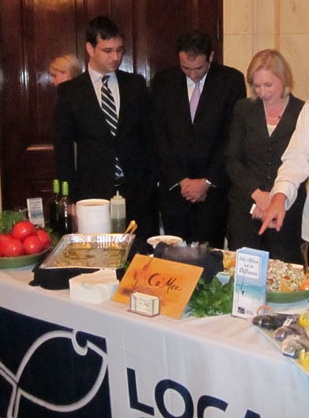
Sen. Chuck Schumer climbs aboard the good ship Local Ocean in ’09
Back in March, this site wrote about how Payment In Lieu Of Tax (PILOT) plans, grants, and the business awards in Columbia County often to newly-arrived and unproven businesses like Local Ocean:
Winner of the 2010 Crystal Apple Award from the Columbia County Chamber of Commerce just months after opening, Local Ocean recently lost its sweet PILOT deal with Columbia County.
Welcomed with great fanfare and largesse by local development agencies, and much-celebrated in the regional press, Local Ocean has been bedeviled by two patent lawsuits—and laggard in making payments to the County.
Local Ocean’s meteoric rise and fall from official favor is not a unique path. The tight-knit and often insular County development elite has a history of patting itself on the back, awarding its own most favored projects before they even get off the ground.
Senator Kirsten Gillibrand gets into Local Ocean’s fishy act as well
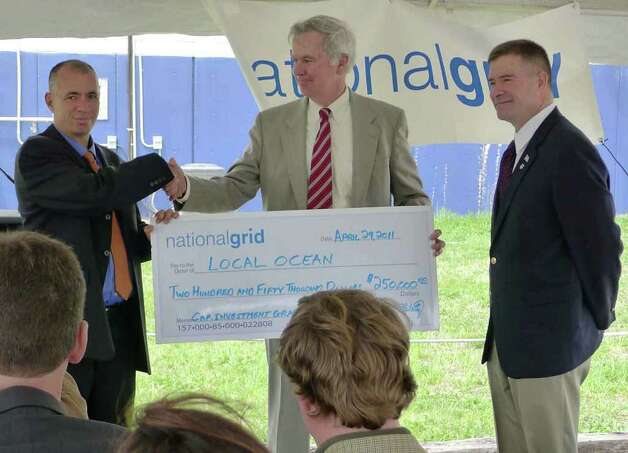
Local Ocean also benefited from a $250,000 incentive from National Grid, with Congressman Chris Gibson (R-Kinderhook) handing over the oversized check.
Now at last comes official word of the long-rumored news that Local Ocean is kaput. Their Greenport facility is closed, their workforce laid off, and the property scheduled for a public foreclosure auction.
Local Ocean joins a long list of failed enterprises or no-shows ushered in by the various City and County development authorities. (In the 1990s, the most egregious examples were Cycletech and Wittcomm.) The history here is that those most eagerly welcomed in by such agencies and their affiliated booster organizations are often the first to fail.
But old habits die hard. This June, a number of better-established businesses such as Basilica Hudson were passed over at another Chamber award ceremony—in favor of the latest new kid on the block, Phoenix Hudson Manufacturing. Like Local Ocean in 2009, Phoenix is the 2012-13 darling of the County development establishment. One can only hope that it will fare better than Local Ocean.
Local Ocean accepts a $250,000 check from National Grid in 2011, as Congressman Chris Gibson looks on. PHOTO: Michael Farrell for The Albany Times-Union
Winner of the 2010 Crystal Apple Award from the Columbia County Chamber of Commerce just months after opening, Local Ocean recently lost its sweet PILOT (Payment In Lieu of Tax) deal with Columbia County.
Welcomed with great fanfare and largesse by local development agencies, and much-celebrated in the regional press, Local Ocean has been bedeviled by two patent lawsuits—and laggard in making payments to the County.
Local Ocean’s meteoric rise and fall from official favor is not a unique path. The tight-knit and often insular County development elite has a history of patting itself on the back, awarding its own most favored projects before they even get off the ground.
Beaten out by Local Ocean, another 2010 Crystal Apple nominee was the rebranded and renovated Historic Blue Stores Restaurant and Bar—reopened under new management just prior to their nomination, then went under again. (Today, it is back open under yet another set of managers, Darren and Tara Buffa, and appears likely to survive.) Passed over that year were the Columbia-Greene Dialysis Center, Catamount Adventure Park, Taconic Farms, and the BeLo3rd business coalition.
A longer look at the Crystal Apple award-winners over its history is instructive.
Among all award winners listed on the Chamber’s site from 1992-2013, more than one in five (20.5%) are out of business or have retrenched locally. For example, Kaz, Inc. won the award in 2002 and shared the award with Stageworks again in 2005. Dunn Builders, the Crystal Apple winner in 2004, closed its downtown Hudson location after a rash of employee thefts, then had its huge Greenport operation swallowed up by Herrington’s. The Old Chatham Sheepherding Inn (1996) closed, though farm operations continue.
A little less than another one in five (18%) have become mired in controversy, fallen out of favor with officialdom, or just fallen into disrepair—such as the once-vibrant St. Charles Hotel, which won the 1997 Crystal Apple but after several management changes no longer features a public restaurant or bar. Its private meeting room and large public event space, once highly-popular gathering spots, today are seldom used.
That renders nearly 40% of the 1992-2013 award winners either defunct, disappeared, or discredited.
This year’s award-winner, the Columbia Land Conservancy, tarnished its image last year by its coy, behind-the-scenes enabling of the City of Hudson’s heavyhanded seizure of the century-old Furgary Boat Club—using a black-suited SWAT team toting machine guns to subdue three older, sleeping men in their ancestral cabins.
Meanwhile, roughly two-in-five awards (38%) have been given to large, established companies and businesses which are closely embedded in the County development establishment, such as Herrington’s, Kaz or Columbia Memorial Hospital. The Chamber’s Board includes Paul Colarusso, whose company A. Colarusso & Sons was the 2009 winner. Other awardees have had seats or representatives over the years on many of the same boards (HDC, CEDC, local and County IDAs, the Chamber itself) which arrange corporate tax breaks, grants and other incentives. Such coziness—bordering on conflict-of-interest—makes the awarding of the Crystal Apple that much less prestigious.
Most laughable and conflicted of all, though, is the original Crystal Apple, awarded to The Columbia County Board of Supervisors for its “development” of Commerce Park. Considered a boondoggle from its very inception, Commerce Park took years to find tenants, and two decades later still is sparsely populated. With the Chamber of that era almost entirely controlled by political interests, today’s equivalent of the ’92 Crystal Apple Award would be like this site awarding itself a blue ribbon for Best Columbia County news source.
Smaller local businesses—such as the Kline’s multigenerational, family-owned Traditions, or the longest-running merchant on Warren Street, Arenskjold Antiques, here since the 1980s, or the rock-solid folks at Jimmy’s Auto Body in Livingston—rarely seem get invited to the Crystal ball.
This is not to say that the Award committee never finds its mark. 2003 winner FACE Stockholm continues to manufacture and maintain a storefront locally, even as it continues to thrive and expand internationally. Camphill Ghent, the 2012 winner, does spectacular work with its residents. The likeable director David Colby, who was brought over from the Berkshires several years ago, has cleared out cobwebs and freshened up the fusty, good-old-boy atmosphere which once pervaded the Chamber’s offices.
But these are the exceptions that prove the rule. Perhaps the trophy should be recast as a giant wooden acorn, and renamed The Blind Squirrel Award.
It hasn’t been reported in the local press yet, but on Wednesday the Greenport Town Board unanimously passed a resolution expressing its opposition to the payment-in-lieu-of-tax plan for Premier Brands.
The PILOT proposal under consideration by the Columbia County Industrial Development Agency would allow Premier to avoid paying its full share of taxes over the next 10 years. The Westchester-based company intends to site a warehousing operation in the now empty Wal-Mart space on Fairview Avenue, in the Price Chopper plaza.
Notably, the attorney representing Premier is Bill Better, the former Columbia County attorney who stepped down after three female County employees filed sexual harassment and discrimination lawsuits against him in 1997. One of those suits alleged that that “Better forced her to contribute to the local GOP, and was sexually harassed and stalked by him,” and was settled for $120,000. Another similar suit was reportedly settled for $210,000. Better denied the charges, with his attorney characterizing the suits in the Times-Union as “a stick-up.”
Better is also currently representing PCB processors TCI of NY before the Ghent Planning Board, and was retained last year by the Stuyvesant Town Board at a $250-per-hour rate to address lawsuits related to Will Pflaum’s dog boarding business.
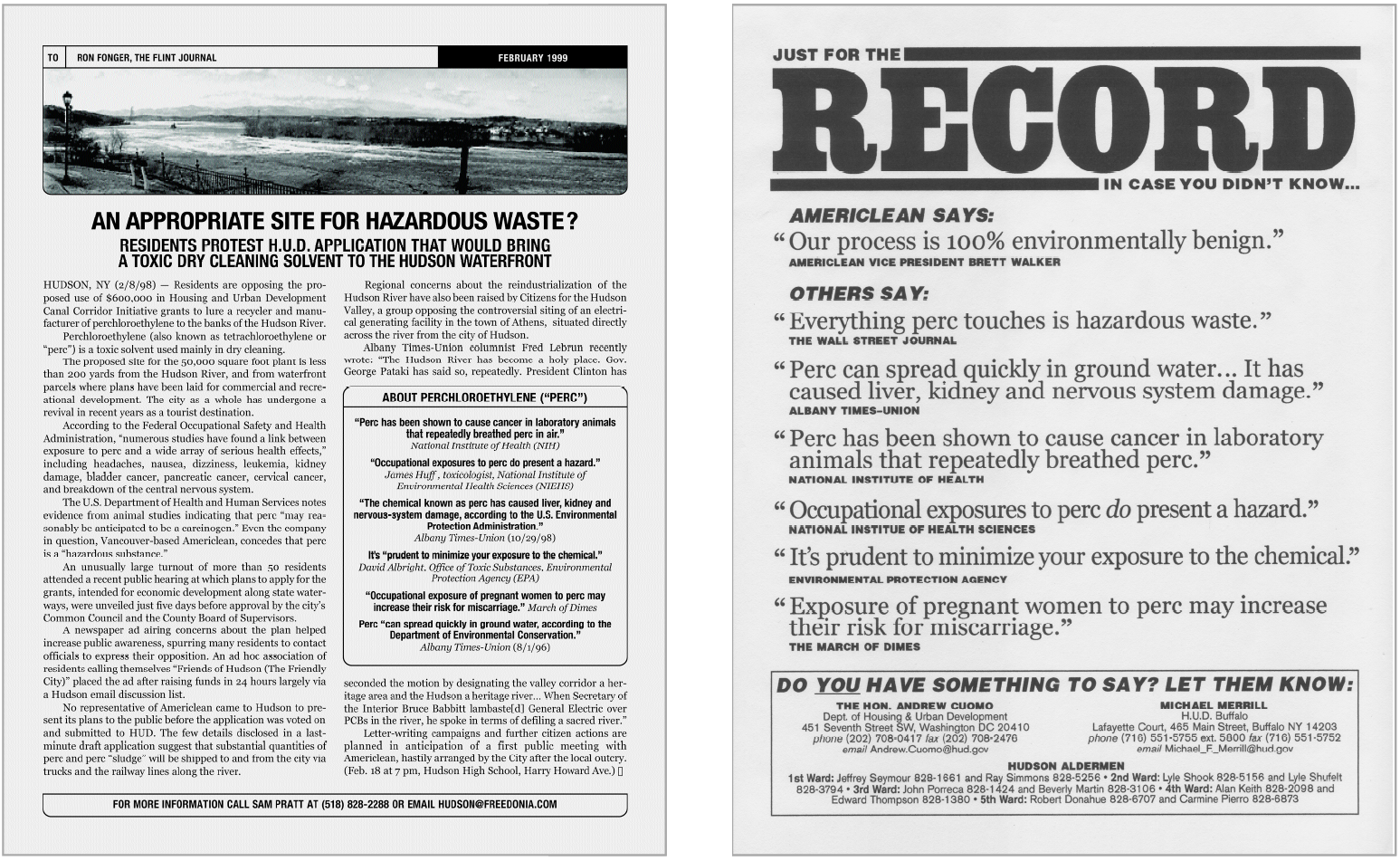
NOTE: This summary of the Americlean controversy was written about ten years ago as background for a (successful) nonprofit grant application. Citizens who were involved in the fight to stop Hudson’s old glue factory—what is now the Basilica—included Philip Alvaré, Jennifer and Kim Arenskjold, Carole Clark, Jack Harrell, Peter Jung, Peter Meyer, Sara Sterling, myself and many others, including some no longer in Hudson (such as Byrne Fone and Edward Gomez).
During a four-month controversy in 1999, local residents discovered the importance of face-to-face grassroots organizing, diligent research, media exposure, sustained public pressure, and savvy use of the internet for making change at the regional level.
As a result, a unique relic of the Valley’s industrial architecture was spared from becoming a sketchy toxic waste center, and instead preserved to become Basilica Hudson—arguably the most dynamic art and performance center in this stretch of the Hudson River.
Below is a detailed review of those four hectic months, explaining how citizens prevailed against long odds to protect their quality of life and preserve a prime opportunity for more positive development.
In the waning days of 1998, some residents of the City of Hudson, New York, spotted an obscure legal notice in our local paper.
The bland notice indicated that Hudson and Columbia County intended to apply jointly for $600,000 in grant funding from the Department of Housing and Urban Development (HUD) Canal Corridor program to attract “a business”—the name was unspecified—to the City’s waterfront. I said there would be an informational meeting about the application in early January.
As is all too typical of such meetings, this one was scheduled inconveniently on a weekday, during work hours, a time calculated to draw as few audience members as possible. But much to officials’ surprise and dismay, several residents did attend.
After a lot of hemming and hawing, the County development agency was finally convinced that residents deserved to know the name of this mysterious “business” which would benefit from a $600,000 in Federal largesse.
“I think it’s called ‘Americlean,’” he said. About the nature of Americlean’s business, he was similarly vague: “Something to do with supplies for the dry cleaning industry—wire hangers, polybags, that kind of thing.” After further grilling, citizens determined that the proposed site would be an imposing brick building, a former glue factory, adjoining the wetlands of South Bay and a stone’s throw from the Hudson River.
Alarmed by the obvious evasiveness, citizens went home to look up Americlean on the web—a relatively novel task for many in the late ’90s.
It was soon learned that the main business of Americlean (a Canadian company, despite its name) actually involved shipping and “processing” huge quantities of a hazardous waste generated by the dry cleaning industry: a chemical called perchloroethylene.
Thanks to a relatively new search tool called Google, residents then figured out that “perc” is one of the more carcinogenic substances known to man. Once considered a miracle substance, many places such as New York City had begun to ban perc’s use altogether as a health risk to dry cleaning workers and their neighbors.
Americlean’s website claimed to have a miraculous, patent-pending process which would allow the company to recycle perc safely, then resell it to the drying cleaning industry with relatively little leftover waste product. The company claimed to have a pilot plant in Canada that had successfully tested this process.
When we brought this new information to the attention of our local Common Council, its members professed to be both unaware and unconcerned by Americlean’s real intentions. So what if they were hauling and processing hazardous waste, instead of making coat hangers—they were eager to believe the company’s claims of creating 100 well-paid jobs for local workers. Besides, the deadline for applying for the grant was rapidly approaching, and if Hudson didn’t submit something, the funding would be lost. So the Council hurriedly voted in favor of applying to HUD.
In other words: City and County leaders actually wanted the Feds to pay a little-known and even less-tested Canadian company $600,000 to to truck hazardous waste through local neighborhoods, down to the Hudson River, when an unspecified process would be used to neutralize it.
“You people have no idea how much toxic waste already goes through Hudson,” lectured then-Mayor Rick Scalera, as if this would reassure his listeners.
Those who questioned the wisdom of the Americlean plan were subjected to all manner of personal attacks from public officials, from public meetings to the pages of the local newspaper. One woman took the initiative to call Americlean’s president directly, hoping to learn more about his plans—then found herself falsely accused of “impersonating a Common Council member” as elected officials rushed to discredit her unflattering account of the conversation.
In an apparent reference to the sexual preferences of a few of those speaking out against the project, 5th Ward Alderman Bob “Doc” Donahue read a prepared speech in which he insinuated that “these people speaking out don’t have children, they only have pets.”
Weeks of verbal sparring in newspaper articles, public meetings and letters to the editor ensued. It became obvious that the politicians wanted to make this an us vs. them issue, and the local paper was all too happy to help pit neighbor against neighbor.
A major turning point came when challengers of the hazardous waste plant shamed the Mayor into holding a public hearing in which the company would present its plans, and residents would have a chance to question Americlean in person. Up to that point, none of the company’s executives had ever appeared publicly in town.
In preparation for the big hearing, challengers raised $800 to take out a half-page ad in our local newspaper to increase awareness of the event. Even this caused a new controversy, as The Register-Star’s publisher decided to preview the citizens’ planned back-page ad for Americlean in advance of its publication. The paper also ran a front page story the same day featuring the company’s one-sided rebuttal, in an apparent attempt to blunt the ad’s impact.
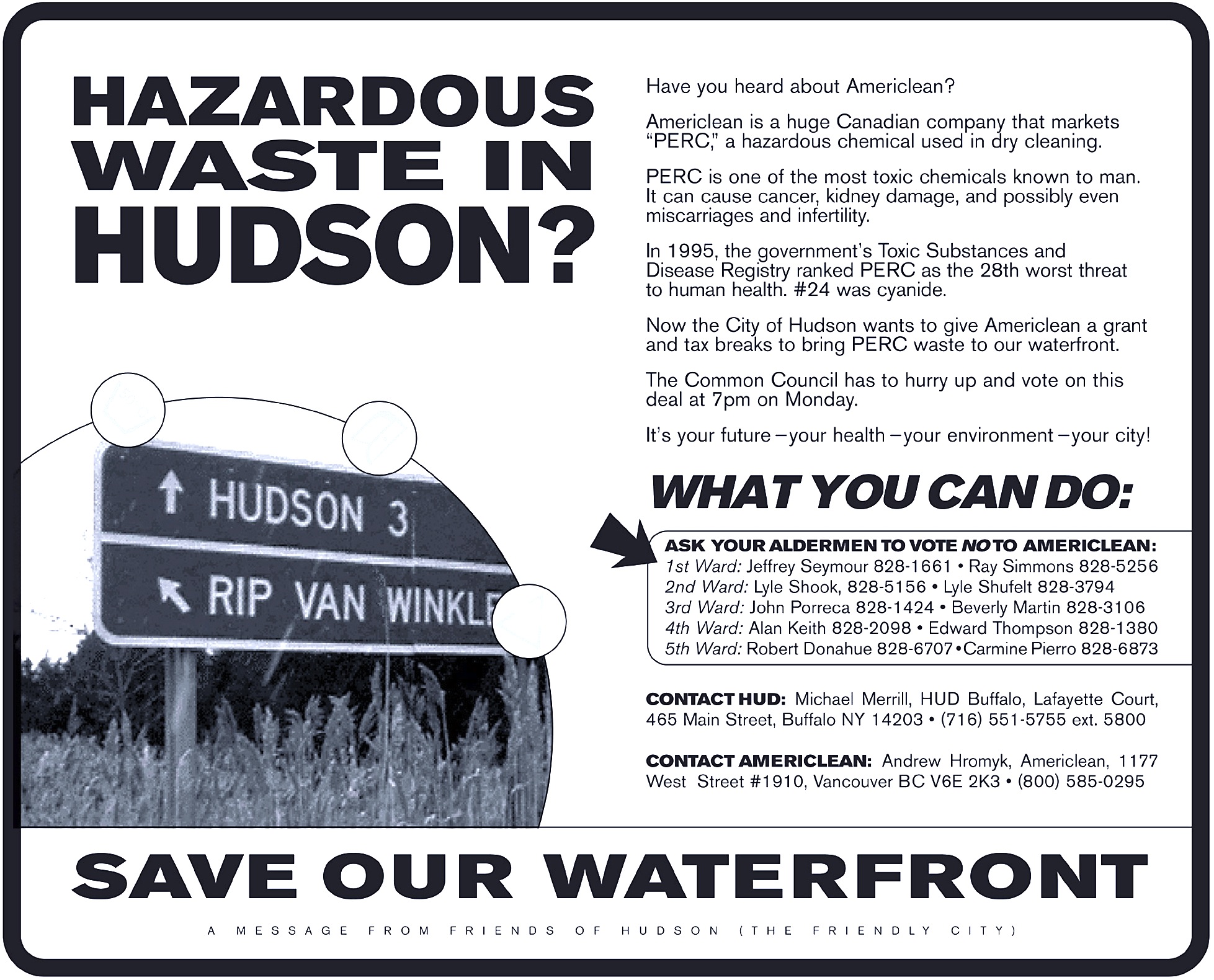
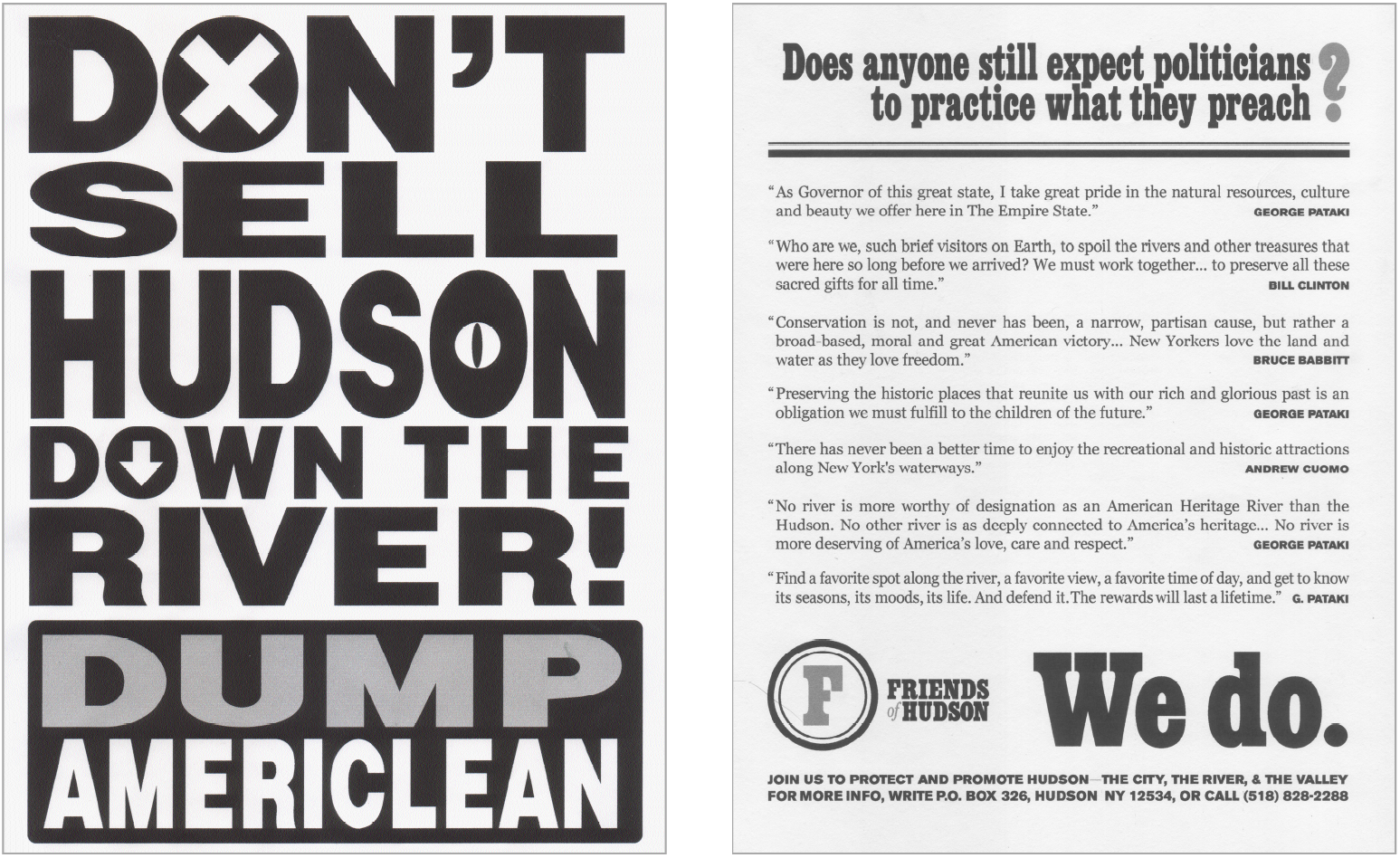
Undeterred, residents followed up with a one-page insert in the paper (see For the Record, below). This contrasted Americlean’s own claims with contradictory evidence to the contrary found in mainstream publications and scientific research reports.
More crucially, citizens made three key decisions:
(1) Going door-to-door in their neighborhoods with flyers about the hazardous waste proposal;
(2) Garnering coverage by the area’s local television stations, bringing a broad range of residents together to be interviewed; and
(3) Meeting privately to review research and stategy, drawing up a list of questions to be raised, and parcelled out among those who would attend.
Previous to these three actions, there was a surprisingly low awareness of the controversy, despite its being the subject of numerous newspaper articles. Going door to door, citizen activists discovered that even most residents living within 300 yards of the proposed toxic waste plant had never heard about it. Exposure on area television also greatly increased awareness among those who hadn’t been attending meetings or following the bitter debate in the papers.
Detailed research about the company, its plans, its technological claims, and track record were boiled down to a list of important questions and revelations to be delivered at the hearing. The process of sharing information about the company, its technology, and the associated health concern was greatly expedited by the (then-novel) internet. Corporate, scientific and regulatory information once hidden in obscure libraries and agency files was readily available to anyone with a computer. A net-savvy new resident set up Hudson’s first “list-serv,” an automated email discussion list. This allowed conversations and debates which might have taken weeks to arrange were condensed into a matter of hours.
Operating as a combination early warning system, round-the-clock roundtable and independent research institute, this email list helped residents to discuss new developments, share research, refine strategy, and mobilize members on a moment’s notice for a public meeting or media opportunity.
Hoping to create an impression of public apathy about the proposal, the powers that be chose a huge auditorium for the hearing, located as far as possible from the proposed toxic waste site without quite leaving town... Officials expected that many would not bother to make the trip, and even if they did the room would look empty.
But much to the Mayor’s obvious annoyance, citizen grassroots organizing resulted in a full hall, packed by a diverse array of local residents from many different walks of life. The company’s representative, Brett Walker, came across as smug, overdressed, overcoiffed and stunningly unprepared for question after painstakingly-researched question. In many ways the audience seemed to know more about perc processing than Walker.
One resident brought along a chemist and safety consultant for labor unions to testify—to devastating effect, as Americlean’s glib spokesman could not answer her direct, technical questions. Walker professed not even to be able to remember where his company’s much-touted “pilot plant” was located, furthering the growing impression that the project was a sham. Many started to believe that Americlean’s real agenda was to take the $600,000 grant, and get paid to accept waste that would wind up in Hudson’s wetlands, or river, or get incinerated in the St. Lawrence Cement proposal, which had just been announced just up the hill in Greenport.
Especially effective were the parents, health care professionals, and lifelong residents who had been reached through our door-to-door outreach. Many spoke out forcefully against the project—debunking the official spin that only “outsiders” were opposed to it. A statement by City of Hudson consultant Bill Loewenstein that the Hudson waterfront was always an industrial wasteland was met with hoots and groans.
By the end of the hearing, even those who had gone in supporting the project left with about the hazardous waste plant. “I was trying to help you out here,” said one exasperated company supporter, who Walker did not recognize as an ally and treated shabbily. The lone exception may have been Mayor Scalera, who complained at the meeting’s conclusion that he had “never been so embarrassed by the behavior” of Hudson residents—who had just saved him from making a catastrophic blunder in welcoming what had just been exposed as a sloppy, fly-by-night development partner.
Over the coming weeks, citizens kept up a drumbeat of letters to the editor, television appearances, and pressure at Council meetings. Finally in mid-April, the headline broke in our local paper: The City had delivered the bad news to the company that the Hudson did not want them to truck any hazardous waste into the City, and would only welcome them if they limited their activity to the original hangers-and-polybags line. Americlean withdrew its proposal in short order, and was never heard from again in Hudson.
Soon enough, the former glue factory found a healthier, more forward-looking purpose, when a developer and restoration expert from Florida purchased it to found an arts center. While that developer ran into obstacles from embittered City leaders (who denied him access to water and sewer services), a second set of developers bought the building and managed to overcome those political obstacles.
Today, the factory complex has been impressively renovated, operating as Basilica Hudson. It features a year-round schedule of exhibitions, performances and festivals, as well as hosting weddings and charity galas. Rather than a dumping ground for toxic waste, “The Basilica” serves as a venue for both local projects and businesses, and internationally-acclaimed artists and groups.
Back in the mid-1990s, Hudson citizens blew the whistle on the City of Hudson’s Federal grant programs. A lesson from that incident speaks to certain claims about Eric Galloway’s Lantern Group by the director of his new Galvan Initiatives Foundation.
David Kermani (who then operated a high-end Warren Street rug shop) and other compatriots alleged that the City had made an improper side deal with L&B Contract Industries, later known as LB Furniture. Prompted by citizen complaints, HUD’s inspector general indeed found major “irregularities” in the City’s handling of a $556,000 grant to L&B, plus a host of problems within Hudson’s development agencies. [PDF of the report] Those irregularities included not just the company’s failure to make interest payments, but also the connivance of Hudson Development Corporation (HDC) staff in allowing L&B to make just one repayment of $4,998.25. Nice deal, if you can get it: $551,000 in free government money.
In addition, HUD discoverd that HDC had “subordinated” the grant lien to obtain a further $3,000,000 bank loan. All the while, the report said, local leadership never alerted HUD that it was making any of these arrangements. HUD’s Inspector General was not pleased, and reprimanded both L&B and the City. Moreover, HUD identified apparent “conflicts of interest” and “procurement weaknesses” at HDC and the Hudson Community Development and Planning Agency (HCDPA). For example, the wife of a Board member was getting paid up to $170 per hour “without competition.” Meanwhile, the agency’s “Rehabilitation Specialist” awarded over $27,000 in work “to a company owned by his brother,” again without giving anyone else a chance to compete for the contract.
The Inspector General’s scathing report was issued to 13 Federal, State and local officials.
And then: HUD continued to award the City of Hudson more development grants from these same pool of funds. And City agencies continued to help the perpetually-failing L&B. Despite years of public largesse, the company finally closed up shop a few years ago, throwing some 150 people out of work.
Through it all, the City was given more grant money to play with; and still it continued to botch projects... For example, issuing $1.8 million in bonds to lure a mysterious Californian corporation called Wittcomm, which disappeared and according to inside sources never repaid its obligations. That’s just to name one among many of the chronic failures of these agencies to manage public funding to achieve real economic development, or alleviate poverty.
In short: HUD knew and acknowledged that the City of Hudson had a lousy track record of managing grants—and yet kept coughing up more grants, often in the face of public concern and opposition.
So, how does all of this relate to the latest controversy instigated by Eric Galloway’s local activities? In response to the detailed exposure of numerous complaints and violations on record for Galloway’s Lantern Group in New York City, Galvan director Tom Swope offered the following dodge:
“That the Lantern Group continues to get funding for their projects should be a testament to the high quality of their management.”
Based on the above examples of HUD and the City, can anyone say that continued funding is a testament to anything except bureaucratic ineptitude? We’ve just seen how the City had made an illegal side deal with a grantee, and its development agencies were found to be rife with problems. And yet HUD continued to give the City grant money to play with, and failed in many cases to monitor its use, in spite of past debacles. Continued funding is no proof of even mediocre performance, let alone success.
Yet based on Swope’s fallacious logic, one would also have to conclude that:
Sustained City support of (the now-bankrupt) L&B was a rousing success;
The ever-increasing budgets of FEMA and the Army Corps reflect the heck of a job they did in dealing with Hurricane Katrina in New Orleans;
The Kardashian sisters’ continued popularity is reflective of their immense talents; and
George W. Bush’s re-election in 2004 served as a clear testament that he was a terrific President.
In making such flimsy arguments, Swope is asking people to believe that bureaucrats are stewards of excellence, and never act to protect their own buddies (or rumps). Someone please furnish Galvan’s director with a copy of The Peter Principle, posthaste.
Today’s the last day of Rick Scalera’s most recent two-year term as Mayor of Hudson. (I won't say his last day ever, because he could always run again if he doesn’t get the leadership positions he covets on the Board of Supervisors.)
Since 1993, Scalera has been ruling City Hall with an iron fist for all but two terms: 2001-2002, when he chickened out of running and put up Cappy Pierro in in place; and 2006-2007, when he again was afraid of losing and backed Danny Grandinetti. Both of his surrogates lost, mainly due to situation’s Rick created but ran away from, so that he could run two years later against his successor’s mistakes, and claim to have been “undefeated.”
Alderman Doc Donahue recently pronounced the signing of an agreement with Colarusso to mine around Hudson’s backup water supply as the Mayor’s “legacy.” It’s tempting to agree, because that document sums up a lot of what has been so wrong with his tenure as Mayor. Scalera’s tenure as Mayor is indeed well-encapsulated a sweetheart deal with a former campaign contributor, feebly negotiated with financial terms highly unfavorable to the taxpayers (what's $100,000 per year going to be worth in 20 years, with no increase in payments to account for inflation?). It represents Rick fumbling away one of the City’s most important assets. The next time there’s a drought, or your tax bill goes up, do remember Donahue’s pronouncement.
But Scalera’s actual legacy is bigger than deals like the one with Colarusso. His true legacy to Hudson is that of job-killer.
During Rick’s tenure, at least 1,000 local jobs were lost. One need look no further than an op-ed Scalera co-wrote with his then-consultant, Bill Lowenstein in 1998, to find the evidence. Stung at the time by criticism of the City’s mishandling of HUD grants, Scalera touted all the good that Federal and State grants had done for Hudson, by proclaiming a list of jobs these programs had created locally. His list of valued local businesses aided by grants included:
Emsig
Foster’s Refrigeration
L&B Furniture
Kaz, Inc.
McGuire’s
Schroeder’s Chevrolet
Today, with Scalera leaving office, all of these businesses (and more) are gone. Several of them continued to receive fresh infusions of public cash long after it was clear they could not survive even with assistance.
Others, such as Wittcomm —which Scalera announced in 1998 he was giving a big loan to bring 100 jobs to the City—never even opened their doors. The money went out the door, but the jobs never came in. (Later, the City forgave much of this debt in a complicated land swap among its own agencies.)
While these 1,000-plus jobs disappeared, others outside City Hall independently, without Scalera's aid, and often with his overt hostility, slowly built a new economy based on small, locally-owned businesses. Individual entrepreneurs steadily created 1-50 jobs each—bit-by-bit, and building-by-building.
As this rejuvenation of a once-abandoned river city gained critical mass about a decade ago, it started to attract still others to invest in crumbling real estate, restore boarded-up storefronts and homes, jumpstart main street activity, support the City’s flagging tax base, and giving people something to do both before and after 5 pm. Yet these same merchants and property owners were the frequent target of Scalera’s scorn and ire, and were thanked for their faith in Hudson by getting to the max with increased property taxes. Shunning those creating actual jobs with limited capital and sweat equity, Rick spent much of his time cheerleading for destructive, incompatible, foreign corporations such as Americlean and St. Lawrence Cement—neither of which offered any paid work except to those willing to help promote phony promises, imaginary pollution control technologies, and cooked job numbers.
Had Scalera been at all thoughtful about the changes our post-industrial society was undergoing, been attentive the many voices suggesting a different path to a new economy, considered open government and sound planning something other than a nuisance for his closed-door deals, and embraced the changes occurring around him, he might have had the best of both worlds: A lot less day-to-day on the job stress, and a lot more cooperation. The benefits of those changes might have been seen a lot more quickly, and been spread around more broadly. Hudson still has a long way to go, and that’s in part because Scalera has been fighting positive development and putting the brakes on progress for so long.
Instead he fought the changes, and closed his mind to new energy possibilities. Thus his legacy: Rick Scalera, Job Killer.