Imagine if Mitt Romney were interviewed on FOX News about his Presidential aspirations by a co-chair of the Republican National Committee. Democrats would howl that this represented blatantly biased and unethical journalism.
How can the same party which is promoting a candidate present an objective news interview of their own candidate?, Democrats would rightly ask.
Yet the progressive, Hudson-based WGXC regularly engages in a similar practice. Its nonprofit airwaves are used at times for partisan interviews of political candidates and officials with whom a host is closely alllied, and in some cases has endorsed and even is actively campaigning.
For example, County Democratic Committee vice-chair Victor Mendolia recently interviewed one of his own party’s candidates for the 107th Assembly, attorney Cheryl Roberts, on the station’s @Issue show.* (When recently asked a direct question about his then hush-hush endorsement of Roberts, Mendolia turned tail and fled in silence.)
By interviewing his own committee’s choice for Statewide office, the host not only provided his own candidate with free publicity; he also did so in a forum where that candidate could feel shielded from any serious challenge over her controversial local activities. Like Romney being interviewed by FOX, the candidate could rest assured that the interviewer would be friendly, bordering on fawning. That Roberts’ portion of the interview was barely audible did not make this episode any less contrary to basic journalism ethics.
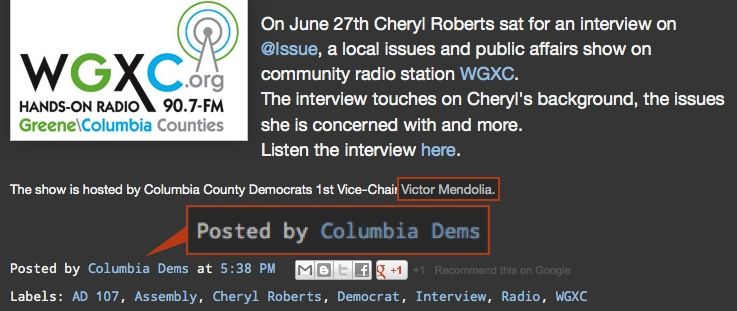
Annotated screenshot from Cheryl Roberts’s campaign website
Predictably enough, a link to Mendolia’s softball interview was swiftly posted on Roberts’ campaign website. The post was made by an anonymous webmaster called “Columbia Dems.” Now, it’s well-known that Mendolia handles most or even all of the Columbia County Democrats’ (rather drab) web presence. In any case, he’s the only person listed in that user’s’ “circles” at
Columbia Dems Google profile. Indeed, all of the posts on Roberts’ website to date have been made by the user Columbia Dems.
Professional electronic journalists should present the news with integrity and decency, avoiding real or perceived conflicts of interest...
Roberts faces a primary challenge from Keith Hammond, a former Rensselaer County legislator and town councilman, in September. Given that the bulk of the new district is in Rensselaer County or even farther north, and includes only a handful of Columbia County towns, many expect that this will be a tough contest for Roberts. The winner of the primary will in turn face one of at least two Republicans also vying for the seat.
A search of the station’s website turns up no mentions of the other three candidates besides Roberts. Of the four potential candidates for this office, WGXC thus far appears to have given only one the opportunity to be heard—the preferred candidate of the host of @Issue.
The station’s stock reply to such observations made privately by several people has been, “Well, hy don’t you do a show then?” But community radio should not have to mean that every single one of the area’s countless interests group needs to have its own separate public affairs program in order to be heard. Many groups and constituencies only have newsworthy content a few times a year. The whole point of public affairs programming is to gather that content from diverse sources, and present timely issues as they crop up, in a reasonably objective forum.
The normal and proper manner of handling such political interviews would be to assign them to a netural host who has no obvious potential conflicts, real or perceived. That independent interviewer would also quiz the other candidates as well. Among the questions that the RTDNA suggests that radio and other electronic media should ask themselves about conflicts of interest are:
- Will the private actions of a journalist with a news source or newsmaker give the appearance of an unprofessional connection?
- Does the subject matter of a story benefit the reporter, the manager, or the station? [...] If so, is there another source or approach for the story that would eliminate that potential conflict of interest?
- Does the station have a policy on if and how employees can participate in political campaigns? [...] Public participation in political events, campaign contributions, or personal messages of support on private time have no place in the life of most journalists. Stations should develop a very specific list of what political activity is never acceptable for their journalists and other employees.
- Is there a system in place to allow journalists and managers to recuse themselves from editorial decisions about stories from which a conflict of interest—real or perceived—may arise. [...] Managers should take time to consider inevitable conflicts that may arise and discuss how to deal with them before the conflict occurs.
Now, perhaps what WGXC attempts to offer isn’t journalism at all. But in the absence of such guidelines, the station would appear to be offering certain candidates friendly to one or more of its hosts free advertorials—which might even constitute campaign donations of in-kind services.
Naturally, hosts like Mendolia are free to speak their own partisan opinions. But generally such figures are media guests, not gatekeepers. Passing such opinions off as “news” or “public affairs” or “just discussion,” without full disclosure of an clear bias or at least providing balancing viewpoints, is best left to disreputable outlets like FOX.
Meanwhile, Mendolia’s cohort and CCDC chair Cyndy Hally has cynically whitewashed what she has called Roberts’ “environmental sensitivity.” Hall somehow imagines that thousands of residents will forget how Roberts repeatedly brushed aside their environmental, quality of life and economic concerns about the fate of Hudson’s South Bay.
As legal advisor to the Hudson waterfront plan (LWRP), Roberts used her position to gloss over the details of written comments from citizens, obtusely misinterpret substantive issues, and offer glib rejections of both well-researched and heartfelt concerns. Instead of being “sensitive” to local concerns, Roberts on the contrary employed slipshod reasoning, incomplete research, and pretzel legal logic to incorporate virtually all the demands of the Swiss-owned mining/cement company Holcim, and its subcontractor O&G, based in Connecticut.
Hall is well-familiar with this recent history, thus making her claim of “environmental sensitivity” all the more cynical.
* ENDNOTE: Such conflict-of-interest problems have been raised by this site in the past year with two of the station’s key personnel, both on the station and in relation to @Issue, where Mendolia also frequently interviews other candidates and allied officials on the show. When the show launched, it was co-hosted by Register-Star reporter Francesca Olsen, an attempt to somewhat temper the show’s slant; but Olsen has moved elsewhere, and Mendolia is almost always the sole interviewer. I myself have once been a reluctant guest on @Issue, though declining subsequent WGXC appearance requests due to this and other reservations about the overall enterprise.