The Columbia County Democrats neglected to elect new officers after the September 10th primary, in apparent violation of both State election law and its own Party by-laws.
Section 2–112 (1) of State election regs for party committees states that
every county committee shall within twenty days after its election… meet and organize by electing a chairman, a secretary, a treasurer and such other officers as they may by their rules provide.
In other words, the County committee was supposed to meet and elect new officers by September 30th. This rule is reiterated in the County Dems own internal by-laws. Moreover, within three days after officers are chosen, the State says that
all state and county committees shall file in the office of the state board of elections a certificate stating the names and post office addresses of such officers. County committees and any other committee contained therein shall file a copy of such statement with their county board of elections.
But neither of these steps were taken, which are a necessary precursor to the election of Town chairs for the party.
The State Election Law is not clear about the consequences of failing to meet these deadlines. At best they could be construed to mean that the previously-elected officers continued to serve as fill-ins until a new vote was cast; at worst, it raises a question if any actions taken after September 30th by officers with expired terms was invalid or improper.
It’s also not clear whether the Dems’ oversight was due to forgetfulness or a deliberate effort to postpone any reckoning for the current leadership. A number percentage of prominent Democratic incumbents were unseated in this cycle, such as Claverack Supervisor Robin Andrews and Copake Town Justice Brian Herman.
But at last, the previously-elected County chair, Cyndy Hall, has finally called a meeting—almost three months late—to elect new officers Wednesday at 6 pm at Ghent Town Hall on Route 66. The email announcing the meeting says that “everyone is welcome to run,” though the short notice likely means that few if any new faces will step forward. The leadership (the term is used here lightly) may have had reason to keep the blunder quiet: if a vote is called to fill vacancies, that could mean that any enrolled Democrat could throw their hat in the ring, whether they are an elected Committee member or not.
Last week was a big one for Columbia County politicians to back down from indefensible, controversial positions.
In Claverack, two outgoing officials—Supervisor Robin Andrews and Town Board member Bob Preusser—made a 180˚ change of course in deciding not to remove Churchtown firefighter Nathan Chess from the Planning Board. They were joined by Board member Katie Cashen to override two Republicans still in favor of punishing Chess for refusing to just “go along to get along.”
A collector’s item still available on Zazzle.com
The reversal came as a huge surprise to many. Andrews herself had signed and pushed for the tendentious complaint against Chess, with the unanimous support of Preusser, Cashen and the two GOP members. Allies and foes of Chess alike expected that despite the thinness of the case against him (plus the evaporation of the Town’s attorney almost immediately after a less-than-impressive Star Chamberish prosecution), the Board would again vote unanimously for removal.
What explains the change of mind? One would like to think that the three came around due to the (lack of) evidence and the obviously subjective nature of the complaint. Chess made a strong, concise case the Town Code did not support the allegations. And as the intensely personal of the dispute came into focus at last Fall’s hearing dragged on for several excruciating hours, the ongoing prosecution seemed to become a costly embarrassment for all involved.
One would like to think that this was a case of cooler heads prevailing. But given the pettiness of what preceded the final outcome (including the non-hanging offense of Planning Board meetings “not being fun anymore”), the change from a 5-0 to 2-3 vote likely derived from less noble sentiments.
As Supervisor, Andrews had bent over backwards to ingratiate herself to the Claverack Republicans—much too far backwards for many Democrats’ taste. She became a huge booster of the Pine Haven nursing home boondoggle-in-the-making, a pet cause of Tea Party elements such as Albert Wassenhove. She refused to take a courageous stand on key issues which crept into Claverack from neighboring Ghent, such as the TCI fire, or the County airport expansion.
Likewise, in her failed attempt to vault from one-term Supervisor to the State legislature, Andrews opposed common sense gun regulations just before the Sandy Hook tragedy, and opposed increasing the State minimum wage.
Thus the attempt to nail Chess to the cross had every appearance of yet another move rightward by Andrews. Yet despite all her accommodations and cop-outs, the incumbent Supervisor lost not only her State Senate campaign, but her local re-election bid. Any of the above issues could have cost her the 20 votes by which she trailed winner Kippy Weigelt. (In a bitter and undignifiied email circulated by Andrews’ partner, the candidate’s other half blamed weekenders for not mailing in their absentee ballots, though absentees cut her deficit from 80 to 20.)
In this context, the changed votes look less like listening to reason, than a departing middle finger to the GOP: We played nice and knuckled under to the GOP agenda for four years, but didn’t get any credit. So here’s something for you Republicans to remember us by. (Chess’s term runs through 2016.) Had Andrews shown that spirit earlier, galvanizing her base rather than demoralizing it, she might be getting sworn back in on January 1st, 2014.
The second instance of backing down last week came from New Lebanon Supervisor Mike Benson, who grudgingly declined to make his threatened motion to suspend the County Airport Committee’s work before it had begun.
Like the end of the Chess game in Claverack, Benson’s retreat seemed based more in calculation than reason: by the end of last Wednesday’s standing-room-only meeting, he must have realized he did not have the votes to carry such a motion. But unlike the Claverack situation, one did not get the sense that Benson had heard the public’s concerns, or recognized any error in his ways, and so his push to use eminent domain against Carmen Nero may well come back at a future meeting.
A more detailed run-down of Wednesday’s illuminating airport meeting will follow in the next day or two.
New Lebanon Supervisor Michael Benson appears to be having a bit of trouble adjusting to the world of public governance—perhaps being more used to running his own private show as a construction magnate.
Last week, Benson was exposed for trying to close down the County’s newly-formed airport committee before it gets a headwind behind it. In a widely-circulated email, Benson not only sought to end the committee’s fact-finding mission, but do do so in a secret executive session. (According to New Lebanon sources, Benson routinely takes his Town Board into Executive Session, regardless of whether the topic qualifies for such secrecy under State Law.) Committee chair has sent concerned residents email assurances that its work will continue.
Following that counterproductive episode, Benson tried a new tactic to distract from the substantive work of the committee. Showing little interest in anything pertaining to actual airport operations, Benson trained his sites on a much more important meta-question: the airport committee’s email list. Who was on the cc: list, he demanded to know over the weekend—and why?
Benson chose to lead off his tirade about this vital matter with an example that blew up in his face.
“I see Cindy Hall’s name, but I don’t see Greg Fingar’s name,” Benson thundered, referring respectively to the County Democratic and Republican chairs—in an apparent effort to imply that Bassin had some partisan agenda in forming the email list.
“This just doesn’t look good,” Benson concluded, wringing his hands: “In fact, I am deeply concerned.”
Unfortunately, Bassin had a ready answer for Benson. “The names on the list at this point,” Bassin patiently explained, “are all people who have voluntarily expressed an interest in being on the list.”
Then came the kicker: “I actually asked Greg Finger if he wanted to be on the list last week, and he said no.”
In other words: Benson was whining about Fingar being left out—but Bassin had gone out of his way to try to include Fingar, but he refused to be included in the discussion.
Oops. Sometimes what is allowed in private business just doesn’t translate to public debate.
New Lebanon’s Mike Benson calls for secret session to shut down airport debate
The Columbia County Board of Supervisors has taken over a decade—more than 120 months—to get around to addressing alleged safety issues with the County airport in Ghent.
But apparently even a single month of research and public participation is too much for one Republican supervisor to bear.
In a typo-filled email sent early this morning to the newly-formed airport committee, Benson calls for a secret session to end debate after just two meetings. He then goes on to vent his spleen at unnamed “groups” who have attended meetings, and to argue Richmor Aviation’s case against that of the County itself.
Benson rants about his impatience to “put this matter behind us.” The New Leb super and BCI Construction magnate then “strongly” urges chair Art Bassin of Ancram “to hold and [sic] Executive Session (of the Airport Committee) next week, so we can consider making a recommendation (on that same night) to the full board.”
His demand would appear to be illegal under the State’s Open Meetings law. That law only allows a limited number of specific reasons for going into executive session, a practice often abused by local and County agencies.
Not satisfied with ending the conversation before the committee has completed its tasks—which Benson did not object to when they were set forth—he then proceeds to become Richmor’s advocate against the public, and even against the County’s own legal interests.
Richmor, Benson thunders, must not “be subjected to too many more parades in front of groups looking to drive [them] from Columbia County. This group, which it appears at times that we are ‘reporting to’ is intent on doing just that; driving business from Columbia County and I do not support that and furthermore I do not want to be a part of it. I would go so far as to say; I am embarrassed by these actions.”
Clear statements have been made by the public at meetings that no one wants to shut down the airport; indeed, attendees have expressed support for the continued operation by Richmor at existing, manageable levels. At an earlier information session, Hudson 5th Ward supervisor Rick Scalera called for a show of hands of anyone who wanted the airport shut down; no hands were raised. (Perhaps Benson missed that meeting.) Richmor’s owner Maylon Richards himself has publicly claimed that he does not wish or expect to expand operations.
Nevertheless, Benson throws a tantrum on behalf of “Richmore”—the airport operator whose interests he’s decided to champion, but whose name he cannot be bothered to spell correctly.
Bassin’s agenda for the upcoming meeting includes a list of yet-to-be-settled questions for Richmor to address as part of the committee’s ongoing research into options to bring the airport into compliance.
Benson then attempts a fear tactic, arguing against the County’s own legal interest in favor of a private corporation. He tries to claim that the County “may be walking dangerously close to a breach of that contract if we do not facilitate the terms and conditions of it.” Benson apparently is not concerned with evidence which has come forward suggesting that the County is not enforcing its end of the contract as far as collecting its full share of fees from Richmor for landings by turbined planes. (More on that in a future post.)
“We need to move on to many other issues,” Benson concludes, without specifying either what issues he deems more pressing, or why he believes his fellow Supervisors are incapable of dealing with more than one issue at a time.
In a polite and sober reponse, Bassin agrees to put Benson’s motion on the agenda, but points out that such a decision should not be taken in executive session. More importantly, Bassin asserts that the only way to move forward speedily and cost-efficiently on the runway issues is to shorten it, rather than expanding it.
Bassin’s full reply is below.
Mike, Thanks for your note. I think its premature to decide this now, but I am happy to put this issue on the Agenda for Wednesday. We should have this discussion in open session, not executive session. If we wanted to make a decision or recommendation next week, common sense and logic would suggest we recommend shortening the runway to 4500 feet. That decision would immediately put us in compliance with the FAA safety zone guidelines & standards, eliminate any insurance risk, and not have any impact on the Richmor business. And we can continue to explore the logic and rationale for expanding the safety zone as has been proposed. If we were to do this, one runway will still be 5350 feet with a 1000 foot safety zone, and the other would be 4500 feet, with a 1000 foot safety zone. And the FAA has told us that the 4500 foot runway can still accommodate class C and D jets as long as they are not "fully loaded". It is unlikely anyone will be flying into or out of the airport "fully loaded". Not shortening the runway immediately leaves us exposed us to being out of compliance with the FAA guidelines & standards and to possible insurance risks for another 3 years. This seems like an unnecessary set of risks to continue to take. I think we all share your concern for Richmor, and I am looking forward to hearing how they feel about this set of issues. I suspect there may be investments in the airport that would be more valuable to Richmor's business than adding a 1000 foot safety zone by buying the adjacent land...like additional hangar space or an ILS. And I am not sure what the need to rush is...we have been working on this for 10 years already...another couple of months is not going to matter. Even if we decide to recommend that we immediately shorten the runway to 4500 feet to immediately comply with the FAA's safety zone guidelines and standards, we can still explore the benefit and logic supporting buying the adjacent land and adding the 1000 safety zone. If we can make that case, we can always implement that plan down the road. Art
The Facebook postings of Ghent Town Board member (and Thruway toll-taker) Richard Sardo are becoming a campaign issue for some local voters.
Most recently, Sardo compared FOX News anchor Megyn Kelly with MSNBC’s Rachel Maddow, misogynistically referring to the latter as “Madcow” and likening her to “an ugly man.” A screenshot is above.
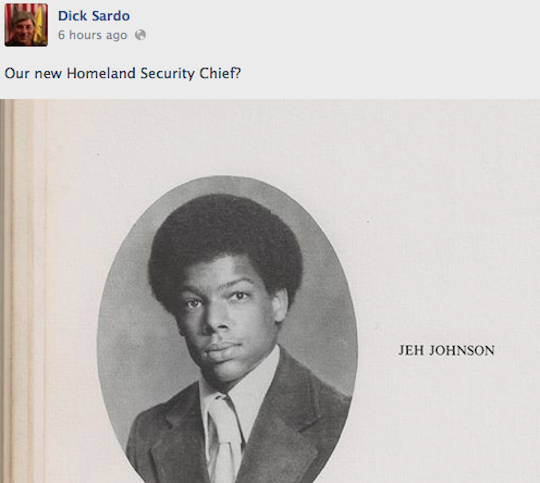
A day earlier, Sardo decided it was important to post a Yearbook photo of Jeh Johnson, Obama’s Homeland Security nominee, seeming to to imply that there is something inherently dubious about Johnson having once been a young African-American male. UPDATE: An email from Sardo’s son, Alexander, offers the contrary explanation that Johnson attended the same high school as his father, claiming that his father was “proudly” posting about the appointment of a “fellow alumni”:
Sardo, a Tea Partier who has also stated that “man-made global warming/climate change is a fraud,” is campaigning against Mike Benvenuto for Larry Andrews’ former Town Supervisor seat. Benvenuto has both the Republican and Democratic nominations, while Sardo is running on the Conservative and Independence Party lines.
With no apparent public disclosure or debate, a $2.5 million grant proposal to help convert the Columbia County Airport into “the Upper Hudson Valley Regional Airport” was made to New York State in July 2012, this site has learned.
The application for Empire State Development funding, signed under penalty of perjury by County Commissioner of Planning & Economic Development Kenneth J. Flood, suggests that the taxpayer-supported airport in Ghent could expand to soak up “more intense” traffic from other “congested” airports in the area.
County officials have been denying any intent to expand, in the face of speculation prompted by recent moves to use eminent domain to acquire more land adjoining the airport, supposedly only to satisfy safety concerns.
But their own 2012 application discloses very different long-term airport goals. Flood writes to the State:
[T]he required infrastructure needs to be extended and capacity increased for more intense airport operations and development of nearly 70 county owned acres of land for aviation and non-aviation companies.
Flood then parenthetically drops a bombshell: The reënvisioning of the County Airport as the “Upper Hudson Valley Regional Airport,” which would attract “substantial” added air traffic now handled by other area facilities:
The future development at the Columbia County Airport (proposed AKA Upper Hudson Valley Regional Airport) that will occur as a result of the improved infrastructure will allow this facilty to absorb a substantial amount of corporate and smaller freight aircraft operations that are causing congestion at other airports in the region.
The funding, Flood continues, would “substantially increase the total land area within the airport perimeter that would be shovel ready for aviation related businesses,” and
would allow for the development of approximately 70 acres of county owned land within the airport perimeter with a prioritization for the attraction of corporate aviation businesses... in order to service Richmor’s Corporate HQ, expand airport operations (construction of new hangars, new terminal, pilot lounge), develop 70 acres of county owned land for high tech aviation businesses and develop the area as a cornerstone of the southern Capital Region...
At the time the grant proposal was submitted, it was described publicly as an attempt to upgrade failing water and sewer services shared by the Commerce Park and Airport. The minutes of the County Economic Development Committee similarly described the application as just a “Water and Sewer Extension to County Airport.”
Likewise, the very end of a July 2012 article in the Register-Star said blandly that “Flood has applied for $2.5 million in funding to upgrade the sewage treatment plan[t] and connect it to the county airport as part of a $3.5 million project.”
In a strained attempt to tie this new “Regional Airport” into existing billion-dollar State investments in nanotech in Malta and the general Albany area, Flood argues:
The County as a whole, but more specifically this Commerce Center location is in a unique position to attract and capture key suppliers that would support the growing nanoscience center located less than 30 miles away in the Capital District.
That such business travelers would land an extra 30 miles south to Columbia County, rather than using the much closer, more convenient and advanced Albany, Schenectady or Saratoga Springs airports, seems specious. Those airports don’t appear to be maxed out as far as their capacity to serve demand.) The notion seems as farfetched as the County’s hopes of someday attracting a major package distribution hub for a company like DHL—an idea reported by Meadowgreens owner Carmen Nero during his speech at the Supervisors’ recent non-information session.
Flood soldiers on, promising the State “the construction of at least one 8-Bay T-Hangar and one corporate hangar in the immediate five year period,” plus “the identification of non-aviation development areas that can be used by the County to generate revenues for the Airport.”
Touting “the success” of the Commerce Park—the source of intense controversy over the seizing of farmland at its inception, and which few local residents seem to view as successful—Flood again attempts to make the case that this
the 70+ acres of land within the perimeter of the adjacent County Airport offered a unique opportunity to attract aviation related businesses that were not able to access the larger airports within the region.
Flood briefly alludes to an unnamed neighboring property owner who could benefit from the funding:
[T]he service area will be expanded to include additional adjacent county and privately owned lands that are presently zoned commercial/industrial. In fact one nearby property owner needs to connect to the existing facilities in order to progress a planned commercial/light industrial development project.
(Who that neighbor might be is unspecified. Again in the Reg-Star in 2012, Flood alluded to the possible siting of a slaughterhouse at the Commerce Park, though this hasn’t come to pass. Another theory floated by a Ghent resident is that Ginsberg’s Foods has been contemplating the construction of a vast new facility on the north side of Route 66 near Whittier, adjoining the Commerce Park and airport. Another source described the project as “the size of Shea Stadium.” Yet another source indicates that David Ginsberg headed up the search committee which originally hired Flood as economic development czar.)
In response to an application question about whether “the proposed project [will] involve participation in community based planning and collaboration?,” Flood responded:
The project involves participation from public and private entities, some of whom work directly with traditionally underserved populations.
No comment.
[NOTE: A copy of the NYS Consolidated Funding Application #17918, orginally obtained by Ghent resident Patti Matheney, can be downloaded here as a PDF.]
At last night’s anti-informational meeting in Hudson, County development czar Ken Flood did his very best Sgt. Schultz impression. Over and over, when asked substantive (and at times pointed) questions, Flood’s answer was “I don’t know.” Even though the County has supposedly been studying the topic at hand—the County airport—for over a decade.
Though billed as informational, Flood seemed to arrive totally unprepared. He delivered no presentation about the County’s push to spend over $600,000 (plus legal fees) to seize developer Carmen Nero’s Meadowgreens propety. Nor did he bother to make more than the most cursory introductory remarks, nor bother to call on Lt. Tom Lanphear, who was on hand to address the claimed safety issues behind that push.
Instead, the man often referred to as the County’s highest-paid employee turned the meeting over immediately to questions.
That move might have been viewed as an admirable step toward engaging the public, except for what came before and after, which made it just look like a lazy lack of preparation.
For nine months previous, Flood and his County cohorts such as Treasurer P.J. Keeler and attorney Brent Stack have been ignoring, deflecting and/or stonewalling Freedom of Information Law requests filed by Ghent residents about the airport. Detailed lists of official questions, such as those from Ancram Supervisor Art Bassin, have been similarly brushed aside.
Now, at last, Flood was opening the floor to the audience. But few answers were forthcoming. Roughly a dozen times, the large crowd in attendance heard him say, unconcernedly, “I don’t know.” Alternatively, Flood waved around one of two reports (one of them a whole decade old) full of consultantese, puffed-up numbers readily deflated by better-informed members of the audience.
(For example, the 2003 report hailed by Flood projected that the airport as of today would be serving over 40,000 takeoffs and landings annually. That would imply that something like an average of 110 takeoffs or landings occur every day of the 365-day year, which any neighbor or even casual visitor to the 9H corridor knows simply isn't happening.)
Flood’s one attempt to convince the audience of the importance of this costly eminent domain idea? To scare people that executives from companies like Flanders or Whittier nursing home would no longer be able to fly in to the County if the runway were shortened to satisfy FAA safety demands.
But Flood could not point to any proof that the FAA actually is making such a demand. Nor did he admit to knowing what type of planes those executives use, or how much runway their planes require.
Airport neighbor Michael Schrom, who has had a dialogue with Richmor Aviation going back to the 1970s, identified specific plane used by one such company, by name and model. He then cited for Flood the exact minimum number of feet such a plane needs—more than enough even if the runway were shortened.
The citation of detailed counter-evidence that blew his case out of the water did not seem to make any difference to Flood—nor to a majority of the Supervisors, who voted down Bassin’s motion to table any eminent domain proceedings until the County had better information.
Ghent resident Mark Johnson made the case against eminent domain from the other side of the political spectrum, arguing its use against a businessman like Carmen Nero was anti-American and dangerous to development.
The meeting was capped by a pleading of his case from an animated Nero, who speech (which involved a perambulation of the Board’s chambers) sadly was not captured on videotape. Suffice to say that one need not own a TV, if one has the schedule of local government meetings. Now that’s entertainment.
As Bassin wrote in an open letter circulated the morning after:
Unfortunately, the nine Supervisors who voted to continue with eminent domain have agreed to support that decision based on incomplete and possibly inaccurate information. This is not really about the Airport safety zone or eminent domain any more, but about the integrity and credibility of the County's decision making process, and the Supervisors and managers who guide that process.
Does the County offer any other high-paid jobs which require no preparation, no need to have answers, and no need to consider inconvenient facts? Seems like very nice work, if you have the political connections to get it.
(Note: If anyone from Richmor Aviation was present, they did not identify themselves, and did not speak up about whether or why they need this costly expansion.)
Below is the draft resolution which Ancram Superviosr Art Basin intends to present to the County Board tomorrow (Wednessday) night at 401 State Street, following an informational meeting hurriedly arranged by Chairman Pat Grattan. An article in today’s Register-Star announcing the meeting neglected to give the time that it starts; the clerk of the Board tells me it is scheduled for 5 pm, but is not sure if it will be on the 3rd Floor or in the ground floor chambers.
Resolution to Temporarily Table Actions to Expand the Airport Safety Zone Until Certain Additional Information Is made Available to the Public and to Members of the Board of Supervisors
Whereas, the Columbia County Board of Supervisors has, by resolution, previously endorsed the 2003 Airport Master Plan, The 2011 Airport Business Plan, and approved purchasing from Carmen Nero and his partners, certain land to expand the Columbia County airport safety zone, and
Whereas, Mr. Nero has declined the County’s offer to purchase such land, and
Whereas, the County has authorized seeking proposals for attorney’s to represent the County in a possible eminent domain process, and
Whereas, it is not clear that the County is required by the FAA to either expand the airport safety zone or shorten the runway if we decide not to expand the airport safety zone, and
Whereas it is not clear that, if the County is required to shorten the runway, the resulting consequences on the County or Richmor would be material, and
Whereas, it is not clear that the $8 million to $13 million of Airport investments proposed in the 2011 County Airport Business Plan are necessary, desirable prudent or economically justifiable, and
Whereas, the future economic development benefits of expanding the airport safety zone or making between $8 million and $13 million in investments at the Airport have not been defined, and
Whereas, the County has received a series of FOIL requests and questions from residents and Supervisors regarding the Airport Business Plan in general and the need to expand the Airport safety zone in particular, which have not yet been responded to,
THEREFORE, IT IS RESOLVED THAT:
All resolutions previously approved by the Columbia County Board of Supervisors authorizing the negotiated purchase of land from Carmen Nero and partners, or the use of eminent domain to take land from Mr. Nero to expand the Airport safety zone are hereby rescinded, and all previous authorizations to purchase or take of land from Mr. Nero are withdrawn, and
All efforts to initiate an eminent domain process, including the hiring of attorney’s to advise on or participate in an eminent domain process shall immediately cease, and
The County Attorney and the Commissioner of Economic Development, working with and seeking information from other County Managers, Richmor, the authors of the 2003 Airport Master Plan and the 2011 Airport Business Plan, and the FAA, will respond to all outstanding FOIL requests and questions from Supervisors and others in writing, and
The County Board of Supervisors will be presented with formal, written responses to the questions recently raised about expanding the Airport safety zone, and
The County FOIL officer will notify the Board of Supervisors when all FOIL requests have been responded to, and will make available to members of the Board of Supervisors all FOIL requests related to the Airport and the County’s responses to them, and
IT IS FURTHER RESOLVED THAT THE
The County BOS will review and decide on the matter of expanding the airport safety zone either by negotiated purchase or eminent domain based on more complete information based on the responses to the Airport FOIL requests that are outstanding, and based on answers to the questions raised by Supervisors and others.
Ken Dow, the attorney for Ghent residents Michael Schrom and Kevin Delahanty, provided details this afternoon of a lawsuit filed against Columbia County for failing to respond to requests for public records about the airport. Dow’s press release appears below; the full petition and affidavits can be downloaded here and
here.
Ghent, October 7, 2013
FOR IMMEDIATE RELEASE:
GHENT RESIDENTS FILE ARTICLE 78 FOIL LAWSUIT
AGAINST COLUMBIA COUNTY
Two Ghent residents commenced on Friday an Article 78 lawsuit against Columbia
County, in connection with the County’s failure to disclose public records related to the County
Airport and proposed plans to acquire, by purchase or eminent domain, lands abutting the
Airport.
Michael Schrom and Kevin Delahanty, both of Ghent, filed a Freedom of Information
(FOIL) request on August 21. Now, well into October, the County has not produced a single
record or document in response. Their attorney, Ken Dow, said “the public has a clear legal right
to know the information in the requested documents. This FOIL request was filed forty-seven
days ago, and the County has produced no documents in response.”
Dow continued, saying “The failure to produce records for this FOIL request is just the
tip of the iceberg. The County has been receiving other FOIL requests for very similar Airport-
related information since at least February. The County has been under a state-mandated legal
obligation to identify and produce Airport records since that time, and has disclosed almost
nothing. For well over half a year, the County has blatantly and brazenly ignored clear state law
in keeping this important information out of the hands of the public.”
Recently, elected officials have publicly complained that the people controlling these
important records won’t even provide them to elected County supervisors. Many of the records
sought in this Article 78 lawsuit are publicly referred to by County Commissioner of Economic
Development Ken Flood and other officers or employees. Dow points out that “the County
acknowledges that eminent domain proceedings are in the works. Yet when citizens ask, the
County cannot seem to find any records that document any basis for taking such an action. We
believe that can only be the result of willful evasion or stonewalling.”
The highest Court in New York, the Court of Appeals, says the FOIL law exists “to
promote the people's right to know the process of governmental decision-making and to review
the documents and statistics leading to determinations.” The County’s unlawful conduct has
stood in direct opposition to this fundamental right of its residents.
Dow said “it is regrettable when citizens must commence proceedings in the Courts to
extract lawful conduct from their governmental officials, but the long and troubling history of the
County’s failure to produce and provide information has brought this on.”
Contact: Ken Dow
Attorney for Michael Schrom and Kevin Delahanty, Petitioners [email protected]
I will be interviewed by Michael Singer this Saturday at 4 pm at Spencertown Academy, on the topics of Columbia County politics, land use and environmental issues, as part of their Conversations With Neighbors series.
Around noon today, Ancram Supervisor Art Bassin sent the following letter and attached list of questions to the County’s economic development czar Kenneth Flood. Flood has been flogging a plan to use eminent domain to seize acreage abutting the County-run airport from owner Carmen Nero.
Ken,
You have stated on numerous occasions over the past few years that if we do not expand the airport safety zone, the FAA will require us to shorten the runway, which could cause Richmor to cut back staff at the airport, and hamper future growth at the airport for the larger jets that require the longer runway.
The recent FAA letter responding to your question about what will happen if we do not expand the safety zone stated we might not qualify for future grant money, but did not say they would require us to shorten the runway.
Even after getting this letter, you maintain that if we do not expand the safety zone, the FAA will require us to shorten the runway, and that they may even require us to repay all or some of the grant money we have already been awarded. You cite "the regulations" to support your contentions.
There here have been a lot of questions raised over the years about the need to expand the airport safety zone. There have been a variety of FOIL requests, and a series of questions from both Supervisors and county residents related to past, current and future levels of activity at the airport by type of aircraft. To date, the County's responses to these questions have not been clear or complete.
The general impression many people have of the airport is that it is, has been and will continue to be a small, low level of activity facility that supports small, mostly propeller driven aircraft. The few larger jets that are based at the airport appear to be anomalies.
Before the County spends any more time or money on the eminent domain process, we need unambiguous answers to the questions that have been asked multiple times, but never adequately answered.
If we find that, in fact, the FAA will require us to shorten the runway, we can evaluate the impact of that action and make a decision about whether to proceed with the safety zone eminent domain action or not, based on the possible impact to Richmor and the County of a shorter runway. It is not clear that even if the FAA does require that we shorten the runway that we can justify moving ahead with the eminent domain process or any material investments of public funds from County, State or Federal sources.
If, however, the FAA tells us we will not be required to shorten the runway if we do not expand the safety zone, there seems to be little reason to continue with the eminent domain process.
Here are the questions I think we need answers to before we decided if we need to expand the safety zone and move ahead on eminent domain. Until we get coherent answers to these questions, we should table the eminent domain discussion and stop spending any tome and money on it.
For the FAA:
If the County decides not to expand the safety zone, will they require us to shorten the runway?
If yes, by how much, and by when?
If yes, under what regulatory authority, exactly?
If this is a safety issue, why have we not been required to shorten the runway already?
For Richmor:
If the runway is shortened by FAA mandate because the safety zone is not expanded, how much revenue and how many jobs, if any, will you lose by year over the next 10 years?
If the safety zone is expanded, how much revenue and how many jobs will you be able to add by year over the next 10 years?
How much in additional facility and equipment investments will you have to make to the facilities at the airport to achieve the revenue and job growth related to expanding the safety zone?
How much annual revenue has Richmor generated, by type revenue outlined on page 5 of the lease agreement, since Richmor started leasing the airport from the county?
How many people have been employed by Richmor, by year, at the County Airport since Richmor started leasing the airport from the County?
How many total take offs and landings have there been at the airport, by year and by type of aircraft, since Richmor has been the base operator?
How many take offs and landing per year, over the next 10 years, does Richmor project if the safety zone is expanded, or if it is not expanded?
For the Economic Development Commissioner and County Financial Managers:
What has Richmor paid the County in rent, by year, since they started leasing the airport from the county?
Have we been auditing Richmor revenues annually to verify that the rent we have been paid, which is based on a percentage certain Richmor revenues outlined on page 5 of the lease agreement, is correct?
If we have been auditing Richmor revenues, how soon can you circulate these audits to members the BOS? If not, when will an audit of the Richmor lease payments since the beginning of the lease period be done and shared with the BOS?
A recent Register Star article mentioned that over $6 million of public money has been invested in the airport and in airport consulting efforts over the years...is this correct?
What was the actual total amount of specific investments made with public money from County, State and Federal sources since the inception of the airport, by project and date?
How much in additional investments using public money from County, State and Federal sources are planned for the airport if the safety zone is expanded, for what, and when?
How much in additional investments using public money from County, State and Federal sources are planned for the airport if the safety zone is not expanded?
For the County Attorney
If we proceed with the eminent domain process and secure the expanded safety zone, can we increase the annual Richmor rent to include the amortization of the additional public money (County, State and Federal) spent to achieve this safety zone expansion, or must we rely only on increased revenues from Richmor's business to raise the County's rental income?
Similarly, can the Richmor lease be modified to include the amortization of all past and/or future public monies spent on behalf improvements to the airport which benefit Richmor, or again, do we have to rely on increases in Richmor's future revenues to see higher rental payments?
For C & S Consultants about the 2011 Business Plan
How did C&S determine that the airport generated an annual economic impact of 95 jobs, $7.6 million in income and $20.4 million in total economic impact, as stated on the cover of the 2011 Airport Business Plan?
The 2011 Business Plan outlines $13 million of recommended capital improvements for the 2011 to 2015 period on page 18, while on pages 32 and 57 it recommends $8 million in capital improvements. Why the $5 million difference in capital projects?
If the Plan had been implemented as recommended, projected activity at the airport was forecast to improve between 2011 and 2015 from 27 aircraft to 38 aircraft, and operations (takeoffs and landings) to increase from 19,200 to 21,900 (page 40). Based on 2013 data and conditions, are these projections still valid looking ahead five years, or should they be modified?
Why and how is a 10% increase from 19,200 to 21,900 operations significant enough to justify an investment of between $8 million and $13 million in public funds?
Operating income was projected to increase from a loss of $30,000 in 2011 to a profit of $85,000 in 2015 (page 57). Is $85,000 in operating income the best we can expect to do for an investment of between $8 million and $13 million in public funds?
One kept expecting the Monty Python crew to break into last night’s hearing in Philmont, held to consider removal of Planning Board member and Churchtown volunteer firefighter Nathan Chess.
The proceeding, instigated by a tendentious complaint from Claverack Supervisor Robin Andrews, appeared to serve little purpose except to give certain residents and officials a chance to vent their spleen against Chess. Having badly lost her attempt to
become a State Senator last year to a Tea Party candidate—despite
pandering to the far right on guns and the minimum wage—Andrews’ complaint looks an
awful lot like another clumsy attempt to curry favor with Republican insiders.
In over 15 years of watchdogging local meetings, this observer has never seen such a proceeding initiated, let alone actually held; and nothing that Chess is accused of seems that unusual by local standards. The airing of several hampers worth of dirty laundry—consisting mainly of petty personality disputes—reflected poorly on the entire Town and Planning Board, several of whose members appeared mortified to have to testify on one side or the other.
If the Board really felt the need to take some action against Chess, it would have been better served by passing a toothlessly symbolic reprimand, rather than dragging their constituents, Town employees, and volunteer agency members along this five-hour slog through the Philmont mud. This audience member began to suspect that the attorney’s fees devoted by Andrews and her colleagues would be better spent on group therapy, rather than litigation.
Even the Town’s handpicked special counsel, Dionne Wheatley, seemed to grow embarrassed by the thinness of the case handed to her by Andrews and her colleagues on the Town Board, with Wheatley’s once-confident tone becoming less and less audible as she sank lower and lower in her chair.
Commanded by the Town Board—which serves in this case as both accuser and jury—to appear in this Star Chamber, Chess hewed closely to self-researched legal arguments and lawyerly cross-examination. He managed, in Perry Mason style, to get Planning Board chair Steven Hook to admit he had incorrectly testified about the words used during their parking lot argument. Chess also pointed out that the Town had filed the complaint under an outdated portion of its code, and had failed to identify an adequate cause for removal, which needs to be factual, not subjective. Likewise, he poked legal holes in his accusers’ argument that he improperly raised safety concerns reviews by citing the Planning Board mission to ensure public safety.
Later, Chess provided a detailed illustration of the type of expert input he brings to the task of reviewing applications, explaining the importance for First Responders to have a turnaround on any long driveway to ensure that emergency vehicles can pass each other.
Several members of the Planning Board testified, with obvious reluctance, that while they might not always approve of Chess’s attitude, his continued presence had not altered the workings or effectiveness of the Board. (One took this to mean that it had been dysfunctional before, and remains dysfunctional after.)
Meanwhile attorney Wheatley refused to allow Chess to question his accuser, Supervisor Andrews—and Ms. Andrews did not insist on standing behind her accusations. Instead, the Supervisor attempted to paper over the ugly nature of the process that she’d put in motion. During the second break at hour three, Andews put on grinning Den Mother act, serving by-now cold pizza to the 30-plus attendees.
Meanwhile Wheatley wisely denied Big Up concert host Sam Wright’s request to be put on the witness stand, likely calculating that the belligerent and intensely personal nature of Wright’s various outbursts from the audience were not aiding the Town’s attempt to paint Chess as rude and intimidating. (Later, during the public comment portion of the meeting, a member of the audience who is friends with both men accused Wright of attempting to pick a boozy fight with Chess at a local pub.)
As the meeting’s fifth hour came to a close, Chess’s real offense came into focus: his steadfast refusal to just Go Along to Get Along. Two fellow members of the Planning Board complained that meeting were “no fun any more” and “not enjoyable,” to which Chess countered that reviewing an application is “not supposed to be fun. It’s work.”
Whether elected or appointed, local agencies are infamous for favoring the appearance of harmony over the more challenging process of weighing facts and regulations. When a lone Board member insists on a proper debate and review, this means his or her colleagues may have to actually read the materials, think for themselves, defend their reasoning and (worst of all) remain at the meeting long enough to miss the first hour of Prime Time TV.
The only bright spot of the evening was the impartial and good-humored moderation by Ancram Supervisor Art Bassin, who managed to dial down several potentially-explosive moments.
NOTE: In an amusing irony, one of the charges against Chess was that he had used expletives during a “man-to-man” discussion with Hook in the aftermath of a contentious meeting. An article in The Register-Star the morning just before the hearing, Bassin himself was reported to have used the word “bull----” in response to evasions by County Development czar Kenneth Flood—during the meeting, not “man to man.” This prompted this attendee to wonder out loud whether Ms. Andrews planned to file a similar complaint against her colleague. Don’t hold your breath; the obvious point here was not integrity or consistency, but the selective politicization of the Planning Board.