At last night’s meeting of the Ghent Planning Board, it emerged that TCI of NY is behind in payments to the Town of Ghent to cover engineering expenses related to cleanup of its Falls Industrial Road site, according to firsthand reports from attendees.
And until such payments are brought up to date, and until the company also puts $10,000 more in escrow for review, the Ghent planners do not intend to take up an application from the company to rebuild and resume operations.
TCI’s Brian Hemlock arrived with his attorney, Bill Better, as well as an engineer from Crawford & Associates and a representative of architect Dennis Wedlick, in an attempt to present an application—but ran into the stumbling block of past due bills and future escrow requirements. The application materials were dropped off, but not considered.
GhentCANN’s Patti Matheney reports: “It seems they have used up all of the escrow for the Town engineer to oversee the clean-up of the site and there are outstanding bills. The Board and [attorney] Ted Guterman were adamant they will not look at the new plans or ask the town engineer to review them until they put 10K into a new escrow account.”
Matheney also noted that a TCI representative “specifically stated that only non-regulated PCB's were dismantled at the plant and they do not handle any regulated PCB equipment. He made no mention of the DEC permit request from June of this year.”
However, that 2012 application indicated TCI’s plans “to store and consolidate regulated PCB wastes,” preparing them “for shipment to EPA approved and alternate disposition facilities,” an apparent contradiction.
Hemlock also circulated a heavily-massaged p.r. statement [ page 1 | page 2 ]. TCI worked with a public relations firm, Blass Communications, in the wake of August’s catastrophic inferno—its second fire of 2012—but it isn’t clear if they are still in the picture.
Lastly, Matheney writes that Planning Board chairman “Jonathan Walters asked the Board to "do their homework" over the next month and come back to the Jan. meeting with questions for TCI.
Audio of the meeting recorded by another resident is expected to be posted online later today.
After many meetings at which TCI of NY was expected to appear, but did not show up, the company finally sidled into a Planning Board “application night” meeting on Wednesday. They were accompanied by their engineers at Crawford & Associates. Ghent resident and realtor Chris Bishop captured the audio:
According to well-placed sources, PCB handler/processor TCI of NY filed an application last week with the Town of Ghent to rebuild its facility on Falls Industrial Park Road. The company’s application is said to have been accompanied by a check which has been placed in escrow by the Town.
However, the application reportedly has been returned to TCI as incomplete, as it did not contain all of the required information. Some town officials have informally signaled that TCI would need to go before its planning board if it wished to resume operations
As it happens, the Ghent Town Board has its regularly-scheduled meeting tonight (Thursday) at 7:30 pm at Town Hall, located at 2306 State Route 66.
To date, the Town has not cited TCI for any of many evident zoning code violations which have been brought to its attention. Activities such as fuel and explosives storage, handling of high-concentration PCBs, safety precautions and hazard prevention, and the introduction of multiple tenants into a building, are all clearly regulated by the Town’s zoning code and State fire safety regulations which are the Town’s obligation to enforce. Records obtained via FOIL and from private legal files held by neighbors indicate that many or most of the company’s uses of the site have never been the subject of a permitting review.
TCI left Ulster County in the mid-1980s after a fire similar to the one in Ghent led Newburgh fire and code enforcement officials, as well as State regulators, to cite the company for multiple violations. The company then attempted to set up shop again in Greene County, but were blocked among other things by stiff opposition from Athens firefighters, who noted that Athens did not have the equipment or resources to fight a major fire at such a facility. It was then that TCI came to Columbia County, representing themselves as an electronics recycler, and claiming that any transformers accepted onsite would be drained and contain at most scarce traces of PCBs.
In addition to having two fires at its plant in just the past year, TCI’s tenure in Ghent includes the death of a young worker on the job due to exposure to freon gas, and two failed applications (one to build an incinerator, the other to process household hazardous waste) which cost the Town enormous legal fees.
In a comment on the previous post here about Hudson getting younger, 3rd Ward Alderman John Friedman noted that:
One problem that I hear from younger Hudsonians and those aspiring to be is that the cost of rental housing in the city has climbed precipitously (is that an oxymoron?) in the last year or so and make finding a decent place to live difficult for this particular demographic. The City is trying to figure out ways to stimulate a market response to this demand but that usually takes 2 years or so...
Speaking as a former Young Person, I can attest that every generation thinks that The Rent Is Too Damn High. But since complex issues like this require more than cursory analysis, below are some examples and considerations that might be taken into account:
In the documentary film Two Square Miles, recently screened at Basilica Hudson, a local resident complains that landlords are asking “six, seven hundred dollars" for an apartment, calling these prices “crazy.” It is suggested by some that “those people” are trying to “push all of us out.” Now, that interview was shot almost ten years ago. A decade later, I still see that same interviewee daily, walking his dog on Warren Street. He’s still here; he didn’t get pushed out, in spite of the alleged “craziness” of Hudson rents.
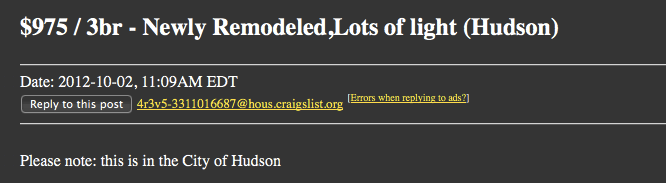
Today, one can readily find on Craigslist listings such as this: a newly-remodeled
three-bedroom apartment in uptown Hudson for under $1,000. Three young people could
share it and pay just $325 each per month. (Does unsubsidized rent get any cheaper than that anywhere in the Hudson Valley, unless you’re prepared to live in a free-fire zone in Newburgh?) One can find many similarly-priced options on Craiglist; while offerings from local realtors tend to be more of the luxury variety.
If rents do need ameliorating, the main way the City of Hudson can help is to get its budget and taxes under control, since rents correlate closely to taxation here. Overall, private investment has been a great benefit to Hudson: derelict structures are saved, delinquent properties go back on the tax rolls, contractors get work doing renovations, and formerly-closed-up apartments go back on the rental market, increasing supply. But if a landlord is paying taxes that exceed their montly mortgage payment, that is going to add substantially to what they have to charge in rent just to hold onto their building. Few if any landlords will take a loss on a rental, and high taxes will lead to high rents.
Another strategy that could moderate rents would be for the City to encourage or require un(der)used properties to be activated again. One example is Galloway’s apartment building on the corner of Warren and 2nd street: it was cleared of tenants at purchase time nearly a decade ago, and inexplicably has remained empty ever since. Ditto the former “Apartments of Distinction” building at the corner of Union and 5th Street, formerly home to multiple families, There are many other examples of “warehoused” residential space all over town—I recall seeing a figure of as much as 15-20% of housing stock being empty here in one recent report. Get those apartments back on the market, and rents will surely come down, if the law of supply and demand is not an economic fiction.
As far as rents going up, it’s worth trying to sort out anecdotal reports from the actual situation before officials take any major action. If a couple of folks’ rents go up, and they talk a lot about it at a local bar frequented by young people, it becomes easy in a small town to jump to the conclusion that everyone’s rent is exploding—even when those two examples are exceptional. For example, just yesterday I went to watch football at the newly-purchased house of a Hudson “young person.” (That in itself is, anecdotally, a good sign.) There were about seven of us hanging out—two of whom had just moved to Hudson to work at a local business. They had been crashing on friends’ couches in search of place to live, and literally during the Patriots/Seahawks game, one of them got a call and they left to move into their new apartment. So what is the reality? Are rents going up too high, or are young people finding apartments? If rents are so problematic, why are young people moving here at a rate unheard of a decade ago? In short, the City might first want to try to collect some rigorous data to find out what is really happening on the ground, rather than acting in haste based on sketchy info.
It remains that Hudson has a tremendous amount of subsidized housing, per capita—certainly higher than any other municipality in the County. This subsidized housing stock has not diminished in the past 10-15 years. And it probably also ranks in the top five in the region in terms of providing affordable housing (again, per capita). In the Terrace apartments, for example, if your situations qualifies you, you can get an apartment at a rent which is pegged to your actual income: you only pay what you can actually afford at any given time. This is not something that most towns offer.
In that context, it would be useful to determine how Hudson rents compare to rents in other towns and small cities nearby. Is it more expensive to rent an apartment in Hudson than, say, Philmont? Kinderhook? Catskill? Albany? If one thinks that rents are too high in Hudson, where else would one go—and what would one be passing up by moving, in terms of either job or lifestyle opportunities? If you move to a place where rent is cheaper, will there be any work or anything to do after work in that place, or would it be cheaper precisely because it is dead? If housing is really hard to come by in Hudson, it must be even harder elsewhere; and to that extent, rental pressure is a New York State or American problem.
Our American capitalist system is an unfair one, and one that needs fixing. Even former Alderman Quintin Cross (a past master of divide-and-conquer local politics) acknowledges toward the end of Two Square Miles that it is “not the fault” of people who have embraced Hudson’s potential that our society remains full of economic and social ills. With that in mind, it would be good for City officials to consider ways to address the most catastrophic rental situations—such as when a building sells, and longtime renters are given minimal time to move out. Renters ought to have the right to a lease, and a reasonable amount of time to find new quarters if owners change.
Like every place inhabited by humans, Hudson has some greedy landlords, some slumlords, as well as some elitists whose rental rates are calculated to enact some sort of social engineering. And like every place inhabited by humans, some people latch onto shallowly-understood buzzwords such as gentrification, deploying it as a social pose or way to assuage their own guilt over being privileged, without ever backing it up with actual data or acting meaningfully upon that concern. Gentrification is common in our society; people interested in really understanding and addressing are rare. If anything, thanks to Hudson’s situation, its resources, its walkability, its building stock, and most of all its people, the City may be better positioned than most rural towns to address with the profound flaws of that system.
As noted by that film’s co-producer Sven Huseby at Basilica the other night: if you visit similar towns around the country, one quickly realizes that Hudson’s survival and slow, steady improvement is not merely exceptional in America today, it is almost unique.
Six years ago this fall, PBS aired Two Square Miles, a one-hour documentary about Hudson in the tumultuous years around the turn of the 20th Century. The film is not readily available on DVD, nor found on Netflix, Hulu, etc.
But on Friday at 7 pm, Basilica Hudson will screen this film about how the Hudson of today was forged in the kiln of of the cement plant struggle. After appearing to have a “done deal” in place, Swiss-owned St. Lawrence Cement spent $60 million to impose its will on a small community, and failed.
Afterward, the Basilica folks have asked filmmakers Barbara Ettinger, Sven Huseby and yours truly to discuss the documentary and take questions.
For those who were not around during these endlessly trying times, the screening is a rare glimpse into the making of the Hudson of today, whose steady improvement is easy to take for granted. And with much pug mill water down the sluice since the fight ended in 2005, those who have seen it before may see some of the events and characters in a different light.
One sees former Alderman Quintin Cross in combative, charismatic and reflective modes—above saying “I dislike you, Sam”. (The local viewer now knows that Cross’s path of transformation was soon disrupted by a conviction for stealing from the City via credit card, and by a new arrest more recently for allegedly breaking into City Hall.) Red Dot owners Perry Cooney and Alana Hauptmann getting into it with 5th Ward Alderman Doc Donahue. Rick Scalera talks about his “sputtering political machine.” The Walthours talk movingly about their ambivalent family history with the Atlas cement company, which went out of business here in the 1970s.
And Linda Mussmann of TSL engages in what now looks an awful lot like situational ethics, taking her then-nemesis Scalera to task for accepting campaign support from the cement company while negotiating contracts with them. (Mussmann of course went on to lose her hard-won position as Democratic chair after negotiating in private with St. Lawrence to hand them the keys to the Waterfront, and eventually even to get married by Scalera himself.)
Basilica Hudson is located just south of the Amtrak Station near the Hudson waterfront on the east side of the tracks.
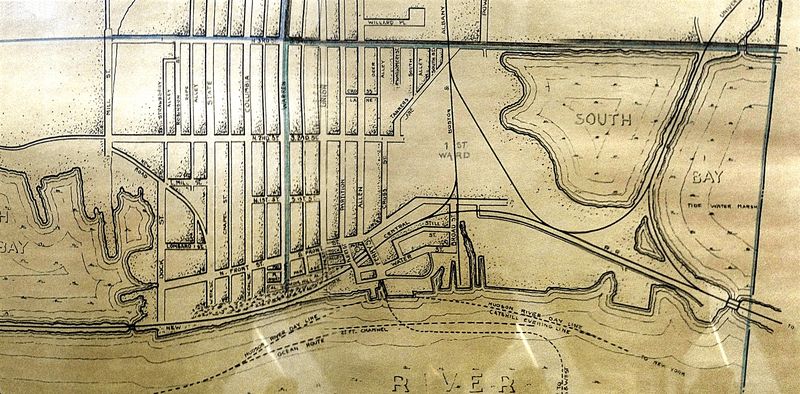
An article this morning by Tom Casey in The Register-Star reports that the City of Hudson is seeking funding “to create a marketing and development plan for several vacant buildings, including the L&B Furniture and McGuire properties, and to create a detailed plan to connect the separated portions of the waterfront from the North Bay to the South Bay.”
In point of fact, the L&B Furniture site (actually renamed LB Furniture before it closed) is hardly a “vacant building.”
The vast space houses plenty of renters, including the highly successful CNC fabrication business Digifab, a metal shop, a recycler, music practice spaces, and more. Indeed, The Register-Star itself published an article by Lindsay Suchow in November 2010 about the revival of the building, entitled “New life at old furniture warehouse.”
(Note: The above correction was submitted as an online comment to the paper’s website early this morning, but it has suppressed it. Apparently the Hudson “community paper” feels free to make obvious mistakes, but does not like them being pointed out.)
The focus of the article is to bemoan the seeming lack of interest in a Hudson grant application, reporting that “on Tuesday, there were no members of the public at the public hearing, which the group stressed needs to change to help take the ideas and proposals to improving and developing Hudson’s waterfront to the next step.” Casey quotes a development official as claiming that
“All the ideas you (the public) provided during the LWRP are now bearing some fruit... So much of that comes out of that public comment, you gave us the foundation, and now it’s step two.”
The official may be making that statement naïvely, or in hopes of changing the dynamic, but its whitewashing sentiment comes across as an affront to those who actually were around for the degraded Waterfront process.
The LWRP was a travesty of public input. One would be hard-pressed to make up a more textbook example of how to undermine public faith in public policy.
The sustained participation and comments of thousands of residents over many years—in public workshops, surveys, hearings, postcards, petitions, emails, letters and more—was cast aside for the South Bay in favor of the demands of a Swiss-owned multinational polluter and a Connecticut-based construction company. The former has racked up millions internationally in fines for environmental and anti-trust violations, and the latter is known for its role in the huge Rowland corruption scandal, and for an explosion at one of its projects that killed six workers.
The architects of the highly unpopular and unresponsive Waterfront plan were former Mayor Rick Scalera, Linda Mussmann of TSL and her real estate attorney, Cheryl Roberts, now a candidate for State Assembly, with the spine-free connivance of Council President Don Moore. Roberts erased records of two well-attended workshops and a 300-person survey from the LWRP narrative, because that input ran counter to her agenda—while incorporting virtually all of the demands of lawyers from Holcim and O&G. (This is what the leaders of the Columbia County Democratic Committee, such as Cyndy Hall and Victor Mendolia, shamelessly trumpet as Roberts’ “environmental sensitivity.”)
And Moore, having tried but failed to block public access to a key draft of the plan, refused to allow any of the 80 people who attended the final meeting about the plan to speak before the Council voted on it.
Meanwhile on the North Bay side, a huge outpouring of support for the Furgary Boat Club was again spurned by Roberts, Moore and the current mayor, Bill Hallenbeck. The Furgarians were evicted at gunpoint by a SWAT team, no less. A widespread local belief is that the eviction of Furgary after 100 years of peaceful stewardship of the North Bay was driven by a plan advanced by the Chatham-based Columbia Land Conservancy—which would be the beneficiary of some of this new Hudson grant funding, , according the The Register’s article.
No wonder then that no one showed up for these hearings. The public has gotten the firm message that their input does not matter, and would be a waste of a citizen’s breath. The current backers of these grant proposals no doubt are operating in better faith than their predecessors. But mix these recent and strong impressions of official disdain with a dearth of publicity about the weekday meeting (announced via obscure public notice), and you have a perfect recipe for the public to stay away, even though the topic is one of keen importance to the future of Hudson.
The public is interested—it just isn’t convinced that the City will listen. It’s up to its leaders to convince people otherwise, by making a serious outreach to groups and residents who have been burned multiple times before.
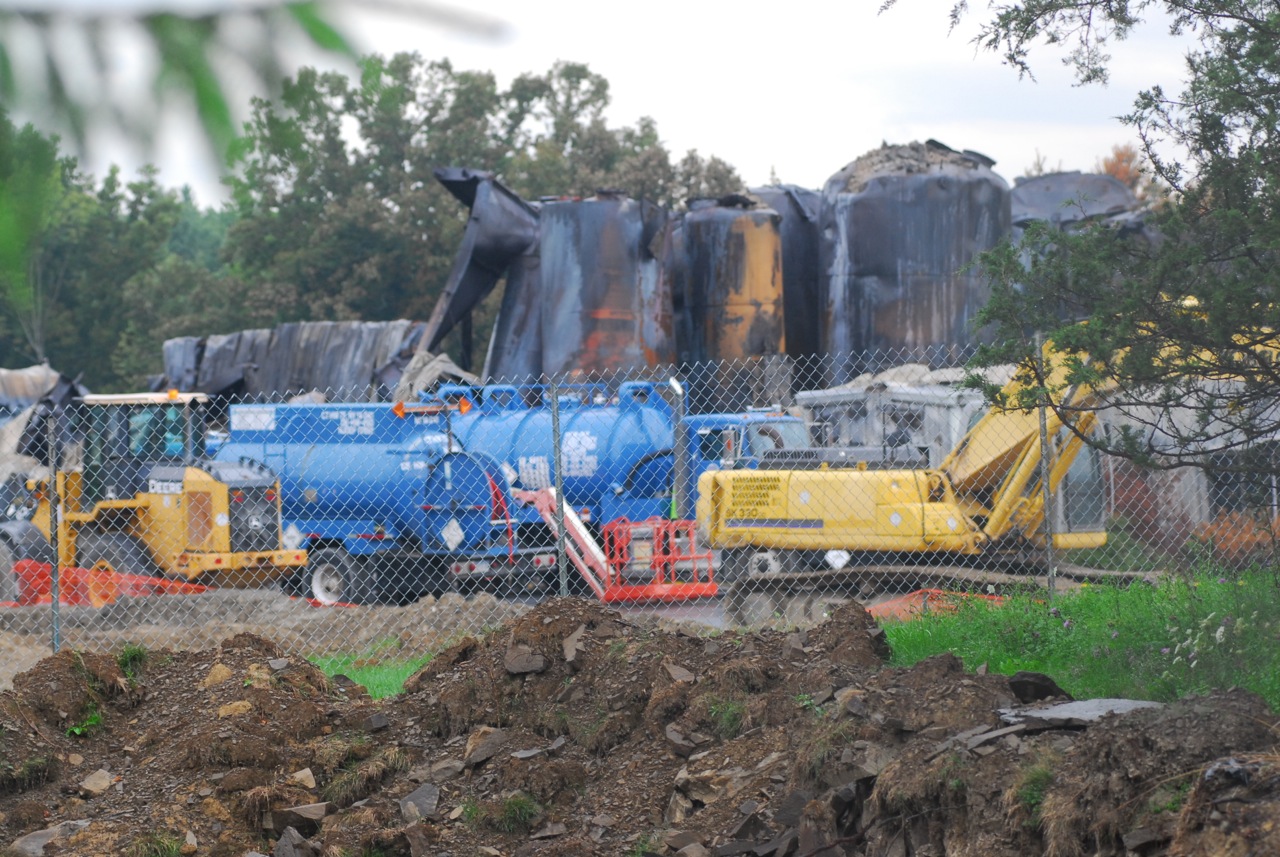
Cleanup at TCI is being closely guarded. PHOTO: Lance Wheeler
What was stored at TCI, the PCB waste handler whose building went up in flames earlier this month? And what was the company supposed to be storing?
An engineering report was released recently by the New York State Department of Environmental Conservation (DEC), disclosing what TCI has pieced together so far about materials present in its Ghent facility at the time of its massive August 1st inferno.
That inventory appears to run up against other public statements by the company and official sources, and against the past expections of the Town of Ghent. Such conflicting information in turn points to key questions about about what TCI was permitted to store onsite in the first place. In several cases, it appears that the company obtained materials handling and transport permits from State or Federal agencies, without updating the Town or local firefighting companies about new activities.
To come to grips with these seeming contradictions requires a brief trip back in time, as well as a review of more recent information which has come to light. (Regular readers will have to bear with any repetitions below.) These questions may prove central to the question of whether TCI will be able to rebuild, and how residents can be protected from similar disasters in the future, whether involving this company or others like it.
This site has previously noted the discovery of documents sent by Town of Ghent attorney Ted Guterman to the Town’s Planning Board chairman on behalf of the Town Board in 1989. Guterman attached to his cover letter what he called “a Position Statement that the Town of Ghent has issued in connection with to [sic] TCI, Inc.”
This letter came several years after TCI received a building permit, and was in response to a proposed incinerator the company sought to add to its Falls Industrial Road site. That incinerator never came to be. But the Town’s Position Statement contained many eye-opening statements about the genesis of the facility—statements which are especially relevant today, since the company has had two fires in eight months, and says it intends to rebuild.
Among many other things, the Town’s two-page letter stated that:
• “The Town of Ghent has always been and continues to be concerned wth any possible environmental impact evolving out of the operations of TCI, Inc.”
• “When TCI initially applied for a use permit in 1986... [i]t was specifically indicated that the process would not include nor would TCI accept any material that has been manufactured as PCB equipment.”
• “It was further indicated that any oil filled electrical equipment would be tested and drained prior to be received at the premises in order to insure that there were no PCBs.”
• “The Town is further concerned that the process, if approved by ENCON, will not result in any toxic waste generated or disposed of on the property or through the air, including PCBs.”
• “[T]he Town of Ghent Zoning Ordinance contains a provision specifically prohibiting storage collection, retention or utilization of toxic waste products or by-products or other similar toxic chemicals in any district within the Town of Ghent.”
Got that? No PCB equipment, no PCBs, no disposal of PCBs or other waste through the air and no storage of toxic waste products or by-products or other similar toxic chemicals in any district. Information which slowly has come to light in the aftermath of the TCI suggest that at least some of the activities the Town had deemed unwelcome were in fact occurring at the facility.
Again, all of the direct quotes above come from Ghent Town Board’s own 1989 statement, as conveyed by its lawyer. And as we’ve seen previously, those sentiments were echoed at the time in a Times-Union article which quoted attorney Jason Shaw, who was then representing the nearby Gallagher Stud farm, as stating:
“TCI was not forthcoming about the presence of PCBs when it applied three years ago to open its operation. I don’t think TCI was up-front about the fact that there would be toxic substances at the facility... They did not clarify the definition they used in an attempt to muddy the issue.”
The T-U also wrote at the time that “Town attorney Theodore Guterman said he remembers [TCI chief David] Laskin telling the Planning Board there would be no PCBs on the property.”
Now, compare this 1980s background concerning what was planned to be stored on the TCI site with the inventory reported in a memoradum by Hudson-based engineering firm Crawford & Associates Engineers, and posted recently on the DEC’s website.
In the Crawford memorandum, the firm’s vice president Brandee Nelso states that though TCI’s records were destroyed in its massive August 1st fire, the company has been attempting to reconstruct its storage from discussions with clients. Nelson states that “according to the eecords TCI has obtained, quantities of regulated and non-regulated materials at TCI are estimated as
follows:”
• 750,000 to 1,000,000 pounds of non-regulated materials consisting primarily of electrical
equipment
• Non-regulated mineral oil – approximately 125,000 gallons
Diesel fuel – approximately 500 gallons
• (3) 6,800 pound transformers, each with an estimated 255 gallons of dielectric fluid (mineral oil)
with PCB concentrations of 930 ppm, 1,300 ppm and 1,600 ppm, respectively.
• 9 drums of PCB Debris, which it typically soil or absorbent materials, with a total weight of
approximately 1,779 kilograms
• 6 bushings, each with 15 gallons of 50-499 ppm PCB, having a total weight of 1,304 kilograms
• 2 Oil & Water Drums, used for floor washdown and assumed to have PCBs, totaling 100 gallons
and having a weight of approximately 462 kilograms.
In a telephone interview on August 7th, this site asked Kenneth Bogdan, Ph.D of the State Department of Health’s Bureau of Toxic Substance Assessment whether his State agency had any firm idea of what was stored at TCI. Bogdan indicated that while it was unclear at the time, he believed there was only one drum of PCBs onsite—a statement that mirrored other official reassurances on the Thursday afternoon the fire.
Mason
Similarly, John Mason of Hudson-Catskill Newspapershad reported on August 10th that company co-owner Brian Hemlock and former controller Fran Vecellio “have said there were likely to be very few PCBs in the building at the time of the fire.” Hemlock was further quoted as saying that:
“Only equipment testing less than 50 ppm are accepted and processed at TCI of NY, LLC.”
Yet the Crawford inventory shows that TCI now believes it had not one but eleven drums onsite which contained an unspecified concentration of PCBs, and 90 gallons of bushings containing PCBs in the hazardous 50-499 ppm (parts per million) concentration, plus three transformers containing 765 gallons of fluid with a whopping 930-1,600 ppm of PCBs.
Indeed, a DEC “investigation has determined that three transformers located inside the facility at the time of the fire contained levels of PCBs between 1,000 and 2,000 ppm,” far in excess of both the company’s original stated intent, and more recent statements.
Oddly, the Crawford inventory of storage at TCI does not mention sodium. Sodium is known to cause violent explosions when it comes in contact with water and other substance, and has been repeatedly cited as a principal firefighting concern on the night of the inferno. Sodium would be a likely cause of the 10-15 fireballs witnessed by first responders and neighbors on the night of the catastrophe.
“[T]he building housed mineral oil tanks, tractor trailers containing fuel oil, propane tanks, and other hazardous substances, including sodium that came from transformers disposed of at TCI.”
State records indicate another limited liability company, KMOJ Acquisitions LLC, which like TCI is incorporated in Delaware and appears closely related to TCI, stores petroleum in bulk on the site.
A consent order just signed with DEC (which allows TCI and KMOJ to move stormwater into the nearby Widow’s Creek) indicates a number of permits the State has on file for the company that may not have been known to local officials. DEC notes for example, permitting for the site as a “registered petroleum bulk storage facility” and as a hauler of “non-hazardous industrial/commercial, hazardous industrial/commercial, and waste oil.”
Mason has also reported that the West Ghent fire company had been unaware that a TCI subcontractor, Power Substation Services incorporated in Florida,“had brought sodium on the site for use in recycling transformer oil.” Mason quoted West Ghent chief James Cesternino as saying “The fire company never received any haz-mat inventories from PSS nor was the sodium ever mentioned to us at our last building tour.”
According to The Columbia Paper, PSS “stored materials within the building” as follows:
16 - 55-gallon drums of sodium metal
3 cylinders of gas/liquid mix of sodium and oil
2 - 150 gallon diesel tanks
Several nitrogen tanks
Fatalities among firefighters were narrowly averted only because at the last minute, a TCI employee saw first responders “setting up the hose lines and informed [them] that there was sodium in the building and it reacts violently with water. It becomes explosive and produces hydrogen gas.” As firefighter Nathan Chess has written:
“It is only based on sheer luck that a serious loss of life was avoided. It was only based on basic ‘off the cuff’ comment by the company’s ‘keyholder’ that the responding units were advised that there was a substantial amount of solid sodium stored in the plant. This chemical is used as part of alternative treatment of low level PCB (< than 50ppm). But when exposed it creates an exothermic reaction and produces hydrogen gas...”
Dr. Mitchell L. Gaynor, who previously discussed his concerns about the TCI fire based on his extensive expertise in environmental carcinogenesis, has also noted that the material safety guidelines from companies like Sargent Welch recommend that sodium metal be stored in “red storage... away from any strong oxidizers,” for example in a “dedicated flammables cabinet,” in a “cool, dry, well ventilated, locked storeroom away from incompatible materials,” as well as keeping it immersed in mineral oil.
Gaynor then asks:
“Why would TCI and PSS store a mix of highly explosive chemicals in close proximity in their warehouse, which also contained highly toxic PCBs, which when incinerated at high heat create the most potent carcinogens known to man?
“Chemical storage guidelines from the CDC state that nitrogen and sodium metal are incompatible chemicals and should not be stored nor used near each other as they might cause explosive reactions if mixed. What industrial purpose would be served by storing 16 55-gallon drums of sodium metal near nitrogen tanks, diesel and oil, as was done at the PSS/TCI facility the night of August 1, 2012?
“Given the highly flammable and explosive nature of these chemicals, was West Ghent apprised of this, and what contingency and evacuation plans were in place for the town and surrounding counties?”
All of this again raises questions not just about what TCI (and PSS) had stored on the night of August 1st, but what it had been permitted to store locally, what it had been reporting to various local, County, State and Federal oversight agencies, and what its commitment has been to keeping these materials stored safely.
Taken in both its historical and its recent context, the Crawford inventory of TCI’s storage thus points to at least three central issues for further investigation:
Given the Town’s stated expectations in 1986-1989 that “no PCBs”—or at best that only very low concentrations of PCBs—would be present at TCI, how does this square with the current inventory?
How does this inventory (and the apparent presence of other substances such as sodium) square with the Town’s 1989 reference to zoning prohibitions against storage of certain types of materials “in any district” of Ghent?
What was stipulated, if anything, in any use permit issued to TCI when it was first built, and was that local permit ever modified or enforced?
Reviews thus far in local records leave vast gaps in even rudimentary permitting information for TCI’s operation.
It is not even clear at this point whether any formal application was submitted in 1986, beyond the company’s brief letter of introduction; or whether any special use or other ordinary permit was issued along with TCI’s building permit; or whether any SEQR (State Environmental Quality Review) process was performed for the facility; or whether any local permit modifications were ever requested, apart from the failed attempt to build an incinerator, for all the other materials brought onsite.
Until such documents come to light—and they may never materialize, much like the company’s untraceable PCBs—concerned observers are left to wonder whether there were major omissions in the process, major misunderstandings, or outright violations that are going uninvestigated.
As has been said before: If any ordinary Columbia County resident took all the cans of paint, turpentine, gasoline, bleach or even ordinary garbage from his or her garage or basement, and burned it in a barrel in the backyards, that ordinary resident almost surely would wind up in trouble.
Likewise, if any of ordinary resident had two big fires in the same year at his or her home, neighbors understandably might begin to wonder about how committed that person was to basic safety.
And if, as a result of a community fighting and cleaning up from fires, that ordinary resident was discovered to be to storing unexpectedly large quantities of unusual equipment and fuel—let alone PCB wastes—someone surely would ask to see that person’s papers.
Yet to date, no public mention has been made of any potential fines or enforcement actions against TCI by local, County, State or Federal agencies. And there is little paper trail to explain how these activities and storage came to be accepted in the context of the Town of Ghent’s zoning code.
If there are good answers, it’s incumbent upon elected and appointed officials, as well as the company—which still has not responded after several weeks to this site’s request for an interview—to take the lead in providing them.
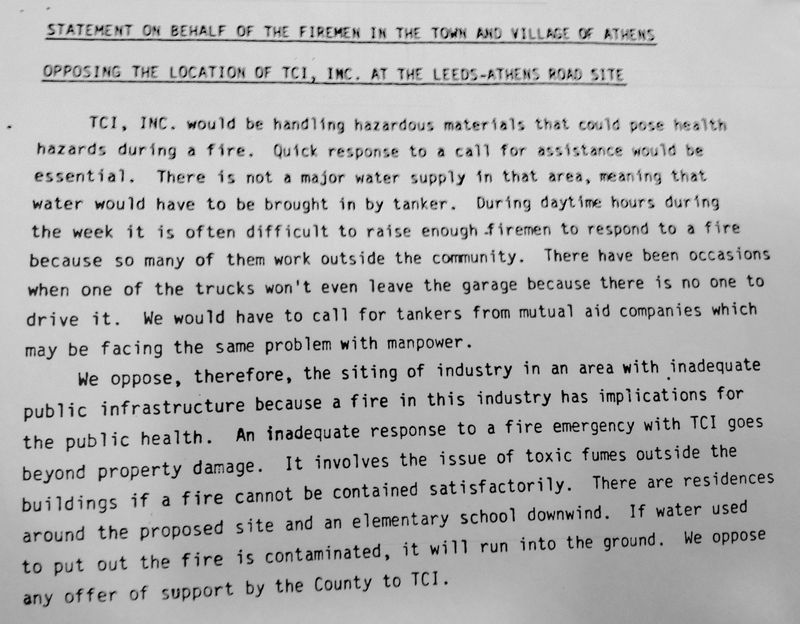
Before TCI moved to Ghent, it was known variously as Trans-Cycle Industries and TCI Incorporated. Documents from the early 1980s show the company was dogged by residents reporting fires at and emissions from its Newburgh location. The company initially tried to move to Athens (NY), but ran into a buzzsaw of community opposition.
The opposition of Athens’ first responders was particularly instrumental to TCI’s defeat there. The 1980s document above (found in a large archive of legal papers held by a Ghent resident’s attorneys) reveals what the firefighters of the Town and Village of Athens thought about the project. The Athens firefighters opposed it based on their assessment that that:
the “hazardous materials” handled by TCI “could pose health hazards during a fire”;
fighting such a fire would require extensive “public infrastructure”;
“a fire in this industry has implications for the public health”;
“an inadequate response” to such a fire could have implications “beyond property damage”;
these implications could include “the issue of toxic fumes... if a fire cannot be contained satisfactorily”;
“water used to put out the fire” could be “contaminated” and “run into the ground.”
Abandoning the idea of moving from Newburgh to Athens, TCI set its sights on Ghent, securing permission in 1986-87 from the Town to build a structure on land owned by David Rivenburgh.
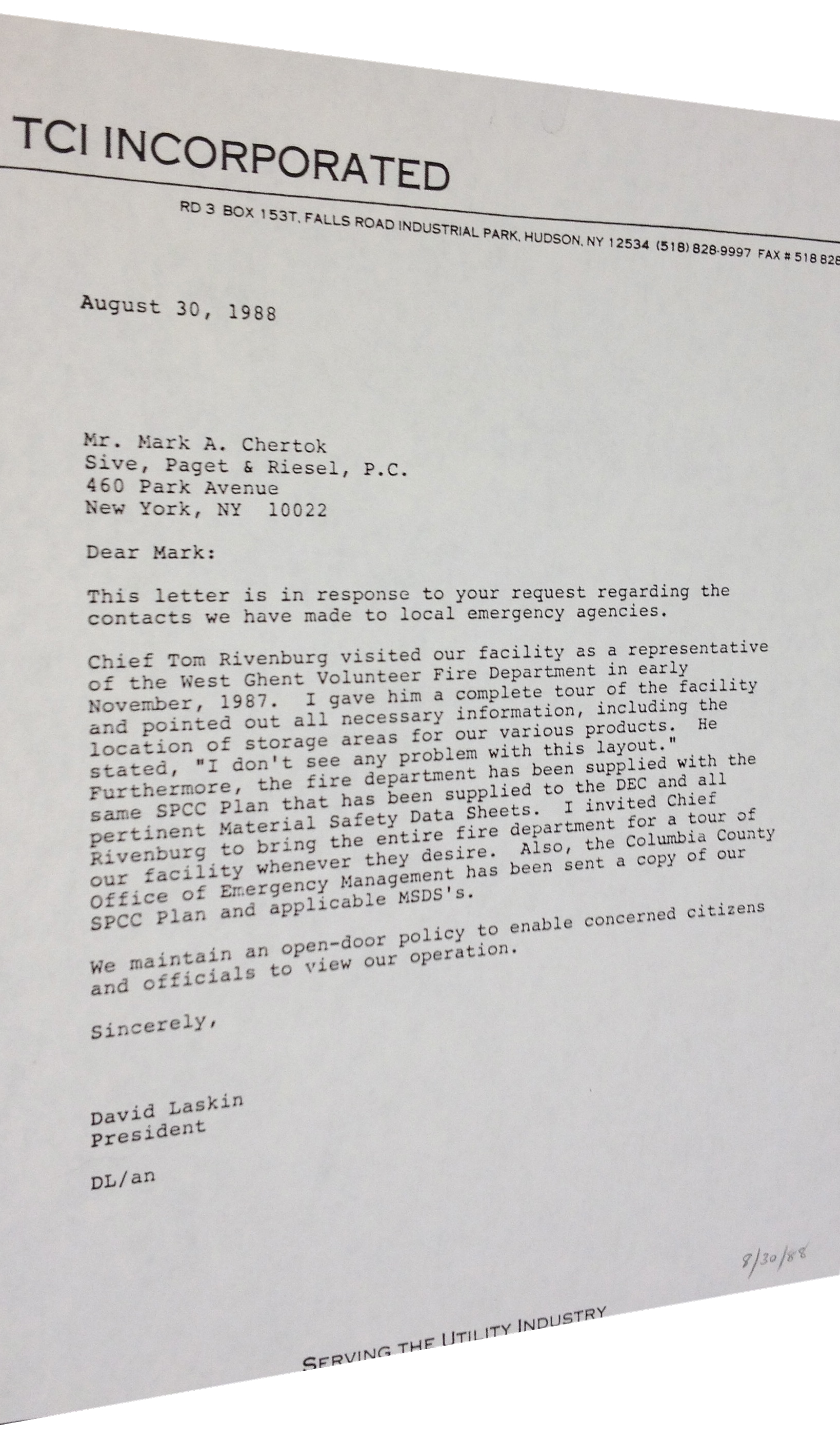
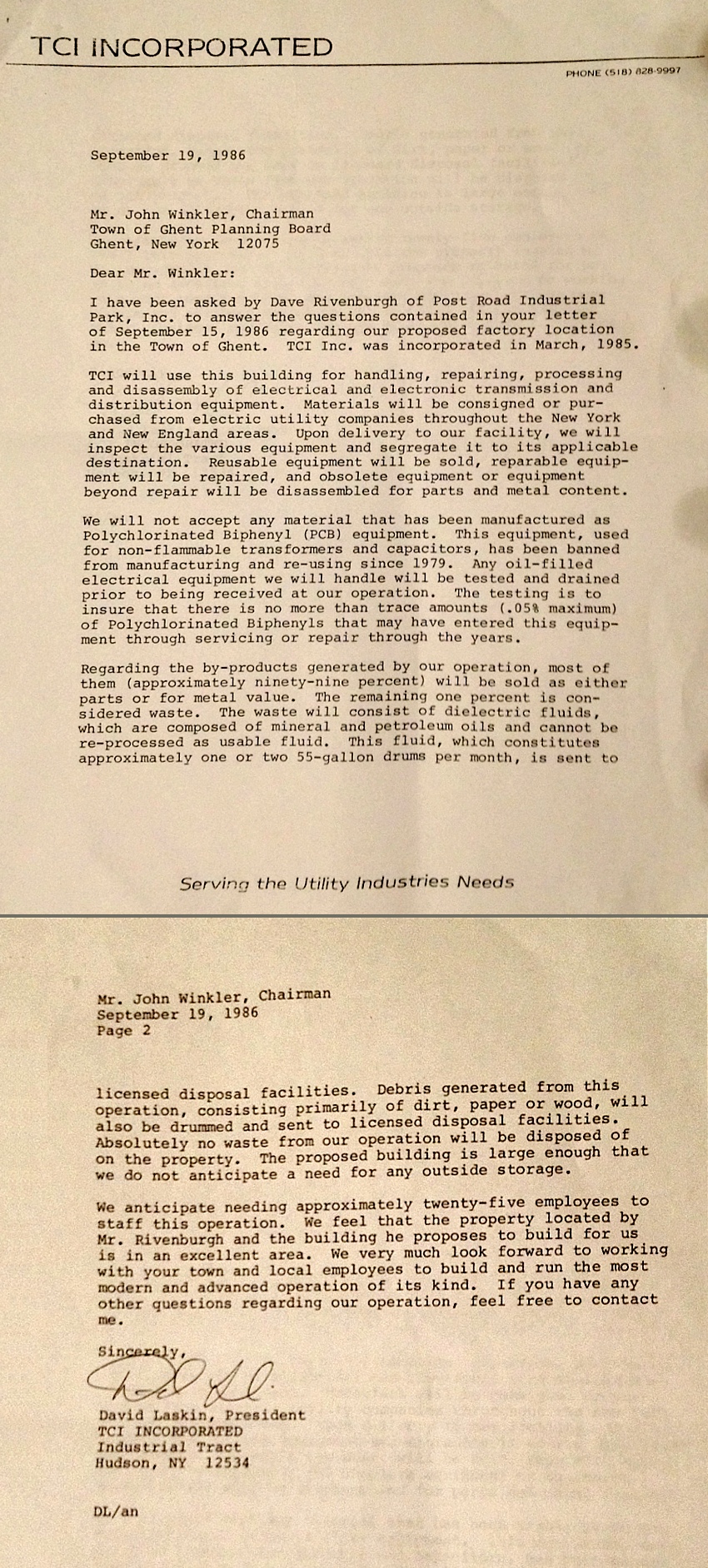
No similar objections appear to have been raised, except for the Town Planning Board chair briefly quizzing the company in a short letter about the potential presence of PCBs onsite. The same archive referenced above contains a 1988 letter from TCI of NY President David Laskin to a lawfirm in New York City, which purports to memorialize a visit to TCI by West Ghent fire chief Tom Rivenburg—a different spelling of the name, and no known relation to David:
Here, Laskin claims that Rivenburg said that “I don’t see any problem” with the facility’s arrangements. The letter also claims that “the fire department has been supplied with the same SPCC [Spill Prevention, Control, and Countermeasure] Plan that has been supplied to the DEC and all pertinent Material Safety Data Sheets,” and that this had also been forwarded to the Columbia County Emergency Management office.
The letter further invited “the entire fire department” to tour TCI’s newly-built plant, which Laskins says has “an open-door policy to enable concerned citizens to view our operations.”
Today, multiple reports indicate that the remains of the TCI facility is under 24-hour armed guard while it is being demolished and, the public has been told, remediated of any pollutants. A stormwater plan for the site was recently agreed to by TCI and the NYS Department of Environmental Conservation, but not before almost a foot of rain has fallen on the site since the time of the catastrophic fire.
Late ’80s paperwork obtained by this website raises questions about when and how TCI of NY became a processor of PCBs. Company letters, official Town of Ghent correspondence, and media reports dating from 1986-1989 indicate that either TCI’s plans changed, or Town officials were mistaken about the company’s real intentions.
On September 3rd, 1986, David Rivenburgh of Falls Road Industrial Park, Inc. applied for two building permits related to land his corporation was acquiring from William Wiegelt. Rivenburgh indicated that one of the buildings planned for the site would be bought by TCI Incorporated of Hudson. Accompanied by a $50 check, his application didn’t mention the use of PCBs, but alluded to handling “electronic transmission and distribution equipment.”
Plainly, this language set off alarm bells with Ghent Planning Board chairman John Winkler. He wrote back on September 15th asking Rivenburgh to produce a letter from TCI Inc. The letter, Winkler said, should explain among other things “what waste products are produced,” “how is waste matter disposed,” and whether the company deals with “any toxic materials, particularly PCB’s.”
Within four days, David Laskin of TCI Incorporated wrote to Winkler, affirming that:
“We will not accept any material that has been manufactured as Polychlorinated Biphenyl (PCB) equipment.
Laskin then goes onto reassure the Town:
“Any oil-filled electrical equipment we will handle will be tested and drained prior to being received at our operation. The testing is to insure that there is no more than trace amounts (.05% maximum) of Plycholorianted Biphenyls that may have entered this equipment through servicing or repair through the years.” [emphases added]
Later correspondence and official comments suggests that either Laskin was not adequately clear in that last sentence, or the Town failed to grasp a nod-and-a-wink message buried within the letter’s technical language.
Laskin also wrote to the Planning Board chair that its “proposed building is large enough that we do not anticipate a need for any outside storage.” Photographs of the site, as well as published accounts, show that materials were stored outside the building. Indeed, some have suggested that the impact of the fire might have been worse had more transformers and other materials been stored inside instead of out.
Indications that the Town of Ghent was starting to feel a bit bamboozled emerge from documents and news reports from 1988-89, when TCI applied to the State to add an incinerator to its Ghent facility. That incinerator plan was opposed by neighbors such as Marlene and Jerry Brody of Gallagher’s Stud, as well as by the Town. Legal wrangling dragged into the early ’90s, but the incinerator never came to pass.
The Brodys
The Town of Ghent’s legal correspondence firmly reiterates that TCI’s original application for a local use permit did not include the handling of “PCB equipment,” and that any other equipment would be drained “to insure there were no PCBs. On September 22nd, 1989, Town attorney Ted Guterman, (who is still serving in that capacity today) forwarded the Town’s Position Statement on the project to Planning Board chair Winkler:
“When TCI initially applied for a use permit in 1986... It was specifically indicated that the process would not include nor would TCI accept any material that has been manufactured as PCB equipment. It was further indicated that any oil filled electrical equipment would be tested and drained prior to being received at the premises in order to insure that there were no PCBs.”
Guterman’s understanding was echoed in a December 13th, 1989 article in the T-U, which quoted Brody attorney Jason Shaw as saying that “TCI was not forthcoming about the presence of PCBs when it applied three years ago to open its operation.” He added that “I don't think TCI was up-front about the fact that there would be toxic
substances at the facility... They did not clarify the
definition they used in an attempt to muddy the issue.”
In the same article, Guterman recalled “Laskin telling the Planning Board there would be no PCBs on the property.” Laskin countered that the Board “ knew we'd be handling the material and the amount would be miniscule... I can't remember how many hours we spent going over this.”
The Position Statement forwarded by Guterman also flagged the Town’s concern that TCI’s activities
“not result in any toxic waste generated or disposed of on the
property or through the air, including PCBs. It should be noted that the
Town of Ghent Zoning Ordinance contains a provision specifically
prohibiting storage collection, retention or utilization of toxic waste
or by-products or other similar toxic chemicals in any district.”
23 years later, the Town experienced what many residents now view as an uncontrolled incineration of materials which may never be authoritatively inventoried.
Whoever one chooses to believe as to TCI’s original intent, clearly PCBs at some point began passing through the facility in both lower and higher concentrations than 50 parts per million.
For example, as reported previously at this site,
a March 2012 TCI manifest shows roughly 2,000 pounds (901 kilos) of
liquid PCBs with a concentration of 50-499 ppm (parts per million),
along with 350 pounds of solid PCB debris, was shipped from TCI in Ghent
to their sister company in Alabama. The Albany Times-Union for its part has obtained records “that showed some 50,000 pounds of PCB-containing materials and oils moving from the Ghent complex this year.”
It remains to be seen if, when and how TCI modified its original
application materials to secure permission for such use—or if the Town
let this unintended use slide. With TCI saying it plans to rebuild, and
many residents calling for a full site plan review if it really does, it
becomes all the more essential to determine what precisely the company
has been permitted to do locally.
NOTE: This summary of the Americlean controversy was written about ten years ago as background for a (successful) nonprofit grant application. Citizens who were involved in the fight to stop Hudson’s old glue factory—what is now the Basilica—included Philip Alvaré, Jennifer and Kim Arenskjold, Carole Clark, Jack Harrell, Peter Jung, Peter Meyer, Sara Sterling, myself and many others, including some no longer in Hudson (such as Byrne Fone and Edward Gomez).
During a four-month controversy in 1999, local residents discovered the importance of face-to-face grassroots organizing, diligent research, media exposure, sustained public pressure, and savvy use of the internet for making change at the regional level.
As a result, a unique relic of the Valley’s industrial architecture was spared from becoming a sketchy toxic waste center, and instead preserved to become Basilica Hudson—arguably the most dynamic art and performance center in this stretch of the Hudson River.
Below is a detailed review of those four hectic months, explaining how citizens prevailed against long odds to protect their quality of life and preserve a prime opportunity for more positive development.
In the waning days of 1998, some residents of the City of Hudson, New York, spotted an obscure legal notice in our local paper.
The bland notice indicated that Hudson and Columbia County intended to apply jointly for $600,000 in grant funding from the Department of Housing and Urban Development (HUD) Canal Corridor program to attract “a business”—the name was unspecified—to the City’s waterfront. I said there would be an informational meeting about the application in early January.
As is all too typical of such meetings, this one was scheduled inconveniently on a weekday, during work hours, a time calculated to draw as few audience members as possible. But much to officials’ surprise and dismay, several residents did attend.
After a lot of hemming and hawing, the County development agency was finally convinced that residents deserved to know the name of this mysterious “business” which would benefit from a $600,000 in Federal largesse.
“I think it’s called ‘Americlean,’” he said. About the nature of Americlean’s business, he was similarly vague: “Something to do with supplies for the dry cleaning industry—wire hangers, polybags, that kind of thing.” After further grilling, citizens determined that the proposed site would be an imposing brick building, a former glue factory, adjoining the wetlands of South Bay and a stone’s throw from the Hudson River.
Alarmed by the obvious evasiveness, citizens went home to look up Americlean on the web—a relatively novel task for many in the late ’90s.
It was soon learned that the main business of Americlean (a Canadian company, despite its name) actually involved shipping and “processing” huge quantities of a hazardous waste generated by the dry cleaning industry: a chemical called perchloroethylene.
Thanks to a relatively new search tool called Google, residents then figured out that “perc” is one of the more carcinogenic substances known to man. Once considered a miracle substance, many places such as New York City had begun to ban perc’s use altogether as a health risk to dry cleaning workers and their neighbors.
Americlean’s website claimed to have a miraculous, patent-pending process which would allow the company to recycle perc safely, then resell it to the drying cleaning industry with relatively little leftover waste product. The company claimed to have a pilot plant in Canada that had successfully tested this process.
When we brought this new information to the attention of our local Common Council, its members professed to be both unaware and unconcerned by Americlean’s real intentions. So what if they were hauling and processing hazardous waste, instead of making coat hangers—they were eager to believe the company’s claims of creating 100 well-paid jobs for local workers. Besides, the deadline for applying for the grant was rapidly approaching, and if Hudson didn’t submit something, the funding would be lost. So the Council hurriedly voted in favor of applying to HUD.
In other words: City and County leaders actually wanted the Feds to pay a little-known and even less-tested Canadian company $600,000 to to truck hazardous waste through local neighborhoods, down to the Hudson River, when an unspecified process would be used to neutralize it.
“You people have no idea how much toxic waste already goes through Hudson,” lectured then-Mayor Rick Scalera, as if this would reassure his listeners.
Those who questioned the wisdom of the Americlean plan were subjected to all manner of personal attacks from public officials, from public meetings to the pages of the local newspaper. One woman took the initiative to call Americlean’s president directly, hoping to learn more about his plans—then found herself falsely accused of “impersonating a Common Council member” as elected officials rushed to discredit her unflattering account of the conversation.
In an apparent reference to the sexual preferences of a few of those speaking out against the project, 5th Ward Alderman Bob “Doc” Donahue read a prepared speech in which he insinuated that “these people speaking out don’t have children, they only have pets.”
Weeks of verbal sparring in newspaper articles, public meetings and letters to the editor ensued. It became obvious that the politicians wanted to make this an us vs. them issue, and the local paper was all too happy to help pit neighbor against neighbor.
A major turning point came when challengers of the hazardous waste plant shamed the Mayor into holding a public hearing in which the company would present its plans, and residents would have a chance to question Americlean in person. Up to that point, none of the company’s executives had ever appeared publicly in town.
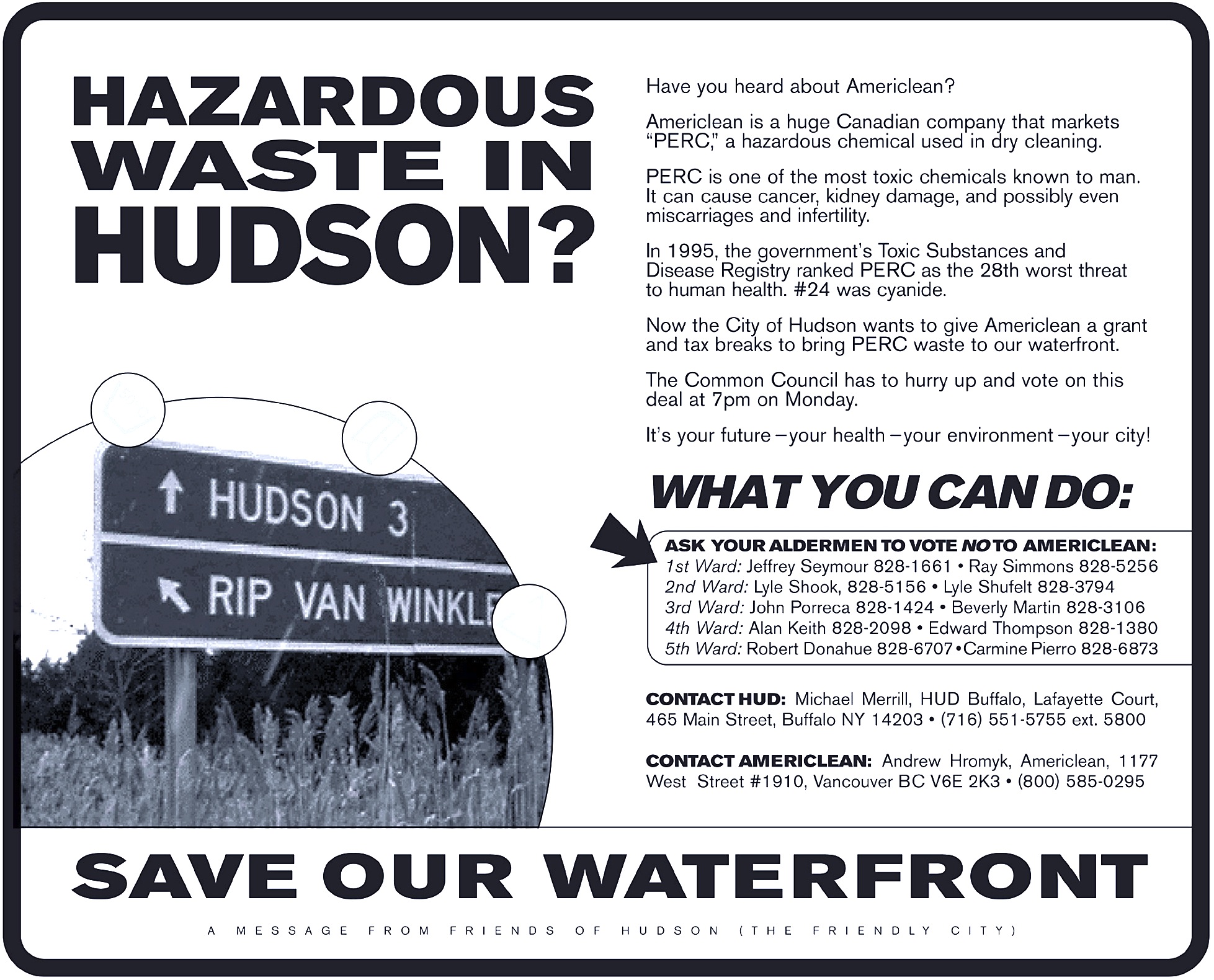
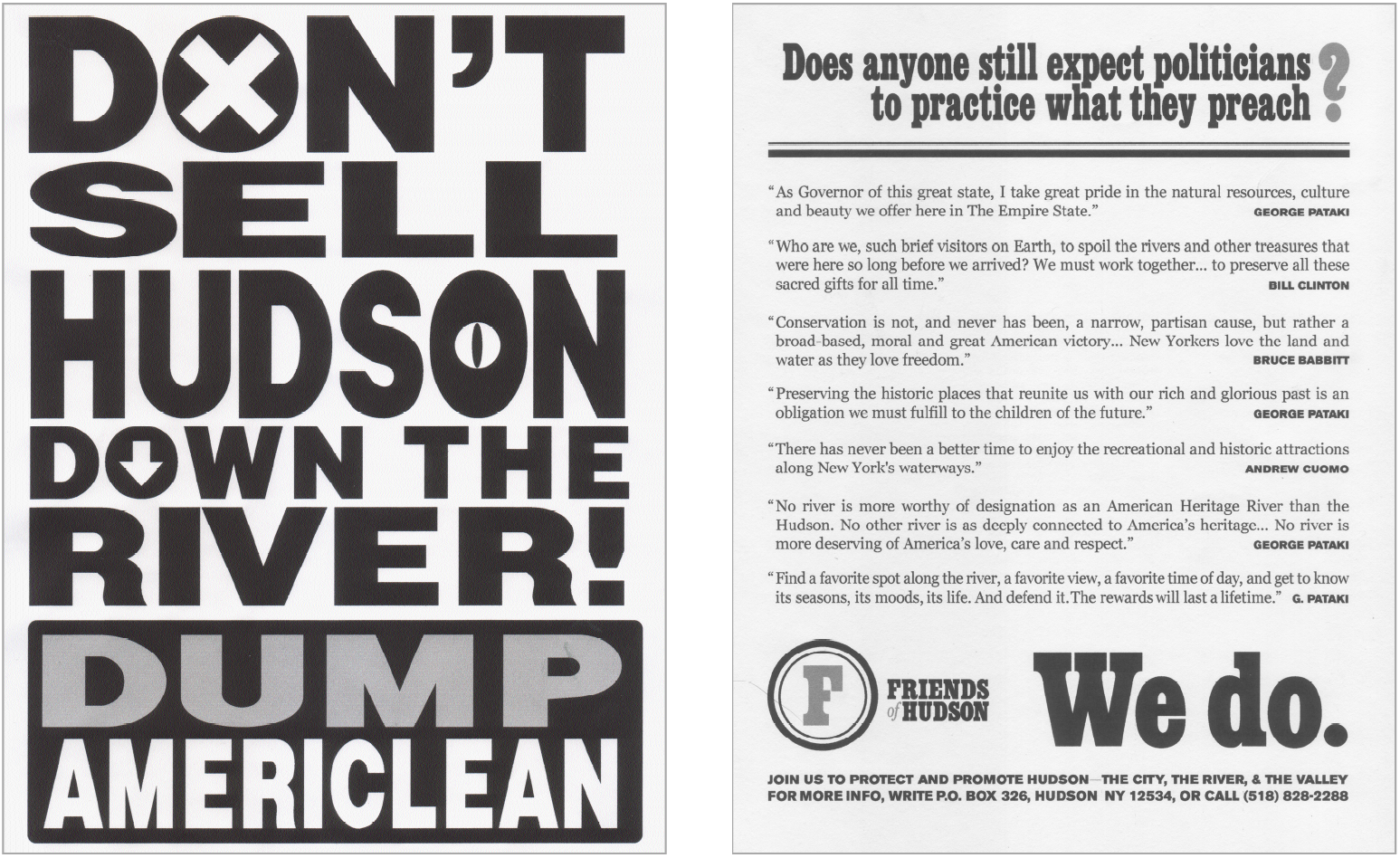
In preparation for the big hearing, challengers raised $800 to take out a half-page ad in our local newspaper to increase awareness of the event. Even this caused a new controversy, as The Register-Star’s publisher decided to preview the citizens’ planned back-page ad for Americlean in advance of its publication. The paper also ran a front page story the same day featuring the company’s one-sided rebuttal, in an apparent attempt to blunt the ad’s impact.
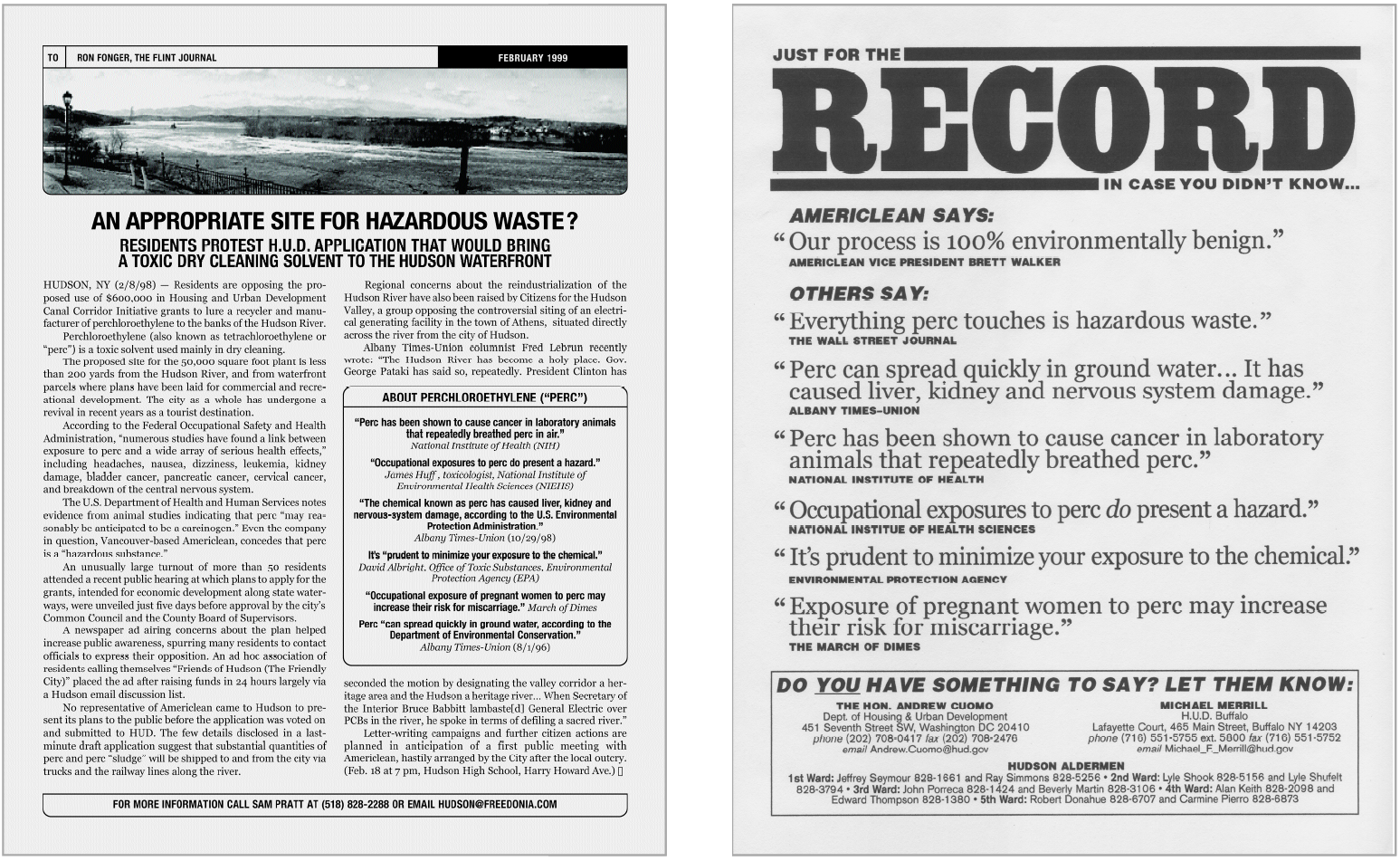
Undeterred, residents followed up with a one-page insert in the paper (see For the Record, below). This contrasted Americlean’s own claims with contradictory evidence to the contrary found in mainstream publications and scientific research reports.
More crucially, citizens made three key decisions:
(1) Going door-to-door in their neighborhoods with flyers about the hazardous waste proposal;
(2) Garnering coverage by the area’s local television stations, bringing a broad range of residents together to be interviewed; and
(3) Meeting privately to review research and stategy, drawing up a list of questions to be raised, and parcelled out among those who would attend.
Previous to these three actions, there was a surprisingly low awareness of the controversy, despite its being the subject of numerous newspaper articles. Going door to door, citizen activists discovered that even most residents living within 300 yards of the proposed toxic waste plant had never heard about it. Exposure on area television also greatly increased awareness among those who hadn’t been attending meetings or following the bitter debate in the papers.
Detailed research about the company, its plans, its technological claims, and track record were boiled down to a list of important questions and revelations to be delivered at the hearing. The process of sharing information about the company, its technology, and the associated health concern was greatly expedited by the (then-novel) internet. Corporate, scientific and regulatory information once hidden in obscure libraries and agency files was readily available to anyone with a computer. A net-savvy new resident set up Hudson’s first “list-serv,” an automated email discussion list. This allowed conversations and debates which might have taken weeks to arrange were condensed into a matter of hours.
Operating as a combination early warning system, round-the-clock roundtable and independent research institute, this email list helped residents to discuss new developments, share research, refine strategy, and mobilize members on a moment’s notice for a public meeting or media opportunity.
Hoping to create an impression of public apathy about the proposal, the powers that be chose a huge auditorium for the hearing, located as far as possible from the proposed toxic waste site without quite leaving town... Officials expected that many would not bother to make the trip, and even if they did the room would look empty.
But much to the Mayor’s obvious annoyance, citizen grassroots organizing resulted in a full hall, packed by a diverse array of local residents from many different walks of life. The company’s representative, Brett Walker, came across as smug, overdressed, overcoiffed and stunningly unprepared for question after painstakingly-researched question. In many ways the audience seemed to know more about perc processing than Walker.
One resident brought along a chemist and safety consultant for labor unions to testify—to devastating effect, as Americlean’s glib spokesman could not answer her direct, technical questions. Walker professed not even to be able to remember where his company’s much-touted “pilot plant” was located, furthering the growing impression that the project was a sham. Many started to believe that Americlean’s real agenda was to take the $600,000 grant, and get paid to accept waste that would wind up in Hudson’s wetlands, or river, or get incinerated in the St. Lawrence Cement proposal, which had just been announced just up the hill in Greenport.
Especially effective were the parents, health care professionals, and lifelong residents who had been reached through our door-to-door outreach. Many spoke out forcefully against the project—debunking the official spin that only “outsiders” were opposed to it. A statement by City of Hudson consultant Bill Loewenstein that the Hudson waterfront was always an industrial wasteland was met with hoots and groans.
By the end of the hearing, even those who had gone in supporting the project left with about the hazardous waste plant. “I was trying to help you out here,” said one exasperated company supporter, who Walker did not recognize as an ally and treated shabbily. The lone exception may have been Mayor Scalera, who complained at the meeting’s conclusion that he had “never been so embarrassed by the behavior” of Hudson residents—who had just saved him from making a catastrophic blunder in welcoming what had just been exposed as a sloppy, fly-by-night development partner.
Over the coming weeks, citizens kept up a drumbeat of letters to the editor, television appearances, and pressure at Council meetings. Finally in mid-April, the headline broke in our local paper: The City had delivered the bad news to the company that the Hudson did not want them to truck any hazardous waste into the City, and would only welcome them if they limited their activity to the original hangers-and-polybags line. Americlean withdrew its proposal in short order, and was never heard from again in Hudson.
Soon enough, the former glue factory found a healthier, more forward-looking purpose, when a developer and restoration expert from Florida purchased it to found an arts center. While that developer ran into obstacles from embittered City leaders (who denied him access to water and sewer services), a second set of developers bought the building and managed to overcome those political obstacles.
Today, the factory complex has been impressively renovated, operating as Basilica Hudson. It features a year-round schedule of exhibitions, performances and festivals, as well as hosting weddings and charity galas. Rather than a dumping ground for toxic waste, “The Basilica” serves as a venue for both local projects and businesses, and internationally-acclaimed artists and groups.
Once again, a proposal has been floated in Hudson to put parking meters on the lower blocks of Warren Street, i.e. below 3rd. According to a Register-Star’s account today, this would rake in between $25K and $27K in revenue annually.
Let's be generous, and round that revenue up to $30,000. To put that (piddly) amount in perspective in relation of the City’s (giant) 2012 budget:
That’s just 3/5th of 1% (.006) if computed as a percentage of Hudson's $4,687,618 tax levy;
That’s just 3/10ths of 1% (.003) if computed as a percentage of Hudson's $9,651,173 in general fund appropriations.
And that's just 1/4 of 1% (.0025) if computed as a percentage of Hudson's $12,122,801 in total expenses.
Any way you slice it, the savings would be invisible (a lot less than 1%) to pretty much every taxpayer.
And even in a highly-unlikely best-case scenario, in which the entire $30,000 gets applied directly to reduce peoples' tax burden, an average person paying $2,500 in property taxes would save a grand total of $15 a year. If instead, the amount were subsumed into the entire appropriations or expenditures, the personal savings might be more in the $4-$8 range. With that kind of cash, one maybe could afford lunch once a year at Applebee's in Greenport, where parking is free.
Unfortunately, even after paying off the installation costs within 6-12 months, the external costs of metering would likely erase any such savings by causing some area residents to shop less in town, and causing more casual visitors to vow not to come back to Hudson again because they got a ticket.
Meter advocates tend to argue (often without any supporting data) that metering results in more turnover of parking spaces, deterring people from parking in the same spot all day. But at 25 cents per hour, many can easily afford to stay in the same spot all day anyway, or just pay the ticket: the marginal difference between 8 hours at 25 cents and a $6 ticket is all of $4. Unless Hudson begins chalking tires to prevent people buying more than 2 hours at a time, ticketing only really affects those least able to afford parking, and those easily ticked off by tickets.
Meanwhile, as has been pointed out here before, many thriving area towns such Millerton, Rhinebeck and Great Barrington have no parking meters on their main streets. So how is it that these meterless towns are doing as well as their metered neighbors?