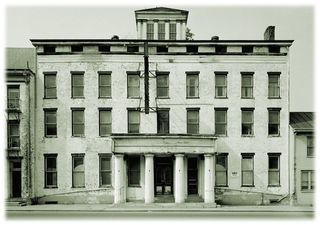
Overreacting to the arrival of a single new food cart on Warren Street, Hudson politicians started making grunting noises about limiting or even banning them altogether.
But their spastic response—something conservatives normally refer to as a “Nanny State” impulse—has already backfired. It’s created more competition, not less, by driving the lone target of their concern into a more stable setting.
Seeking shelter from the political storm, or maybe just a more appealing venue, the street cart Ponto Brasil has forged a partnership with retailer Melinda Slover to move into Lili & Loo’s well-appointed backyard space.
By pushing proprietor Steve Walsh off the street, the powers that be have actually driven his business into slightly more direct competition with conventional restaurants... because now Ponto patrons have a place to sit while they enjoy their feijoada, and will always know where to find it. And by taking such a heavy-handed and reactionary approach, City Hall has engendered nothing but publicity and sympathy for Walsh’s fledgling business.
“We have to protect the restaurants!” came the politicos’ cry, improbably fretting over the investments and tax contributions of unnamed restaurateurs who allegedly were complaining en masse. Somehow a single cart, serving cheap kebabs and coconut water, was going to put restaurants out of business whose typical bill for two people can rise to the $50-$100 range.
(Tellingly, when queried on a local business email list not a single proprietor copped to having a problem with street vendors. Publicly, nothing but support for Ponto Brasil has come from their quarter. At least some of that support may have been two-faced, as one restaurateur now professing enthusiasm for Walsh’s business had just harangued a friend about it.)
This odd new concern about the investments of main street businesses struck many as peculiar, given that City Hall here has shown little but hostility to Warren Street’s hard-working entrepreneurs. Hudson’s eateries have indeed made major investments, and contribute mightily to the tax base. But a lone street cart posed no threat whatsoever to either, as such carts operate in an entirely different price range and serves a wholly different market.
Dining destinations catering to parties of two or four or eight coming to Hudson for a sit-down dinner (featuring table service, cocktails and wine lists, busboys refilling their water and coffees, in climate-controlled surroundings out of the snow, rain or heat) has nothing to fear from a $5 street meal eaten standing up, and offered only seasonally.
Yet somehow, the same Boulevards-centric politicians who have complained for years about Hudson being too expensive were improbably inclined to shut out more affordable fare. The widespread suspicion is that perhaps a single controversial business owner known for backing Republican politicians was behind this latest Hudson teapot-tempest.
Even by Hudson standards, this was a silly episode—and I use the past tense guardedly. According to some Aldermen, Mayor Bill Hallenbeck has continued to press for action on street vendors, calling on the Common Council members to poll their constituents and brainstorm ways to address a nonexistent problem. Apparently Hudson has solved all its other issues, and now enjoys the luxury of someone who’s survived cancer to worry about their hangnails.
Paradoxically, the whiff of anti-competitive spirit from Free Market politicos has already had the opposite effect than that intended. By mid-afternoon on Saturday, his first at the new location, Walsh had sold out completely of his day’s stock.
A Register-Star article today quotes local politicians such as the Mayor voicing worries that food carts could be taking business away from restaurants.
Leaving aside the (de-) merits of that dubious argument, an obvious question arises: Are any restaurant owners actually complaining about such carts? Any at all?
No restaurateurs are quoted in the article, only politicians—most of whom are rarely if ever seen dining on Warren Street.
So on whose behalf are these politicians acting? Have any complaints been made behind the scenes? Did the paper ask any restaurant owners for their opinion? And if anyone does have concerns, shouldn't those be voiced publicly, so that an actual dialogue can occur?
Otherwise, the impression left is that someone privately lobbied to go after vendors like Walsh, and is hiding behind politiicians' skirts. If instead these politicos are acting on their own initiative, without restaurants’ approval, that begs the question: What is their real motive?
One wonders whether this is a “hot topic” (in the Register’s words) anywhere besides he 2nd floor of City Hall.
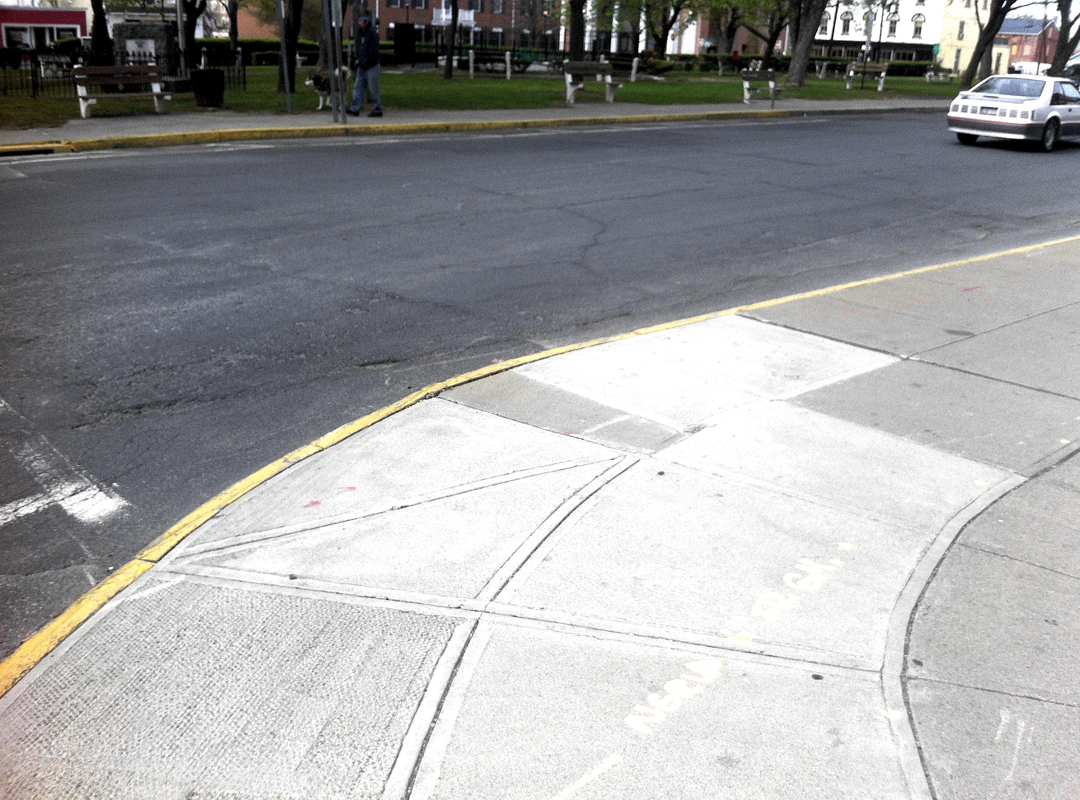
Notice anything different about this street corner?
Walking the length of Warren Street, from Front to Worth, every corner curb is festooned with one or more of the following:
Street signs;
Stop signs;
Stop lights;
Light poles;
Telephone poles;
Electrical boxes;
Garbage cans;
Dog warnings;
Hydrants;
Meters; and
Trees.
Some, like the southwest corner of 5th and Warren, feature a half-dozen or more obstructions.
But out of some 48 corners on Warren Street, one solitary curb is bare: the southeast corner at Park Place. Why?
The reason is simple: The City gave up trying to put anything there, because they always get demolished by big trucks whose drivers have strayed off the designated truck route. Every sign, tree, can, or other vertical object placed at that corner gets knocked down, sooner or later. Usually sooner.
It was this exact corner which inspired various politicos in 1999-2000 to form an ad hoc Truck Route Task Force. Sometime Alderman Dean Melino had a shop called Ecclectables just around this corner, and he was tired of tractor trailers illegally coming down Warren Street from Worth Avenue or Prospect, then trying to negotiate this tight turn. Either they’d take down a sign or tree, or cross into the oncoming lane, or even wind up in the parking areas along the Park, or all three.
Melino was locked in a second election campaign with then-Hudson resident (now Greenport Supervisor) John Porreca, and both worked to out-do each other in calling for (A) more police enforcement of existing truck rules, (B) better signage designating the truck routes, and (C) ideally, moving the truck route of Hudson entirely. The Task Force was formed by then-Assemblyman Patrick Manning with other Republicans and various citizens, including myself, to make meaningful progress on the issue, rather than merely complaining about it.
For several weeks, I lunched daily in a booth in the front the Diner, counting how many trucks were illegally using upper Warren and Park Place. Though I saw dozens of trucks per session, not once did I see one stopped by the Hudson police for being off the route. Manning and I also staked out this corner for an afternoon, hailing truckers who tried to make the turn to interview them: Why are you here? Where are you headed? How do you feel about having to drive through Hudson, with its stop signs, cyclist, kids playing in the street, tight turns, etc. (Without exception, the truckers said they’d rather take a longer but speedier route than have to negotiate Hudson’s stop-and-go urban traffic and pedestrian hazards.)
But after productive meetings with the DOT, with whom we mapped out alternative routes, and who clearly stated that the route could be removed from Hudson, County leaders seized control of the effort, removed all the
All this history is relevant again now because Linda Mussmann and various politicians apparently held a non-public meeting recently about the truck route issue. And what did they reportedly conclude? That this very same problematic corner at Warren and Park Place should become the new the ground zero of Hudson’s truck route.
Yep, the same corner that big trucks can’t get around without either knocking something over, or veering into the opposite lanes, or both.
Interestingly enough, Mussmann refused to participate in the late 90s Task Force, because of her aversion to Manning and other members. Meanwhile, now that he’s Greenport Supervisor, my friend John Porreca evidently is opposed to the route including more Greenport miles, even though a high percentage of the trucks are destined for that town’s big box shopping centers. To add to the fun, 5th Ward Supervisor Rick Scalera now is posturing that something must be done to move the route, though he did not lift a finger to do so in all his years as Mayor.
(Does some politician have a feud with a resident or business in the 700 or 800 block, causing them to be targeted repeatedly? This year has also featured a push to put a homeless shelter in the middle of these blocks, which have seen a great deal of positive business and real estate movement lately. Like the siting of halfway housing in the middle of North 5th Street just as it was showing signs of life in the late 90s—a move which effectively blocked the spread of business off Warren Street—it often seems like City Hall wants to slow down progress driven by independent people and businesses.)
Hudson sometimes seems to exist solely to illustrate two sayings that are so well-known by now that they have achieved cliché status. Namely: Santayana’s nostrum that “Those who cannot remember the past are condemned to repeat it,” plus Einstein’s definition of insanity as “doing the same thing over and over again and expecting different results.” To move the truck route to arguably the most problematic corner in town would represent both a failure to learn from the past, and an insane exercise in futility.
More background on this long-running issue is to come, including some research on the genesis of this truck route several decades ago.
Back in the mid-1990s, Hudson citizens blew the whistle on the City of Hudson’s Federal grant programs. A lesson from that incident speaks to certain claims about Eric Galloway’s Lantern Group by the director of his new Galvan Initiatives Foundation.
David Kermani (who then operated a high-end Warren Street rug shop) and other compatriots alleged that the City had made an improper side deal with L&B Contract Industries, later known as LB Furniture. Prompted by citizen complaints, HUD’s inspector general indeed found major “irregularities” in the City’s handling of a $556,000 grant to L&B, plus a host of problems within Hudson’s development agencies. [PDF of the report] Those irregularities included not just the company’s failure to make interest payments, but also the connivance of Hudson Development Corporation (HDC) staff in allowing L&B to make just one repayment of $4,998.25. Nice deal, if you can get it: $551,000 in free government money.
In addition, HUD discoverd that HDC had “subordinated” the grant lien to obtain a further $3,000,000 bank loan. All the while, the report said, local leadership never alerted HUD that it was making any of these arrangements. HUD’s Inspector General was not pleased, and reprimanded both L&B and the City. Moreover, HUD identified apparent “conflicts of interest” and “procurement weaknesses” at HDC and the Hudson Community Development and Planning Agency (HCDPA). For example, the wife of a Board member was getting paid up to $170 per hour “without competition.” Meanwhile, the agency’s “Rehabilitation Specialist” awarded over $27,000 in work “to a company owned by his brother,” again without giving anyone else a chance to compete for the contract.
The Inspector General’s scathing report was issued to 13 Federal, State and local officials.
And then: HUD continued to award the City of Hudson more development grants from these same pool of funds. And City agencies continued to help the perpetually-failing L&B. Despite years of public largesse, the company finally closed up shop a few years ago, throwing some 150 people out of work.
Through it all, the City was given more grant money to play with; and still it continued to botch projects... For example, issuing $1.8 million in bonds to lure a mysterious Californian corporation called Wittcomm, which disappeared and according to inside sources never repaid its obligations. That’s just to name one among many of the chronic failures of these agencies to manage public funding to achieve real economic development, or alleviate poverty.
In short: HUD knew and acknowledged that the City of Hudson had a lousy track record of managing grants—and yet kept coughing up more grants, often in the face of public concern and opposition.
So, how does all of this relate to the latest controversy instigated by Eric Galloway’s local activities? In response to the detailed exposure of numerous complaints and violations on record for Galloway’s Lantern Group in New York City, Galvan director Tom Swope offered the following dodge:
“That the Lantern Group continues to get funding for their projects should be a testament to the high quality of their management.”
Based on the above examples of HUD and the City, can anyone say that continued funding is a testament to anything except bureaucratic ineptitude? We’ve just seen how the City had made an illegal side deal with a grantee, and its development agencies were found to be rife with problems. And yet HUD continued to give the City grant money to play with, and failed in many cases to monitor its use, in spite of past debacles. Continued funding is no proof of even mediocre performance, let alone success.
Yet based on Swope’s fallacious logic, one would also have to conclude that:
Sustained City support of (the now-bankrupt) L&B was a rousing success;
The ever-increasing budgets of FEMA and the Army Corps reflect the heck of a job they did in dealing with Hurricane Katrina in New Orleans;
The Kardashian sisters’ continued popularity is reflective of their immense talents; and
George W. Bush’s re-election in 2004 served as a clear testament that he was a terrific President.
In making such flimsy arguments, Swope is asking people to believe that bureaucrats are stewards of excellence, and never act to protect their own buddies (or rumps). Someone please furnish Galvan’s director with a copy of The Peter Principle, posthaste.
Not sure whom to believe regarding the record of the Lantern Group, the housing organization headed up by Hudson developer Eric Galloway? Here’s a firsthand report received from someone who has actually lived in Lantern-managed housing:
One of the very important things that wouldn’t be apparent to most people who are just looking at the violations is the number of complaints for work being done after hours or on weekends. This is Galloway’s MO. They do illegal conversions etc at night and on weekends. This was the case in the building I lived in [...] which was owned by Galloway.
People make complaints about the illegal work going on. They send out inspectors Mon-Fri 9-5. When they arrive, there is no work going on. Of course there isn't. Galloway's crew works at night and weekends when there are no inspectors on duty.
While I am not in position to stake out every Galloway-managed property in NYC around the clock, I am at least confident that this source has, in fact, lived in a Lantern-managed building.
Recently, unnamed persons at the new Galvan Initiatives Foundation—which is forging ahead without approval yet as a nonprofit by the IRS—took shots at David Marston, who was elected by a very large margin to represent Hudson’s 1st Ward on the Common Council. Galvan called recent statements by the new Alderman “innaccurate,” “misleading” and “demonstrably untrue.”
But a detailed look at New York City public records, below, appears to back up Marston’s position.
Image: TomSwope.com
The fledgling fund’s testy reply to Marston is oddly anonymous. It thus could be the work of one or both of its co-founders Eric Galloway and Henry Van Ameringen, or special advisor Rick Scalera, or director Tom Swope, or some hydra-headed, Shiva-armed combination thereof— which one prefers not to visualize... Anyway, it’s Swope who has gone out on a limb to defend Galvan’s tantrum on Carole Osterink’s Gossips of Rivertown blog, saying that “the violations [Marston] finds on the website are misleading.”
Galvan was reacting to a Register-Star article stating that Marston wanted to “bid out contracts” on a proposed hybrid police station, court and low-income (or maybe homeless) housing facility to be sited at the corner of 4th and State.
Alderman Marston
Marston, according to the Register, cited “a questionable history with other Lantern buildings” as driving his rationale. (The Lantern Organization, formerly the Lantern Group, is a nonprofit controlled by Galloway in NYC, which has proposed several projects in Hudson that never got off the ground, including an outsized homeless facility smack-dab in the center of Hudson’s business district.)
The paper further claimed that Marston alleged 11 Galloway buildings in New York City “average 26 department or building violations per building.” That’s what prompted unnamed Galvan reps to fulminate that this is “demonstrably untrue” and that Lantern has never “failed any inspections.” But Galvan’s overheated response is long on bluster and short on demonstrable hard evidence, citing a total of zero specific, outside sources. Instead, Galvan trumpets only their own sweeping assertion that they’ve researched “all public records.” (Really? All? Like Sarah Palin answered the question about which newspapers she reads—“All of 'em”?) The faceless Foundation then triumphantly declares that it has has conclusively ratified their own argument. (Take that!)
But Galvan did not stop there. The Foundation then launched into a broad attack on Marston’s credibility, describing his position as “inaccurate and misleading,” insinuating that he and two other elected Aldermen must have some other nefarious secret “agenda,” such as being insufficiently sympathetic to the disadvantaged, a quality Swope himself has not been known to evince in the past. (More on that some other time.)
Now, Marston is known to his constituents as a bright, diligent and responsible neighbor; that’s why he was elected so handily. So it is hard for most to imagine, as Galvan would have us believe, that he’d make up such an assertion from whole cloth. (Of course, there is also the separate matter of whether he was accurately quoted by the Register.)
So how to resolve this stark discrepancy? At Gossips, Marston suggested a simple way this could be done:
I encourage anyone to go to the NYC Dept of Buildings online [...] and explore the Lantern violations themselves. GalVan can marshall lazy deceptions about my ‘prejudices’ against the people supportive housing helps, or they can listen to those very people, and speak to the hundreds of complaints they have lodged against Lantern through the NYC DOB.
Not a bad idea: Rely on an independent, outside source to settle the matter.
The evidence would seem to be squarely on Marston’s side. To the best of this site’s knowledge, each of the following 11 buildings which appear in the New York City Department of Buildings public information system is either owned by and/or managed by the Lantern Organization or associated groups. Spot checks trace these buildings’ addresses back to Lantern, and in any case all of their pictures appear on Lantern’s website.
If you average the number of complaints on file per building, it computes to 26.18—which rounds down to 26, just as Marston reportedly said. If you average the violations, you get 26.91—which rounds up to 27. Below is a building-by-building report:
• 1384 Fulton Avenuea/k/a Amber Hall, in the Bronx (BIN# 2115578): 21 complaints and 13 violations are on record, 8 of them currently “open” or “active.”
Just this morning (April 3rd), a complaint was lodged that “all the doors to the stairwells are locked, only security has the keys. If you go in the stairs you cannot go out. No secondary means of egress in case of emergency.” In the meantime, another complaint lodged says that one of the building’s elevators has been out of order for a week. These complaints have been assigned to the Building Department’s Emergency Response Team and Elevator Division. (Another complaint about one of the building’s elevators was lodged on January 5th, and is still active.) Past problems include other items like a $500 fine related to the building’s boiler
• 111 East 118th Streeta/k/a Schafer Hall in Manhattan (BIN # 1087381): 6 complaints and 30 violations are on record, 2 of them currently “open” or “active.”
Lantern lists this as a building they manage on their website. For example, this building has an active boiler violation dating back to late 2009, and another from 2011 for failing to file a boiler inspection report. (Boilers, elevators and missing reports are a recurring theme of these records.) In 2010, a violation notice was served after a caller reported that both elevators “in a six story b[ui]ld[i]ng are out of service” with disabled tenants.”
• 333 Kosciusko Streeta/k/a Clover Hall, an “immediate care facility” in Brooklyn (BIN# 3332251): 13 complaints and 13 violations are on record, none currently “open” or “active.”
In December of 2010, a complaint similar to the one above at Schafer Hall alleged that the building’s elevator was “not working properly” and that there were “disabled people (HIV)” who “need this elevator.” A violation was served in June of 2011 after an inspection in May.
• 440 West 163rd Streeta/k/a Audubon Hall in Manhattan (BIN# 1087429): 15 complaints and 7 violations are on record, none currently “open” or “active.”
Like several buildings above, this one has multiple complaints on file about an elevator being out of service. However, by the time an inspector came out—typically several months later—the elevator apparently was back in service. Complainants noted that there were disabled people in the building (“everyone has AID[S] and many are in wheelchairs.”)
• 194 Brown Placea/k/a Leeward Hall in the Bronx (BIN# 2114428): 22 complaints and 16 violations are on record, 1 currently “open” or “active.”
As with other Lantern-managed properties, a lot of the complaints and violations on record have to do with uninspected boilers or problems with the the elevators. For example, a $500 penalty was levied in 2005 related to the boiler. (Once fines are paid, the Buildings Department lists such violations as “dismissed,” which to most readers sounds like there was no merit to the complaint, when it actually means that it was resolved by a fine.) Other complaints can stay active for long periods of time, without a resolution. For example, in May of 2011 a caller alleged that “there is an unlicensed super altering the boiler.” The Buildings Department sent out an inspector twice on August 2011, but s/he was “unable to gain access” to the building. There is no indication that the inspector went back on a later date, or that the caller’s complaint was ever resolved.
• 1856 Washington Avenueat 176th Street a/k/a Silverleaf Hall in the Bronx (BIN# 2112853): 9 complaints and 24 violations are on record, 4 currently “open” or “active.”
As is so often the case, this building has four open tickets for elevator problems dating from March 2011 and Febraury 2012.
• 2612 Broadwaya/k/a Huntersmoon Hall in Manhattan (BIN# 1056409): 25 complaints and 47 violations are on record, 2 currently “open” or “active.”
Surprise: The active items (going all the way back to August of last year) are for an elevator problem. A notice that a $2,500 fine would be levied for “failure to maintain [the] building in [a] code-compliant manner” was served on the management on September 26th, 2011, apparently due to failure to service a fire extinguisher and “remove water from [a] pit.” A hearing date is schedule for Thursday the 5th, with the City still awaiting proof of correction and payment of the fine.
• 863 Melrose Avenuea/k/a Jasper Hall in the Bronx (BIN# 2116638): 11 complaints and 37 violations are on record, 2 currently “open” or “active.”
A stop work order was served on the building in 2008 because no overhead protection had been put over the “entry walkway” to prevent residents from being injured by construction. As an example of how landlords technically can comply by responding to City officials, while leaving tenants at risk, the complaint was received on April 26th, but only resolved (without a fine) on June 2nd.
• 730 Beck Street/745 Fox Streeta/k/a Cedars/Fox Hall in the Bronx (BIN# 2005517): 8 complaints and 6 violations are on record, 2 currently “open” or “active.”
There is an active violation listed for, you guessed it, a problem with the elevator reported in February of this year
• 319 West 94th Streeta/k/a St. Louis Hall in Manhattan (BIN# 1034178): 146 complaints and 93 violations are on record, 22 currently “open” or “active.”
This appears to be by far the Lantern-managed building with the most extensive record of problems. Renovations appear to be in progress. The most recent active violation on record dates from just a month ago (March 6th). According to the City’s records, work is “taking place outside [the] scope of plans,” with construction “contrary/beyond approved plans/permits.” In January of this year, a neighbor complained of construction debris “falling all over,” but the Buildings Department sided with management. In late November of last year, another still-active problem was cited about exposed “high beam bulbs” on the construction site bothering neighbors.
• 260 West 99th Streeta/k/a Bilander Hall in Manhattan (BIN# 1056413): 12 complaints and 10 violations are on record, 2 currently “open” or “active.”
A wheelchair lift elevator is the subject here of an ongoing investigation, begun last month, for possible defective or exposed electrical writing. A “professional certification compliance audit” is also underway. In January 2010, the City investigated the building for construction “taking place at the location, throughout the building” with “no permits posted.” An inspector cited a “failure to maintain and clear and [sic] unobstructed corridor and passageway,” with a violation issued.
ENDNOTE: In fairness, it should be said that not all of the complaints on file are borne out by the Building Department’s investigators, and some of them may date back to previous owners or managers. (That’s why the above narrative of specific problems focus only on relatively recent ones.) In New York City, more perhaps than most places, you are going to get some unusual tenants who make a career of phoning in complaints to the building department. For example, a caller claimed that there were illegal offices on the 1st floor and cellar, but an investigation found that the certificate of occupancy allowed for them.
By the same token, NYC is notorious for, shall we say, the cozy relationships which often exist among bureaucrats, inspectors, superintendants and building management. In many cases, the long lag times between when complaints get filed and an inspector shows up gives management a lot of opportunity to clear things up before things ever get to a serious enforcement action, though the timeframe is probably a lot longer than tenants would like.
All that said, it appears from the record that many complaints and violations required some action by the City, and some resulted in fines or other corrective action.
In a letter this morning to The Register-Star brimming with resentment, Marcel Boisvert blames the lack of motocross racing in the Town of Ghent on “an influx of folks from 212 area code” who came to the area “15, maybe 20 years ago.”
There’s an obvious factual problem with Boisvert’s argument, beyond its inflammatory and divisive tone: The local zoning code which prevents motocross tracks and events in Ghent was enacted some 40 years ago, in the early 1970s.
So by the author’s own claim, the newer Ghent taxpayers—derisively described by Boisvert as “guests”—arrived 20, maybe 25 years too late to play any role in passing the laws to which he objects.
In short, that zoning code was enacted four decades ago by longtime residents, not newcomers (if one must discuss issues in these simplistic demographic terms). Still, Boisvert claims that “motocross has long been something the hardworking people of this town have enjoyed for decades,” ignoring that it has been illegal in Ghent for his whole lifetime.
Moreover, a majority of the current Town board (none of whom, to my knowledge, are newcomers possessed of the “ugly” sense of “entitlement” alleged in the letter) recently reaffirmed that they aren’t going to change the code.
Not that anyone’s length of residency should matter. The law is the law, to be fairly and evenly applied to all. Every Ghent resident has the same rights and obligations under it. The amount of taxes you owe (or the number of votes you cast) is the same whether your family has lived in a place for 2 or 200 years. (This same point was raised by commenters on newly-minted Town Board member Richard Sardo’s Facebook page, though he appears to have deleted much of that dialogue. Sardo was in the minority not agreeing to drop efforts to change the 40-year-old code to suit a single property owner.)
UPDATE #1: Mr. Boisvert does not appear in the voter rolls anywhere in Columbia County, at least as of last month—despite his strongly-worded opinions on citizenship and community. (His letter to the local papers ends with a call for people to “get involved with town meetings and business... before it’s too late.” Registering to vote would be a start.)
UPDATE #2: The Town of Ghent completed its extensive Comprehensive Plan revisions in 2009. Motocross and other motorized racing were not part of it. The committee in charge consisted of Jim Galvin, Jim Beal (chair), Janice Fingar, John Fishman, J. Aaron Groom. Frank Mendelson. Peter Nelson, Sr., Gilbert Raab, Nicolas Tipple, Phil Trowbridge, Lawrence VanBrunt, Jonathan Walters, Kyle Wilber and property rights activist Albert Wassenhove. This was not a group that can be accused collectively of being dominated by “citiots” or “newcomers.”
Issues often seem to come in bunches in rural towns. The Town of Ghent, which had been struggling in recent years with the Molinari gravel mine project, also now has a controversy over motocross racing at Meadowgreens, which has gone forward despite decisions reaffirming that such uses are not permitted by the zoning code. (The Town’s code was adopted, by the way, some 40 years ago, when there was nary a weekender in Ghent; but that hasn’t stopped some from playing the usual us vs. them cards.)
Meanwhile, a separate group called Protect Ghent has sprung up to address another pressing issue: a proposal by New York State Electric and Gas (NYSEG) to string a high-voltage power line on high towers across the Town. The proposed zig-zag route would run through farms owned by longtime residents, past historic resources, and through several large landholdings such as Francis Greenburger’s Art Omi.
Protect Ghent has posted a handy Google Map showing NYSEG’s proposed route, which would involve clearcutting a 50-to-150-foot swath from east to west, and potentially placing one or more substations on private property. An obvious question arises: Why not take the most direct route possible, to impact the fewest neighbors?
The answer would appear to involve a bit of regulatory sleight-of-hand. By law, if such lines are shorter than 10 miles, local towns gain some oversight of the project, and thus the ability to modify or prevent the line from going through at all. But if they are longer than 10 miles, the central permitting responsibility lies instead with New York’s Public Service Commission (PSC). Protect Ghent says it has a low-voltage alternative, and has hired attorney Bill Hurst to represent their interests following an organizational meeting several weeks ago.
This confluence of controversies in Ghent got me thinking about how issues often seem to crop up in bunches in our towns. If your town has a racetrack issue, you’ve probably also got a mining issue. If you have a cement plant issue, you probably also have a corruption issue—and a tax assessment issue, and an open government issue, and about seven other issues.
I tend to doubt that some bad karma, or mystic aligning of dark stars, accounts for issues coming all at once in small towns. The reality is that every place has its problems. But many short-term or institutionalized local problems stay under the radar until people mobilize to do something about one of them.
Once citizens get activated on on thing, they start to notice all the other things that are amiss, from ingrained problems with their local government, to proposals which appear quietly in the legal notices. They learn how zoning and planning regulations work (or don’t work). They educate themselves about their State’s open meetings laws and freedom of information acts. They put their local reps’ numbers on speed dial, and encourage neighbors to attend meetings.
Soon enough, they realize that politics is often at the root of the problem. So then they start registering new people to vote, explaining to existing voters why it’s so crucial to turn up at the polls, and demonstrating to everyone why it’s essential to pay attention to what happens in Town Hall.
They often also begin asking more fundamental questions: How did these issues arise in the first place? What safeguards and tools do we have? And where do we want to go in the future—both to prevent further controversies, and to take responsibility for bettering the places we live in.
Some of these converging issues may involve compatible groups, or competing ones. But one set of citizens’ willingness (or proven ability) to make progress on one issue tends to inspires others to be less apathetic about their own.
But it’s that first issue which turns on people’s radar, and makes everyone realize how little real adult supervision there is most places. If you want to live in a safe, healthy, vibrant community, the burden of responsibility falls as much or more on “ordinary” citizens than on local government or big name institutions, both of which are often the last to recognize a problem as it develops.
(In the case of the massive, coal-fired new industrial city proposed in the late 90s by St. Lawrence Cement, pretty much every “major” institution in the region, from local government and development agencies, from the Chamber of Commerce to the Business Council, from the Columbia Land Conservancy to Scenic Hudson, either ignored the problem or even cheerleaded for the project for several years, until grassroots citizens forced everyone to reconsider through sustained, tenacious research and organizing.)
Hudson 3rd Ward Supervisor Ellen Thurston has been known to say that Hudson’s slogan should be: We’ve Got Issues! There’s a general sense among some residents that Hudson is more troubled or turbulent than other municipalities in the area. But if you turn over a rock most anywhere in the County, you’re going to find some worms. Taghkanic was an epicenter of problems for several years, from the Wilzing Racing Manor to Republican vote suppression antics to the Berry Pond mining proposal. Right now in Ghent, a lot of the same rocks are starting to get pried up.
At 3 pm on Saturday, The Olana Partnership presented an illuminating panel discussion at Stair Galleries moderated by Hudson resident and Manhattan attorney Dorothy Heyl about the successful late 1970s fight to stop a nuclear power plant proposed in Cementon—smack in the middle of Olana’s southern viewshed.
Overall, the panel discussion was highly informative, stimulating and at times even inspirational. Of particular interest were Carl Petrich’s recollections of how officials within the Oak Ridge lab of the Nuclear Regulatory Commission supported his landscape planning work in spite of his eventual conclusion that this wasn’t a suitable location for a nuclear plant.Petrich’s independent-minded analysis was in many ways responsible for the project’s demise.
Fellow panelist Wint Aldrich similarly recalled that he was afforded a remarkable degree of autonomy to question the project within the Hugh Carey administration. Today it seems hard to imagine that the same level of non-politicized, objective, but ultimately oppositional research would be as tolerated in our 21st Century Federal and State bureaucracies...
There were, meanwhile, a couple of moments when an informed observer couldn't help wishing for a longer and more detailed debate than is possible on a late Saturday afternoon.
For example, panelist Rick Benas, a semi-retired NYS DEC staffer, touted a visual impact assessment policy he helped finalize in 2000. As reported by John Mason in The Catskill Daily Mail, Benas heralded this internal agency policy as a signature achievement growing out of the nuclear plant fight—characterizing it as “the basis with which the DEC judges all submissions regarding aesthetics. You identify the resource, figure out how to minimize the impact.”
Benas (who had earlier offered an authoritative explication of the visual elements which make the view from Olana so powerful) touted the policy as “an objective way to measure a subjective phenomenon.” He further claimed that it “is supported by both industry and environmentalists, concluding that “What’s in here is what we all share. If an agency’s not doing its job, throw this in their face.”
That sounded pretty darn good... prompting another panelist to suggest that maybe this policy should become law, rather than just an internal guidance policy.
However, Mr. Benas neglected to mention that in 2001 he and his colleagues at DEC had interpreted that very same policy to justify their support for the proposed St. Lawrence Cement Greenport project—a project resolutely opposed by Olana primarily due to visual impacts.
In 2001 proceedings before Administrative Law Judge Helene Goldberger, Olana attorney John Caffry expressed amazement at Benas and DEC’s policy-backed assessment, calling it “mind-boggling.”
Why “mind-boggling”? Because the SLC Greenport proposal featured, among other things, a 400-foot stack the size of an office building, with a plume stretching five miles or more, as well as several dozen other major structures atop Becraft Mountain and at the Hudson Waterfront. County resident Moisha Blechman aptly called it a “new industrial city.” As seen in the documentary Two Square Miles, balloon tests insisted upon by citizens later confirmed just how colossal and pervasive the visual impact of that new “city” could have been.
Yet the DEC’s 2000 policy made it very difficult, if not impossible, for the agency to reject a proposal based on visual impacts... even impacts as vast as those proposed by SLC. That’s because their policy is based on the premise that if a company does everything it can to “mitigate” and “offset” its presence in the landscape, then the project can still be approved—even if after those efforts, there are still significant, adverse, “residual” impacts.
In lay terms, the DEC policy says: If a company gets an A for effort, it makes it OK for them to get an F on the actual test. The policy allows approval of a project despite its harsh and discordant elements, so long as the applicant makes a good faith effort to mitigate them “to the maxium extent practicable.”
So while Mr. Benas and DEC acknowledged in 2001 that it was impossible to hide such a big project, since SLC was offering as many mitigations as possible given the circumstances, the remaining negative impacts did not constitute grounds for a denial.
Thus Benas, backed by then-DEC attorney Bob Leslie, argued from their visual policy that hiding a small portion of the 400-foot stack in an 80-foot hole in the Greenport quarry, painting parts of it light blue, then removing several structures plus the plume from Catskill was an adequate combination of mitigation and “offsets” to warrant approval, even though the plant would still have undeniable visual impacts. Following this policy, the agency proceeds from the assumption that virtually every proposal will be built. In that context, the agency’s job becomes limited to making the best of bad situations—not to prevent them. (This mindset is not limited to government bureaucrats; Scenic Hudson president Ned Sullivan has similarly argued, in the pages of The New York Times, that his organization’s role is to “manage” development, not to stop it.)
Below is the key section of Benas’ 2001 testimony from the Issues Conference held at the Hudson Elks’ Lodge referenced above, pp. 1696-7:
10 Staff is guided by DEC program policy
11 number DEP-00-2 assessing and mitigating visual
12 impacts. The policy was the subject of public review
13 and comment, had a peer review and comment, and was
14 issued in July of 2000.
15 What the policy does is, among other
16 things, it gives the universal list of all mitigation
17 strategies in this discipline. With that list, if an
18 Applicant demonstrates that they have employed every
19 strategy of mitigation, then the Applicant can assert
20 that they have minimized impact and Staff can either
21 refute or confirm that by looking at the generic list
22 and making sure that all strategies have been
23 applied.
24 In this case, even after employment of
2 all those strategies, there remains a residual
3 significant adverse impact, then the policy directs
4 Staff to explore the possibility of offsets to
5 compensate for and reach the balance that SEQR
6 requires.
7 Applicant has offered significant and
8 important offsets in this proceeding and, further,
9 Staff has gone to require in the draft permit that
10 the facility be decommissioned at the end of its
11 useful life, thus, minimizing the duration of the
12 impact.
13 We believe that the issue before your
14 Honor, among other things, is are those offsets
15 sufficient to justify approval.
The decision had tremendous precedential value; fortunately, it was not left solely up to the discretion of EnCom staff, who worked closely and privately for year's with SLC to hone its application. For if the Greenport project could have been built here, pretty much anything could. One seriously has to wonder whether, under the terms of the current policy, DEC would be able to stop a nuclear plant at Cementon on visual grounds.
State regulators were also relying on an assumption that was wholly rejected by The Olana Partnership itself, namely that only the southern view from the site really matters... Frederic Church plainly designed a 360-degree experience at Olana, and sketched or painted other views in other directions, for example looking toward Becraft Ridge. DEC staff also rushed to ratify the cement company’s assertion that the project would have no significant, adverse effect on historic resources within the Coastal Zone, even though neither the Department of State nor the Office of Parks, Recreation and Historic Preservation (OPRHP) had weighed in on the matter yet.
Ultimately, citizens concluded that the DEC was not, in Benas’ own formulation, “not doing its job” and indeed threw more enforceable laws “in their face.” after years of wrenching controversy and millions spent by both sides, the project was denied via those same Coastal Consistency rules that EnCon had shrugged off … The decision came down from a different agency, much to the chagrin of many DEC staffers, from what opponents soon heard through various Albany grapevines. (“They were shocked and angry over the Secretary of State’s decision,” one well-placed Capitol source reported to me.)
As it turns out, there was no need to compromise one view for another, or to settle for making the best of a bad situation. The 2005 rejection of the Greenport project has now been coupled with clear confirmation of the closing of Holcim’s (SLC’s) Catskill facility. The visual plumes from that destructive, foreign-owned company now have been removed from both sides of the Hudson River, along with the pollution they discharged into our region’s environment. What had been posited as a tough either/or choice, pitting Olana’s stunning southern views against its overall experience, now has played out as a complete win/win for the site.
Another topic worthy of more detailed future discussion: the way in which boundaries were later drawn (under the guidance of Cementon anti-nuclear activist Loretta Simon) to protect the Catskill-Olana and Columbia-Greene Scenic Areas of Statewide Significance, but left a gap omitting all of the City of Hudson in between the two. But that’s something for another day, as this post has already gone overlong.
In 1954, Hudson and the vicinity were severely afflicted with unemployment [...] so serious that the entire vicinity was designated a critical unemployment area, and Hudson was listed as eligible to receive Federal Government surplus food for distribution.
Since then, unemployment has not appreciably decreased. For the past few years, the Gifford Wood Company and the cement industry have operated with sharply curtailed labor. [...] The reduction in the labor force in the cement industry is due to automation and the decreased demand.”
—R. MARY WEND (1963)
This November 5th would be the 112th birthday of R. Mary Wend, who was born in 1899 and died in 1975. There is precious little information about Wend on the web, and I know next to nothing about her—except that she wrote an exceptionally insightful capsule history of Hudson. It is essential reading for all local residents, new and old.
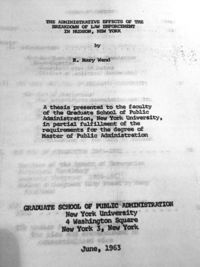
By clicking here, you can read about 20 pages of Wend’s remarkably concise and incisive 1963 master’s thesis, The Administrative Effects of the Breakdown of Law Enforcement in Hudson, New York.* That dry title masked a story that, some 20 years later, Bruce Edward Hall would tell in more antic, if somewhat less analytical, terms in his well-known Diamond Street—which appears to have relied heavily on Wend’s text.
Her paper is chockful of telling but largely forgotten local details, for example the claim that Hudson lost out becoming the home of General Electric because of “the unwillingness of local merchants to raise $10,000.” (That surely would have been an economic blessing, but it also might have made Hudson ground zero of today’s PCB cleanup.)
Wend traces not just the familiar story of the Proprietors arrival around the end of the Revolutionary War and Hudson’s quick rise to prominence, but also the less-rosy decades which ensued—including the decision to sell of much of Hudson’s acreage to form neighboring towns, a/k/a “the partitioning.”
She finds that almost from the start, Hudson’s wheel of fortune spun in cycles of boom and bust. These at first stemmed from the travails of the whaling industry, but continued far into the 20th Century. By 1845, which Wend identifies as the “end of the era of navigation,” Hudson was in collapse, setting the stage for the spread of vice and its concomitant political corruption:
Shorn of its prestige, divested of most of its territory, stripped of its fleet of ships, Hudson faced the future with uncertainty. As a city of commercial importance—its course had been run; its day was done.
Wend’s research also shows how political and moral corruption was a chronic and nearly intractable problem throughout much of Hudson history, right up to the 1960s. Periods of decline inevitably led to the election of a “reform” Mayor. However, the reformer quickly would either get co-opted by the corrupt City establishment, or else would quit in frustration.
The following 120 years she characterizes as “The Era of Stagnation.” Wend quotes Gorham Worth’s description of Hudson in the mid-19th Century as having “an all pervading air of listlessness.” Local politicians, law enforcement, the Chamber of Commerce and an apathetic citizenry alike get a sober but sound drubbing from Wend’s pen. About the latter she writes:
A significant contributing factor to the stagnation of the city was the penny-wise, pound-foolish attitude of the average taxpayer toward municipal expenditures.
An extreme example of this “municipal parsimony” came in 1855, when “due to an empty treasury and a dispute with the gas company,” the Common Council
was obliged to discontinue street lighting. [...] When it was bombarded with petitions to restore this service, it called a taxpayer’s election to raise $1200 to pay for this service until the end of the year. [But] the taxpayers were unwilling to be taxed for it, and at the election, the proposition was overwhelmingly defeated. For the remainder of the year the city was in darkness [and] the commission of crimes was greatly accelerated.
By 1868, the once-advanced City of Hudson had become, per Wend, “an old fogey town” and “hopelessly behind the times.” Even the purchase of a then-modern steam fire engine to replace hand-operated equipment was rejected by the populace, who only reversed their position after a calamitous fire.
Education was another sore point: in the 1880s, it was found that less than 25% of school-age children were attending classes. That problem had apparently been reversed by the 1930s, when the schools were found to suffer from precisely the opposite problem: overcrowding. Hudson voters rejected the construction of a new school despite funding offered by the Federal Public Works Administration (their version of “stimulus” funds). Again, the situation had to reach crisis proportions before the 45% funding was finally accepted and the new school built.
The ’50s-era Chamber’s top request to a visiting Governor Harriman was to plead for the shutdown of the Volunteer Fireman’s Home and Training School for Girls (now the prison).** Much like some official present-day attitudes in Greenport toward Olana, leaders of that time bellyached about such institutions not paying taxes, while dismissing their employment, purchasing and other economic impacts.
By 1963, Wend summarized the State of Hudson as “a stagnant city beset by many problems.” These she enumerated as:
a high tax rate
a declining population
slum areas and substandard housing
lack of a public library
the lack of a sewage disposal system
the lack of imaginative leadership.
The more things change...
* When first in Hudson in 1998, I encountered a copy in the musty old history room of the library, where I volunteered for some time (straightening up after visitors, who mainly seemed interested in the genealogy books). A copy also used to exist at the Columbia County Historical Society. Whether either can still be found, given the long history of misfiling, pilfering and neglect of such local archives, I do not know. The entire thing really ought to be scanned and republished.
** Hall provides one of the only known details about Wend’s life, and obliquely acknowledging his debt to her writing. Wend, he says, served as the Training School’s “resident dentist,” and describing her as “an older woman of frugal ingenuity and worldly knowledge; she had tried to straighten inmates’ teeth with bamboo braces of her own design, and she had written a master’s thesis on the history of prostitution in the city of Hudson.”
Patting himself on the back for a job poorly done, Hudson Council President Don Moore awards himself a gold star in the pages of The Register-Star. The achievement of which he’s so proud? Ushering through a sorry excuse of a Waterfront plan, one which doesn't guarantee Hudson any new jobs, or any meaningful environmental protections, or even a realistic new location for a boat launch... The one thing it does guarantee is plenty of headaches for future leaders and residents alike.
If Moore actually believes any of what he’s written, why have few if any of the concerns that he himself raised in his own March 2010 letter been addressed in this plan?
For example, Moore argued last year that if a certain zoning change demanded by Holcim/O&G were made, the City would lose control over its activity, and (in his words) there would be “no longer any restriction” on their South Bay activity.
Yet exactly that change was made for H/OG—with Moore’s apparent blessing—and now he ignores his own warning. Instead, he attempts to place gauzy halo over a Plan that has gotten weaker with each revision that he’s overseen in office.
If the Council President actually believed any of what he has written, he presumably would not have been so afraid to allow any of the 80+ people in the audience who attended the recent “special meeting” on this plan to speak, before rushing it to a vote.
What was he afraid of, exactly? That if the public were allowed to participate, this carefully-manicured veneer of responsibility might be punctured by actual facts— from both citizens and legal experts, who were waiting to speak?
Moore’s Politiburo-style move was un-democratic and un-American no matter what your position is on this plan. It was conduct ill-befitting any Common Council President, and something his precedessors such as Mary Anne Lemmerman, Mike Vertetis and John Cody never stooped to, even in the midst of other controversies.
As to the tissue-thin “substance” of Moore’s commentary, it reveals that he either does not understand his own Plan, or simply does not want to understand it—because to do so would be to require him to show some political mettle. (Moore has been heard many times to make bilious remarks about Linda Mussmann as a public figure, but his current position on the Waterfront is indistinguishable from hers.)
Moore apparently doesn't want to understand that the issue is not whether such activity stems from the cement, or gravel, or some other industry. If it were garbage hauling, or incineration, the concerns would be fundamentally the same, just with slightly different particulars. The public's concerns have been, for years now, the impacts.
Can Moore look the owners of, say, the Basilica, and tell them that a four- or five-fold increase in trucks running all day past the entrance used by their patrons and workers is not new "industrialization"? Can he tell us that the dust and fumes and noise from such a major increase is not further "industrialization" of the dock area, with no impact on neighbors trying to enjoy the publicly-funded park next door? (If he can, then he is sadly self-deluded, because such impacts have not even been assessed in the shoddy Generic Environmental Impact Statement associated with the Plan, and would likely never be assessed in the future he extolls.)
As a State attorney at the meeting said, as currently constructed the City would not be able to place limits on either trucks or the volume of gravel at the Waterfront. If that is not heavy "industrialization," what is? When attorney was asked after the meeting if Holcim were to increase the amount to the levels of the SLC Greenport Project, could that be limited or stopped under the current Plan, he could not say that it would.
The hard facts are that Holcim and O&G have estimated in a various applications that they intend to increase existing activity from the current baseline 100-130,000 tons per year to 500,000 tons per year, some 4-5 times the current amount. In 2005, the amount was zero. That is a massive increase in industrial impacts by any measure: many more trucks, many more barges, many more rail crossings, much more noise, and much more fugitive dust and fumes wafting over the Waterfront Park.
Yet the latest version of Moore's vaunted plan actually makes it harder to do anything about the industrial impacts, not just to the environment, but to neighboring businesses and public resources. Future Zoning Enforcement officers and future members of the Planning Commission, Zoning Board of Appeals, or Coastal Consistency Board would have neither clarity nor many tools to deal with an ever-escalating situation.
What are the effects of trucks, or a conveyor, or diesel fumes, or fuel spills, or constant barge traffic? How are neighboring businesses or public activities (from kayaking to concerts) or habitats limited or made impossible by severe nearby impacts? Since the 1970s, local and State and even Federal planners have recognized that Hudson's waterfront is very small, and produces "use conflicts" of this kind. Moore prefers instead to stick his head in the mud and pretend that he is not rushing ahead with a plan that gives the City few real controls over these very real concerns.
At the Valley Alliance website, you can see that the group has sent an authoritative legal memorandum detailing the issues with this plan, as well as 24 pages summarizing continued citizen concerns. The Register-Star and Columbia Paper have been provided with both.


 This odd new concern about the investments of main street businesses struck many as peculiar, given that City Hall here has shown little but hostility to Warren Street’s hard-working entrepreneurs. Hudson’s eateries have indeed made major investments, and contribute mightily to the tax base. But a lone street cart posed no threat whatsoever to either, as such carts operate in an entirely different price range and serves a wholly different market.